
The AI consulting market has exploded. McKinsey reports that 72% of businesses now use AI in at least one function, up from 50% just two years ago. But here's the problem: there are thousands of companies claiming to be "AI consultants," and most of them are repackaging basic API integrations as transformative AI strategy.
Finding the right AI consulting company matters more than ever. The wrong partner burns $50K-$200K and 6-12 months. The right partner delivers ROI within one quarter. This guide breaks down what AI consulting companies actually do, how to evaluate them, what they cost, and how to choose one that fits your business — not just their sales pitch.
Key Takeaways
- AI consulting companies bridge the gap between off-the-shelf AI tools and production-grade business systems — strategy, implementation, and ongoing optimization
- The market splits into three tiers: enterprise strategy firms ($500K+), mid-market specialists ($50K-$200K), and boutique implementation shops ($15K-$50K)
- Evaluation criteria that matter: domain expertise in your industry, proven deployments (not just demos), transparent pricing, and post-launch support
- 67% of AI projects fail to scale beyond pilots — the right consultant de-risks this with phased delivery and measurable milestones
- Red flags: vague proposals, no skin in the game, "we can do everything" claims, and missing references from companies your size
What AI Consulting Companies Actually Do
Strategy and Assessment
Top AI consulting companies start with a diagnostic, not a solution. They assess your data infrastructure, identify automation opportunities, map workflows where AI creates measurable impact, and build a prioritized roadmap. This phase typically takes 2-6 weeks and costs $10K-$30K for mid-market firms.
A real strategy engagement includes:
- Data readiness audit — Can your current data support AI? What's missing? What needs cleaning?
- Opportunity scoring — Which use cases have the highest ROI? Which are feasible within 90 days?
- Build vs. buy analysis — When does a custom model make sense vs. using existing APIs?
- Risk assessment — Data privacy, model bias, regulatory compliance, vendor lock-in
Implementation and Engineering
This is where most "AI consultants" fall short. Strategy decks are easy; production systems are hard. The best AI consulting companies have full-stack engineering teams that can:
- Build and deploy custom AI agents using frameworks like LangChain, CrewAI, or custom architectures
- Integrate LLMs with your existing CRM, ERP, and data warehouse
- Fine-tune models on your proprietary data for domain-specific accuracy
- Set up MLOps pipelines for monitoring, retraining, and version control
- Build secure API layers and user interfaces for internal teams
Change Management and Training
AI systems fail without adoption. The top consulting firms include change management as part of their scope — not an afterthought. This means:
- Training sessions for end users
- Documentation and SOPs for AI-assisted workflows
- Feedback loops so users can flag bad outputs
- Success metrics tied to business KPIs, not technical metrics
How to Evaluate AI Consulting Companies: 7-Point Framework
1. Industry Domain Expertise
Generic AI knowledge isn't enough. A consultant who understands manufacturing supply chains will deliver 10x faster than one learning your industry on your dime. Ask:
- How many projects have you completed in [your industry]?
- What are the top 3 data challenges specific to our sector?
- Can you name a regulatory constraint that affects our AI deployment?
If they can't answer these specifically, they're learning at your expense.
2. Proven Track Record (Not Demos)
Demos are theater. You need proof of production deployments. Request:
- Case studies with metrics — Not "improved efficiency" but "reduced processing time by 64% for a $200M manufacturer"
- Client references — Ask to speak with 2 past clients, ideally in your industry
- Live system access — Can they show you a working system, not a slide deck?
3. Technical Depth
| Capability | Must-Have | Nice-to-Have |
|---|---|---|
| LLM Integration | ✓ | |
| Custom Model Training | ✓ | |
| MLOps / Model Monitoring | ✓ | |
| Data Engineering | ✓ | |
| UI/UX Development | ✓ | |
| DevOps / Cloud Architecture | ✓ | |
| Security & Compliance | ✓ |
If a firm outsources all engineering, they're a broker, not a consultant. You're paying for a middleman.
4. Engagement Model and Pricing Transparency
| Engagement Type | Typical Cost | Duration | Best For |
|---|---|---|---|
| Strategy Sprint | $10K-$30K | 2-4 weeks | Identifying use cases, building roadmap |
| Pilot Implementation | $25K-$75K | 4-8 weeks | Proving ROI on one use case |
| Full Implementation | $75K-$200K | 3-6 months | Production deployment, integration |
| Retainer / Optimization | $5K-$15K/mo | Ongoing | Monitoring, optimization, scaling |
| Enterprise Program | $500K+ | 6-18 months | Multi-use-case transformation |
If a firm won't share pricing ranges until you sign an NDA, that's a red flag. Reputable firms publish indicative pricing.
5. Team Composition
Ask who will actually work on your project — not the partners who show up for the pitch. You want:
- 1 AI/ML engineer (full-time on your project)
- 1 data engineer (part-time, for pipeline work)
- 1 product/strategy lead (part-time, for alignment)
- 1 QA/devops (part-time, for deployment)
A team of 3-4 people is standard for a mid-market engagement. If they assign you 1 "AI consultant" who does everything, you're getting a generalist.
6. Post-Launch Support
AI systems drift. Models degrade. Data distributions shift. Without ongoing monitoring, your AI system becomes a liability. Ensure the contract includes:
- Model performance monitoring (at minimum monthly)
- Alerting on accuracy drops
- Retraining cadence (quarterly minimum)
- SLA for bug fixes and system issues
7. Intellectual Property and Data Ownership
This is the most overlooked evaluation criterion. Get clarity in writing:
- Who owns the models? If the firm trains a custom model on your data, you should own it — not them.
- Who owns the code? Custom code built for you should be yours.
- Data usage rights — Can the firm use your data to train models for other clients? (The answer should be no.)
AI Consulting Companies: Pricing Breakdown
Pricing in the AI consulting market follows a power law — a few firms charge enterprise premiums, while the majority cluster in the mid-market range. Here's what to expect:
Hourly Rates
| Firm Type | Hourly Rate | Typical Engagement |
|---|---|---|
| Big 4 (Deloitte, PwC, EY, KPMG) | $300-$600/hr | $500K+ programs |
| Premium Boutiques (e.g., Palantir partners) | $200-$400/hr | $200K+ projects |
| Mid-Market Specialists | $125-$250/hr | $50K-$200K projects |
| Boutique Implementation Shops | $75-$150/hr | $15K-$75K projects |
| Offshore Firms | $40-$80/hr | Budget-constrained projects |
What Drives Cost
- Complexity of integration — Connecting AI to a modern API-first stack is 3x cheaper than connecting to a legacy ERP
- Data quality — If your data needs significant cleaning, expect 30-40% of budget to go to data engineering
- Custom vs. pre-built — Custom model training adds $20K-$50K; using existing APIs (GPT-4, Claude) keeps costs lower
- Scale of deployment — A chatbot for 100 users costs less than an enterprise-wide document processing system
ROI Benchmark
According to a 2025 BCG study, companies that invested in AI consulting saw an average ROI of 2.3x within 18 months. But the variance is huge — the top quartile saw 5x ROI while the bottom quartile saw negative returns. The difference? The bottom quartile chose consultants based on brand name rather than domain fit.
Step-by-Step Guide to Choosing an AI Consulting Company
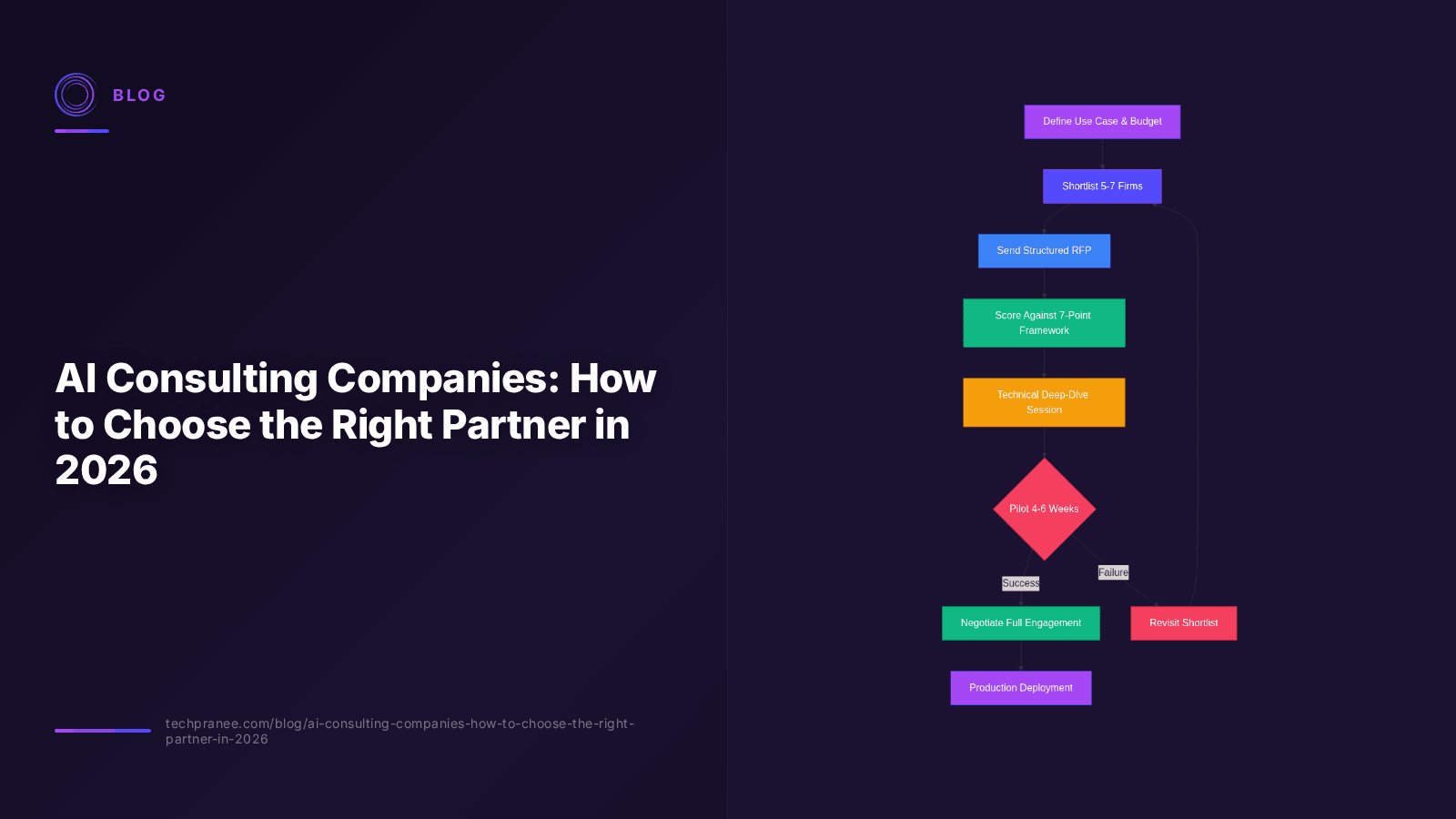
Step 1: Define Your Use Case
Before talking to any firm, write a one-page brief:
- What business problem are you solving?
- What does success look like (quantitatively)?
- What's your budget range?
- What's your timeline?
Step 2: Shortlist 5-7 Firms
Use these sources:
- Industry reports (Gartner Magic Quadrant, Forrester Wave)
- Peer recommendations in your network
- Case studies published on firm websites
- Clutch and G2 reviews (filter for verified reviews in your industry)
Step 3: Send a Structured RFP
Your RFP should include:
- Your use case brief
- Request for similar case studies
- Request for team bios (actual delivery team, not sales team)
- Request for pricing estimate (even a range)
- Request for references in your industry
Step 4: Evaluate Proposals Against Your Framework
Score each firm against the 7-point framework above. Don't let a polished deck override weak substance. Specifically check:
- ✓ Did they propose a specific technical approach, not generic "we'll use AI"?
- ✓ Did they identify risks, not just opportunities?
- ✓ Is their pricing transparent, even if it's higher than competitors?
- ✓ Do they have references from companies your size?
Step 5: Request a Technical Deep-Dive
Before signing, ask for a 60-minute technical session with their engineering team — not the sales team. Have your CTO or lead engineer ask:
- How would you architect this system?
- What's your approach to model drift?
- How do you handle data privacy for our industry?
- Can you walk me through a similar system you've built?
Step 6: Start with a Pilot
Never commit to a $200K engagement without a pilot. A 4-6 week pilot ($25K-$50K) tests:
- Can they deliver on time?
- Is their code quality acceptable?
- Does the AI actually work on your data?
- Is the team responsive and collaborative?
Step 7: Negotiate the Full Engagement
Use pilot results to negotiate:
- Tie payment to milestones, not time
- Include performance clauses (accuracy targets, latency SLAs)
- Secure IP ownership in writing
- Define exit criteria if the partnership isn't working
Red Flags: When to Walk Away
- "We can do everything" — No firm excels at strategy, engineering, MLOps, and change management equally. Specialists win.
- No published case studies — If they can't show results, they haven't delivered them.
- Refusal to start with a pilot — They want lock-in before proving value.
- Team won't meet your engineers — Salespeople sell; engineers deliver. If engineers won't meet you pre-contract, they're either thin or stretched.
- Pricing "depends on discovery" — This is code for "we'll charge whatever we think you'll pay." A reputable firm gives a range.
- No industry-specific examples — Generic AI use cases (chatbots, summarization) don't prove domain expertise.
Checklist: What to Ask in Your First Meeting
- ✓ "Walk me through a project similar to ours that you've completed"
- ✓ "What's the biggest failure you've had, and what did you learn?"
- ✓ "Who specifically will be on our team, and what's their experience?"
- ✓ "What's your pricing model — fixed, T&M, or milestone-based?"
- ✓ "What happens if the AI doesn't meet accuracy targets?"
- ✓ "Do we own the models and code you build for us?"
- ✓ "How do you handle post-launch support and monitoring?"
AI Consulting Market Landscape: 2026
The market has segmented into clear tiers. Understanding where firms sit helps you match budget to need.
Tier 1: Enterprise Strategy Firms
Examples: McKinsey (QuantumBlack), BCG (BCG X), Deloitte (AI Institute), Accenture (AI Practice)
- Engagement size: $500K-$5M+
- Strength: Board-level strategy, change management at scale, brand reassurance
- Weakness: Expensive, often subcontract implementation, slow
- Best for: Fortune 500 transformations requiring board alignment
Tier 2: Mid-Market AI Specialists
Examples: TechPranee, LeewayHertz, Markovate, ThirdEye Data, similar firms
- Engagement size: $50K-$200K
- Strength: Full-stack implementation, industry-specific models, faster delivery
- Weakness: Less brand recognition, limited bench depth for very large projects
- Best for: Mid-market companies ($10M-$500M revenue) needing production AI systems
Tier 3: Boutique Implementation Shops
- Engagement size: $15K-$50K
- Strength: Affordable, hands-on, fast iteration
- Weakness: Limited strategy capability, may lack MLOps maturity
- Best for: Startups and SMBs testing AI with a single use case
Tier 4: Offshore Firms
- Engagement size: $10K-$50K
- Strength: Cost-effective for well-defined engineering tasks
- Weakness: Communication barriers, quality variance, limited strategic input
- Best for: Companies with strong internal AI leadership who need execution capacity
"The biggest mistake companies make is choosing an AI consultant based on brand prestige rather than implementation capability. A $50K boutique that has deployed 20 production AI systems in your industry will outperform a $500K Big 4 team that's learning your sector from scratch." — Industry observation from 2025 AI Implementation Survey
Internal Links and Next Steps
If you're evaluating AI consulting companies, these resources will help:
- Learn about our AI Strategy Consulting services — strategy sprints, implementation roadmaps, and production AI systems
- Explore AI Agent Development — how custom AI agents differ from off-the-shelf tools
- Read our AI Consulting Services Guide — what's included, what it costs, how to choose
- Compare AI Automation Agency vs. AI Consulting Firm — which model fits your needs
- Check our Top AI Consulting Firms ranking — how leading firms compare
Frequently Asked Questions
What's the difference between AI consulting companies and AI development agencies?
AI consulting companies focus on strategy, use case identification, and vendor selection — they tell you what to build. AI development agencies build the systems. The best firms do both: strategy and implementation under one roof, reducing handoff risk and ensuring the strategy is technically feasible.
How much do AI consulting companies charge?
AI consulting rates range from $75/hr (boutique firms) to $600/hr (Big 4 enterprise practices). A strategy sprint costs $10K-$30K, a pilot implementation $25K-$75K, and a full production deployment $75K-$200K for mid-market engagements. Enterprise programs run $500K+.
How long does an AI consulting engagement take?
Strategy phases take 2-6 weeks. Pilot implementations run 4-8 weeks. Full production deployments take 3-6 months. Enterprise transformation programs span 6-18 months. The timeline depends on data readiness, integration complexity, and scope.
Should I hire a Big 4 firm or a boutique AI consultancy?
Big 4 firms are worth it for Fortune 500 transformations requiring board-level strategy, multi-country change management, and brand reassurance for stakeholders. For mid-market companies ($10M-$500M revenue), boutique AI specialists deliver faster, at 1/5th the cost, with deeper technical implementation capability.
What should I look for in AI consulting company references?
Ask references about: delivery timeline accuracy, code quality, post-launch support responsiveness, whether the AI system met its accuracy targets, and whether they'd hire the firm again. Specifically ask about what went wrong — every project has issues; how the firm handled them tells you more than success stories.
Can AI consulting companies guarantee ROI?
No reputable firm guarantees ROI — AI outcomes depend on your data quality, team adoption, and business processes. But reputable firms tie payment to milestones and include performance clauses (accuracy targets, latency SLAs). If a firm guarantees ROI, they're either desperate or dishonest.
Ready to Choose Your AI Consulting Partner?
Choosing the right AI consulting company comes down to three things: domain expertise in your industry, proven production deployments (not just demos), and transparent pricing that matches your budget. Start with a pilot, measure results, and scale what works.
If you're ready to explore what AI can do for your business, talk to us. We offer a free 30-minute strategy session to assess your AI readiness and identify your highest-ROI use case — no pitch deck, just a technical conversation.