
Top AI Consulting Firms in 2026: How to Choose the Right Partner
The AI Consulting Gold Rush (And Why Most Buyers Get It Wrong)
In 2026, everyone claims to be an AI consulting firm. LinkedIn is full of profiles that added "AI" to their title sometime in the last 18 months. Traditional IT shops have rebranded. Freelancers who ran a few ChatGPT workshops now list "AI strategy consulting" as a service.
Meanwhile, businesses that genuinely need AI help — to automate operations, to build intelligent products, to make data-driven decisions — are trying to separate real expertise from marketing fluff. And getting it wrong is expensive: a bad AI consulting engagement can cost $50,000-$200,000 and leave you with a proof of concept that never reaches production.
I'm writing this from the operator's seat. At Spearhub, we're an AI-enabling company — we help businesses adopt AI practically. But I'm not going to pretend we're the right partner for everyone. This guide is about helping you evaluate top AI consulting firms honestly, including us, so you make a decision based on fit rather than hype.
What AI Consulting Firms Actually Do
The Core Service Categories
Before you evaluate firms, you need to understand what the AI consulting landscape actually covers. The services fall into four broad categories:
1. AI Strategy Consulting
Assessment of where AI can create value in your business, prioritization of use cases, roadmap development, and build vs. buy decisions. This is for companies that know they need AI but don't know where to start.
2. AI Agent Development
Building custom AI agents — autonomous or semi-autonomous systems that can handle tasks like customer support, data processing, research, and reporting. This is for companies with specific, well-defined tasks they want to automate.
3. AI Integration
Connecting AI capabilities (LLMs, computer vision, speech recognition) into existing systems and workflows. This is for companies that have the infrastructure but need AI layered in.
4. Workflow Automation
Using AI-powered tools to automate business processes — the practical, immediate-ROI work. This is for companies that want results in weeks, not quarters.
Top AI consulting firms typically specialize in one or two of these categories. Firms that claim to do all four equally well are usually generalists who do none particularly well.
The Engagement Model
Most AI consulting firms work in one of three ways:
- Strategy-only — Workshops, assessments, roadmaps. They tell you what to do; you find someone to do it. (Big 4, boutique strategy firms)
- Build-only — You tell them what to build; they build it. (Development shops, freelance devs)
- Strategy + Build — They assess, recommend, and implement end-to-end. (Mid-size AI consultancies, AI-enabling companies like Spearhub)
The right model depends on your internal capabilities. If you have a strong engineering team, strategy-only might work. If you don't, you need someone who can both think and build.
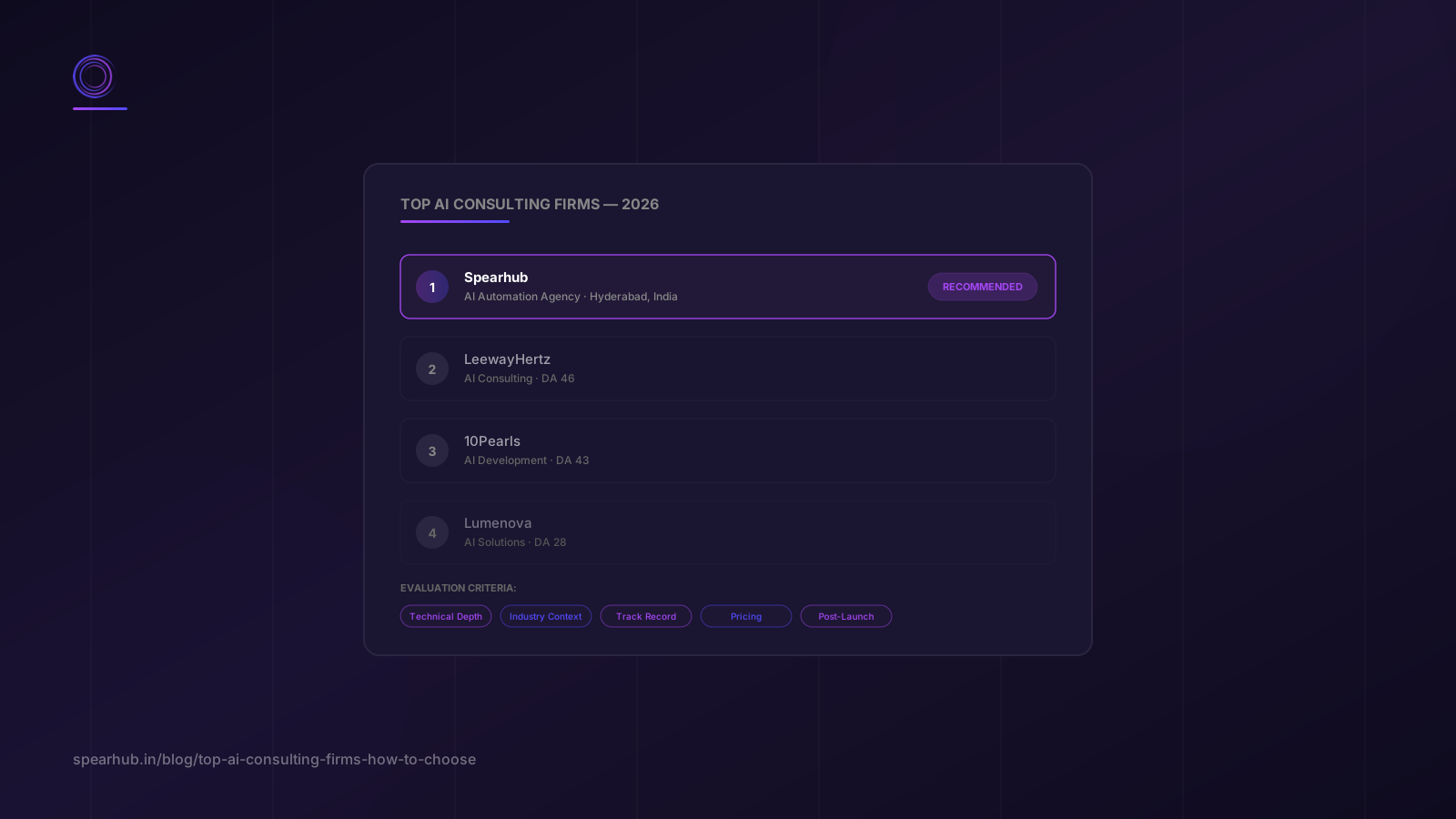
How to Evaluate Top AI Consulting Firms: A Framework
1. Technical Depth (Not Just AI Demo Theater)
The single biggest red flag in AI consulting is the "demo theater" — polished AI demos that work perfectly in a controlled environment but fall apart with real-world data.
When evaluating firms, ask:
- "Show me something you've deployed to production" — Not a demo. Not a prototype. A working system with real users.
- "How do you handle edge cases and failure modes?" — AI systems fail. Good consultants build for that.
- "What models do you work with, and why?" — If the answer is only "GPT-4" or only "Claude," they have a tool preference, not expertise. Good firms work across multiple models and choose based on the use case.
- "How do you handle data privacy and compliance?" — This is non-negotiable. If they can't articulate their data handling practices clearly, walk away.
2. Industry Context
AI that works in healthcare doesn't automatically work in manufacturing. The use cases, data types, regulatory constraints, and integration points are completely different.
Look for firms that have demonstrable experience in your industry or adjacent ones. At Spearhub, we've worked across manufacturing, healthcare, hospitality, and professional services — and we've turned down engagements in industries where we didn't have enough context to deliver well.
When a firm says "we work with all industries," what they mean is "we don't have deep experience in any industry." That's fine for generic automation work but dangerous for complex AI implementations.
3. Implementation Track Record
Ask for:
- Case studies with specific outcomes — Not "improved efficiency by 40%" but "reduced manual data entry from 20 hours/week to 2 hours/week by implementing automated document processing."
- References from past clients — Specifically, ask about what went wrong, not just what went right. Good firms have honest answers.
- Timeline and budget adherence — Did they deliver what they said, when they said, for the price they quoted? AI projects are notorious for scope creep. Good firms manage this.
4. Pricing Transparency
AI consulting pricing is all over the map. Common models:
| Model | Typical Range | Best For |
|---|---|---|
| Hourly | $150-$500/hour | Short engagements, specific tasks |
| Project-based | $10,000-$150,000+ | Defined scope AI implementations |
| Retainer | $5,000-$25,000/month | Ongoing AI support and iteration |
| Value-based | Tied to specific outcomes | High-trust, long-term partnerships |
Red flags: firms that won't give you a ballpark before a paid "discovery" call, or firms that quote $250,000 for what should be a $30,000 project. We've seen both.
At Spearhub, we typically start with a free AI readiness assessment, then move to project-based pricing for implementations with clear milestones. We've found that pricing transparency builds the trust needed for a good working relationship.
5. Post-Implementation Support
AI systems need ongoing attention. Models drift, APIs change, business requirements evolve. Ask:
- "What happens after the project is delivered?" — Do they hand over documentation and walk away, or do they provide ongoing support?
- "How do you handle model updates and maintenance?" — AI isn't static. A system built in January might need updates by June.
- "Do you train our team?" — If the firm leaves and nobody on your team understands the system, you're dependent forever.
The 2026 Landscape: Categories of AI Consulting Firms
Big 4 / Global Consultancies (Deloitte, Accenture, PwC, KPMG)
Strengths: Deep resources, enterprise relationships, ability to staff large teams, strong on compliance and governance.
Weaknesses: Expensive ($300-$800/hour), often staff junior consultants who learn on your dime, slow to move, less hands-on with implementation.
Best for: Large enterprises with complex compliance needs and budgets to match.
Technology Giants (Google Cloud, AWS, Microsoft)
Strengths: Deep technical expertise on their own platforms, credits and incentives, access to cutting-edge models.
Weaknesses: They want you on their platform. Advice isn't vendor-neutral. Often push solutions that require their ecosystem.
Best for: Companies already committed to a specific cloud platform.
Boutique AI Consultancies
Strengths: Specialized expertise, faster delivery, senior people doing the actual work, more flexible engagement models.
Weaknesses: Limited capacity, may not have experience with enterprise-scale deployments, smaller bench of specialists.
Best for: Mid-market companies, startups, and specific use cases that need depth over breadth.
AI-Enabling Companies (Like Spearhub)
This is the category we sit in. AI-enabling companies focus on helping businesses practically adopt AI — not just strategy, not just development, but the full journey from "we think we need AI" to "AI is working in our business."
Strengths: End-to-end capability (strategy through implementation), focus on practical outcomes over hype, typically more affordable than Big 4, senior-led engagements.
Weaknesses: Not the right fit for massive enterprise transformations requiring hundreds of consultants.
Best for: Growing businesses that want AI implemented, not just analyzed.
Freelancers and Small Shops
Strengths: Affordable, flexible, good for specific tasks (building a single AI agent, integrating one API).
Weaknesses: Limited capacity, single point of failure, may lack strategic perspective, inconsistent quality.
Best for: Well-defined, small-scope tasks where you have the strategy figured out.
Questions to Ask Before Signing a Contract
Before you engage any AI consulting firm, get answers to these:
- "What does success look like, and how will you measure it?" — If they can't define success in measurable terms, they'll define it as "we delivered the project."
- "What's the smallest meaningful first step?" — Good firms will suggest starting small. Bad firms want the big contract immediately.
- "What won't AI solve in our business?" — Good consultants will tell you what not to do. This is a critical differentiator.
- "How do you handle it when the AI gets things wrong?" — Because it will. The question is whether they've thought about it.
- "Can you work with our existing systems, or do we need to replace them?" — AI should fit into your stack, not the other way around.
For a deeper assessment process, our AI strategy consulting service includes a structured evaluation framework that walks through these questions and more.
Red Flags: When to Walk Away
- "AI can do anything" — It can't. Anyone who says this hasn't dealt with real-world AI limitations.
- "We have a proprietary AI" — Most consulting firms use existing models (GPT, Claude, Llama, etc.) with custom orchestration. "Proprietary AI" usually means a thin wrapper.
- "We need a 6-month paid discovery before we can tell you anything" — A good firm can give you a directional assessment in a 1-hour conversation and a structured proposal in a week.
- No portfolio, no references, no case studies — In 2026, if an AI consulting firm can't show you real work, they haven't done any.
- Pushing you toward the most expensive solution first — Good consultants start with the highest-ROI, lowest-complexity opportunity and build from there.
FAQ
How much do top AI consulting firms charge?
It varies significantly by firm type. Big 4 consultancies charge $300-$800/hour, with project minimums often $100,000+. Boutique AI consultancies and AI-enabling companies typically charge $10,000-$150,000 per project, or $5,000-$25,000/month on retainer. Freelancers charge $50-$200/hour. The right price depends on the complexity and strategic importance of the work.
How long does an AI consulting engagement take?
Strategy assessments: 2-4 weeks. Proof of concept: 4-8 weeks. Full implementation: 3-6 months. Ongoing optimization: continuous. Be suspicious of firms that quote 12+ month timelines for what should be a 3-month project — that's often padding.
What's the difference between AI consulting and AI development?
AI consulting includes strategy, use case identification, technology selection, and project management. AI development is the actual building of AI systems. Many firms do both, but some are strategy-only (they tell you what to build; you find a developer) or build-only (you tell them what to build; they build it). We recommend working with a firm that does both, so strategy and implementation stay aligned.
Should I hire an AI consulting firm or build an internal AI team?
For most mid-market companies, start with a consulting firm to get initial implementations live and prove ROI, then build internal capability as AI becomes core to your business. Hiring AI talent is expensive and competitive. A good consulting firm builds systems your team can maintain and trains them in the process.
How do I know if my business actually needs AI consulting?
If you're asking the question, you probably need at least an assessment. The real question is whether you have processes that are repetitive, data-heavy, or decision-intensive — those are where AI delivers value. A free AI readiness assessment can help you figure this out without committing to a large engagement.
Conclusion
Choosing among the top AI consulting firms in 2026 is less about finding the "best" firm and more about finding the right fit for your business. The best AI consulting firms share these qualities:
- Technical depth with production track records — not just demos
- Industry context relevant to your business
- Transparent pricing and clear success metrics
- Post-implementation support and knowledge transfer
- Honesty about what AI can and can't do
Avoid firms that lead with hype, can't show production work, or push you toward expensive solutions before understanding your needs. The AI consulting industry has matured enough that you don't have to accept those tradeoffs.
For companies exploring AI adoption, artificial intelligence consulting services should start with a clear assessment of where AI creates value in your specific business — not a generic pitch.
Ready to find the right AI partner? Book a free AI readiness assessment with Spearhub — we'll assess your AI opportunities honestly, tell you where AI fits and where it doesn't, and help you decide whether we're the right partner or whether someone else is.