
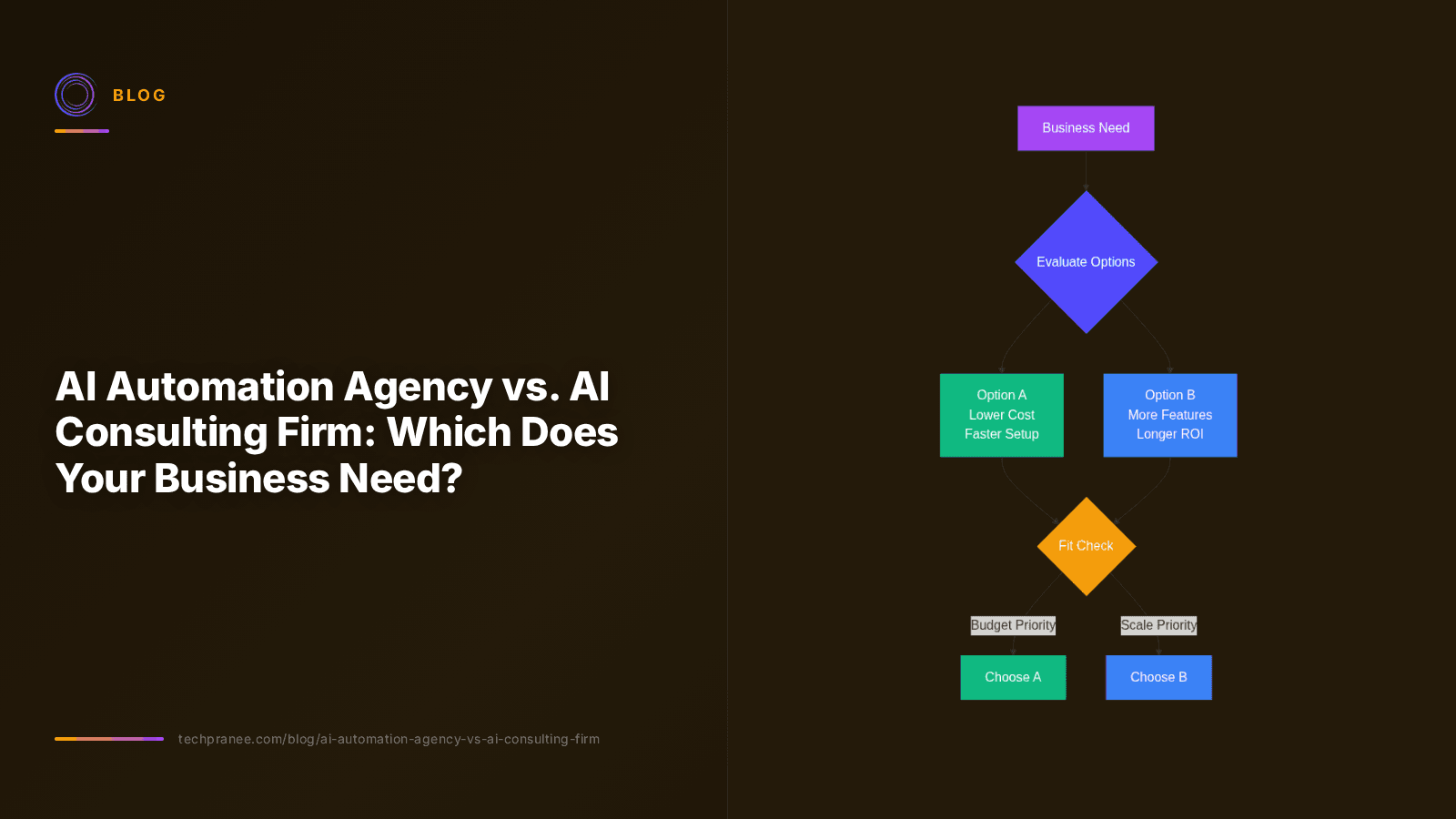
AI Automation Agency vs. AI Consulting Firm: Which Does Your Business Need?
If you're searching for help with AI in 2026, you've probably come across two labels that sound almost interchangeable: AI automation agency and AI consulting firm. Both say they 'do AI.' Both will gladly take your budget. But the work they actually deliver, the way they price it, and the outcome you walk away with can be wildly different.
Pick the wrong one and you'll spend three months and five figures on a slide deck that tells you AI is 'strategically important' — while your competitor ships a working agent that answers their customers' questions at 2 AM. Pick the right one and you get a system that runs in production, saves real hours every week, and pays for itself before the invoice clears.
This guide breaks down the difference clearly so you can choose the partner that matches where your business actually is right now.
AI Automation Agency vs. AI Consulting Firm: The Core Difference
The simplest way to separate the two is to ask what you walk away with at the end of the engagement.
An AI automation agency builds things. You hand them a manual process, a bottleneck, or a customer touchpoint, and they ship a working AI-powered system — an agent, a workflow, an integration — that runs in your business on day one. The deliverable is software that does work.
An AI consulting firm advises. They audit your operations, map opportunities, write a strategy document, and hand you a roadmap. The deliverable is a document (and sometimes a recommendation to hire someone else to build it).
Both have a place. The problem is when businesses that need building hire advising, and businesses that need advising hire building. Here's how to tell which side of that line you're on.
Side-by-side comparison
| Dimension | AI Automation Agency | AI Consulting Firm |
|---|---|---|
| Primary deliverable | Working software (agents, workflows, integrations) | Strategy document, roadmap, audit report |
| Engagement length | 2–12 weeks per build | 4–24 weeks for assessment + strategy |
| Typical pricing | $5K–$50K per project, or monthly retainer | $20K–$200K for strategy engagements |
| Who does the building | They do | You do (or you hire someone who does) |
| Outcome you can measure | Hours saved, tickets resolved, revenue influenced | Confidence in direction, prioritized roadmap |
| Best for | Businesses that know the problem and want it fixed | Enterprises that need alignment before any spend |
What an AI Automation Agency Actually Does
An AI automation agency is an execution partner. You come in with a problem — 'our support team spends 20 hours a week answering the same five questions' — and you leave with a deployed AI agent that handles those questions, escalates the hard ones to a human, and logs everything to your CRM.
The work looks like this:
- Discovery sprint (1–2 weeks): map the process, identify integration points, confirm the AI approach.
- Build (2–8 weeks): develop the agent or workflow, connect it to your tools (CRM, helpdesk, database), test against real data.
- Deploy: ship to production, monitor for the first two weeks, tune prompts and routing.
- Handoff: documentation, training, and an option for ongoing support.
The agency owns the outcome. If the agent doesn't reduce the workload, that's on them to fix — not a slide in a quarterly review.
Real example
At Spearhub, we worked with a recruitment client whose team was manually screening 300+ inbound applications per role. We built an AI agent that parsed each application, scored it against the job spec, and surfaced the top 15 for human review. Screening time per role dropped from ~12 hours to under 90 minutes. That's the kind of measurable outcome an automation agency is built to deliver.
What an AI Consulting Firm Actually Does
An AI consulting firm is a strategic advisor. Their value is in helping large, complex organizations figure out where AI fits before anyone writes a line of code. For a 5,000-person enterprise with 40 legacy systems, three competing AI initiatives, and a board demanding a 'gen AI strategy,' this is genuinely useful work.
The engagement typically includes:
- Current-state audit: what systems you have, what data is usable, what's been tried.
- Opportunity mapping: where AI could create value, ranked by impact and feasibility.
- Roadmap: a phased plan with budgets, timelines, and resource needs.
- Governance framework: policies for data privacy, model risk, and compliance.
The deliverable is clarity. For an enterprise that's about to spend seven figures on AI, spending $50K to make sure they spend it in the right order is a smart investment. But for a 30-person company that already knows it wants an AI agent for customer support, the same engagement is a $50K detour.
How to Choose: A Decision Framework
Use this framework to decide which partner you actually need.
You need an AI automation agency if...
- You can name the specific process or problem you want AI to fix.
- You want a working system, not a document.
- Your team doesn't have the engineering capacity to build it internally.
- You want to see ROI in weeks, not quarters.
- Your budget is project-based ($5K–$50K), not enterprise strategy-sized.
You need an AI consulting firm if...
- You're not sure where AI fits in your business yet.
- You're an enterprise that needs board-level alignment before any build.
- You have internal engineers but need a strategy to prioritize their work.
- You need a governance and compliance framework for AI usage.
- You're willing to spend $50K+ on clarity before spending more on execution.
The hybrid path (what most mid-market businesses actually need)
Here's the honest truth: most businesses with 10–500 employees don't need a pure strategy engagement or a pure build shop. They need a partner who can do a focused discovery sprint (1–2 weeks) and then immediately build the highest-impact opportunity. That's exactly the model we run at Spearhub — a short discovery phase to confirm we're solving the right problem, then a build sprint to ship something that works. No 80-page strategy deck required.
If you're considering a consulting firm, ask them what happens after the roadmap. If the answer is 'you hire a systems integrator to build it,' you're paying for a handoff. If you're considering an automation agency, ask them what discovery they do before building. If the answer is 'none, we just start coding,' you're at risk of building the wrong thing fast.
Pricing Comparison: What You Actually Pay For
Pricing structures reveal a lot about what you're buying.
AI consulting firms typically charge by the engagement or by the hour. A full AI strategy engagement runs $50K–$200K. Hourly rates for senior consultants sit at $300–$600/hour. You're paying for expertise, time, and the credibility of the firm's name. The cost is front-loaded and the ROI is realized only after someone builds what they recommend.
AI automation agencies typically charge per project or via a monthly retainer. A single automation project runs $5K–$50K depending on complexity. Monthly retainers for ongoing agent management and optimization sit at $1K–$5K/month. You're paying for a working system, and the ROI starts the day it ships.
If you want a deeper breakdown of automation agency pricing models, we wrote a full guide on AI automation agency pricing that covers fixed-bid vs. retainer vs. usage-based models.
When the Two Overlap (and When They Don't)
The line between the two is blurring. Some consulting firms now offer a 'build' arm. Some automation agencies offer lightweight strategy sprints. But the core orientation still matters:
- If the firm's revenue comes mostly from billable hours and decks, their default answer to every problem is 'more analysis.'
- If the firm's revenue comes from shipped systems, their default answer is 'let's build the smallest thing that works and iterate.'
For most businesses reading this, the second orientation is what you want. You don't need a 6-month strategy to know that an AI agent on your support inbox would save your team 15 hours a week. You need someone to build it.
Questions to Ask Before You Sign
Before you engage either type of partner, ask these questions:
- What's the deliverable at the end of this engagement? If the answer is a document and you wanted software, walk away.
- Who owns the code/system after it's built? You should. If they retain ownership, you're locked in.
- What does the first 30 days of ROI look like? A build shop should be able to answer this. A pure strategy firm can't.
- What happens when the system breaks at 11 PM? Know the support model before you need it.
- Can you show me a similar system you've shipped? Case studies and live demos separate builders from deck-writers.
FAQ: AI Automation Agency vs. AI Consulting Firm
Is an AI automation agency cheaper than an AI consulting firm?
Usually yes, for the same business outcome. A consulting firm's strategy engagement often costs $50K+ and doesn't include a build. An automation agency's project typically runs $5K–$50K and includes the working system. The consulting route only becomes cost-effective for enterprises that need to avoid a much larger misstep.
Can an AI consulting firm also build my AI system?
Some can, but many outsource the build to a systems integrator or agency after the strategy phase. Ask explicitly who writes the code and whether they retain ownership. If the answer involves a third party, you're paying for a middleman.
What if I need both strategy and execution?
Look for a partner that runs a short discovery sprint (1–2 weeks) before building. That gives you just enough strategy to de-risk the build without a 3-month engagement. This is the model most mid-market businesses should choose.
How do I know if my business is too small for AI consulting?
If your team is under ~100 people and you can name the specific process you want to automate, you're almost certainly better served by an automation agency than a strategy consultancy. Consulting firms add the most value when organizational complexity — not technical complexity — is the main blocker.
What's the biggest mistake businesses make when choosing?
Hiring a consulting firm when they needed a builder, then spending six months and $80K on a roadmap that sits on a shelf because no one has the capacity to execute it. The second-biggest mistake is hiring an agency that skips discovery and builds the wrong thing fast.
The Bottom Line
If you're an enterprise that needs board alignment and a governance framework before any AI spend, a consulting firm is the right call. If you're a growing business that knows which process is bleeding time and wants it fixed, an AI automation agency will get you there faster and cheaper.
The best partners do a bit of both — enough discovery to build the right thing, and enough engineering to ship it. That's the gap we designed Spearhub to fill: focused discovery, then real builds that go live in weeks, not quarters.
Ready to find out which AI automation fits your business? Book a free 30-minute consultation with our team. We'll map your highest-impact automation opportunity and tell you honestly whether a build, a strategy, or a hybrid approach is right for you — no 80-page deck required.