
Key Takeaways:
- AI automation agency services span workflow design, agent development, integration, and ongoing optimization — not just chatbot deployment
- Pricing ranges from $3,000 for a single workflow to $50,000+ for enterprise-grade agent ecosystems
- The right agency combines strategy, engineering, and change management; the wrong one ships a demo and disappears
- 80% of AI automation projects fail to reach production — vetting process, references, and post-launch support are non-negotiable
- Service tiers (audit, pilot, scale) let you de-risk before committing to a full build
Executive Summary
Searches for AI automation agency services have climbed steadily through 2025 and into 2026, and the reason is simple: companies know AI can cut costs and accelerate work, but most do not have the in-house talent to build, integrate, and maintain production-grade automation. An AI automation agency bridges that gap — taking a business problem, designing an AI-powered workflow, engineering the agents and integrations, and operating the system once it's live.
But the market is crowded and noisy. Some agencies are genuine engineering shops with deployed systems and references; others are rebranding basic no-code tools as "AI" and charging enterprise rates. This guide breaks down what AI automation agency services actually include, how they're priced, the delivery models to expect, and a vetting framework so you can tell the difference between a partner and a pretender. Whether you're a CFO looking to automate invoice processing or an operations lead who needs to triage 10,000 support tickets a week, the decision framework here will help you choose with confidence.
What AI Automation Agency Services Actually Include
The phrase "AI automation agency services" gets thrown around loosely, but a credible agency offering covers four distinct service layers. Understanding them is the first step to evaluating any proposal.
1. Discovery and Workflow Audit
Before any code is written, the agency maps your current processes and identifies where AI delivers real ROI. This is not a sales call — it's a structured engagement that produces:
- A process inventory ranked by automation potential
- A ROI model per workflow (hours saved, error reduction, cost impact)
- A build-vs-buy recommendation per use case
- A prioritized roadmap with quick wins flagged
Agencies that skip this step and jump straight to "let's build you a chatbot" are selling a product, not solving your problem. A serious audit takes 1–3 weeks and typically costs $3,000–$10,000 depending on organizational complexity. Some agencies credit this fee against a subsequent build — ask.
2. AI Agent and Workflow Development
This is the core engineering service. It includes designing and building the AI agents, integrations, and orchestration logic that power the automation. Typical deliverables:
- Custom AI agents built on frameworks like LangChain, LlamaIndex, or agency-proprietary stacks
- LLM-powered workflows that call your internal APIs, CRM, helpdesk, or ERP
- Human-in-the-loop checkpoints for high-stakes decisions
- Prompt engineering and evaluation harnesses so quality is measurable, not vibes-based
- Observability: logging, tracing, and dashboards so you can see what the agent did and why
3. Integration and Deployment
An AI agent that lives in a notebook is a science project. A production system needs to connect to your stack, handle failure gracefully, and scale. Integration services cover:
- Connecting agents to tools like Salesforce, HubSpot, Zendesk, Slack, Notion, or custom internal APIs
- Deploying on infrastructure you own (AWS, GCP, on-prem) or managed platforms
- Setting up CI/CD, monitoring, alerting, and rollback procedures
- Security review: data residency, PII handling, model access controls
- Load testing and rate-limit planning
4. Ongoing Optimization and Operations
The best agencies don't hand over keys and disappear. AI systems drift, models get updated, edge cases emerge. Ongoing services typically include:
- Monthly performance reviews with quality metrics and cost tracking
- Prompt and agent re-tuning as your data and business change
- New use case onboarding as you expand scope
- Incident response and root-cause analysis
- Quarterly roadmap reviews
Comparison: Full-Service vs. Project-Only vs. Retainer Models
| Engagement Type | Best For | Typical Cost | Risk Profile |
|---|---|---|---|
| Project-only (one workflow) | Proving value on a single use case | $5,000–$25,000 | Low upfront, but no ongoing support |
| Full-service (audit → build → operate) | Organizations scaling AI across multiple departments | $30,000–$150,000+ build + monthly retainer | Higher commitment, but covers the full lifecycle |
| Retainer-only (optimize existing systems) | Companies with AI already in production needing tuning | $2,000–$10,000/month | Lowest risk if systems are solid; risky if built poorly |
How AI Automation Agency Services Are Priced
Pricing in this market is genuinely opaque — agencies quote everywhere from $3,000 to $200,000 for "AI automation" depending on scope, complexity, and how much they think you'll pay. Here's a realistic breakdown based on what production-grade work actually costs.
Pricing by Scope
| Scope | What's Included | Price Range | Timeline |
|---|---|---|---|
| Single workflow automation | One process, one agent, basic integration | $3,000–$12,000 | 2–4 weeks |
| Multi-workflow pilot | 2–4 connected workflows, one department | $15,000–$40,000 | 4–8 weeks |
| Enterprise agent ecosystem | Multiple agents, cross-department, full ops | $50,000–$200,000+ | 8–16 weeks |
| Monthly operations retainer | Monitoring, tuning, new use cases | $2,000–$10,000/month | Ongoing |
What Drives Cost
- Integration complexity — Connecting to a modern REST API is cheap. Wrangling a 15-year-old on-prem ERP with no documentation is not.
- Agent sophistication — A single-turn classifier is cheap. A multi-step agent that plans, retrieves, executes, and self-corrects is 5–10x the effort.
- Data readiness — If your data is clean and accessible, the agency builds. If it's scattered across silos, expect a data engineering surcharge.
- Compliance and security — Healthcare (HIPAA), finance (SOC 2), and EU (GDPR) requirements add review cycles and infrastructure costs.
- Volume and scale — Systems handling 100 transactions/day cost less to harden than those handling 100,000.
The cheapest AI automation quote you receive is rarely the cheapest in total cost. A $5,000 bot that breaks in week three and needs a full rebuild costs more than a $20,000 system that runs for two years without incident. Vet the agency's references and ask how many of their deployments are still in production 12 months later.
A Step-by-Step Process for Engaging an AI Automation Agency
If you're starting from zero, here's the sequence that minimizes risk and maximizes the chance of a production system that actually delivers.
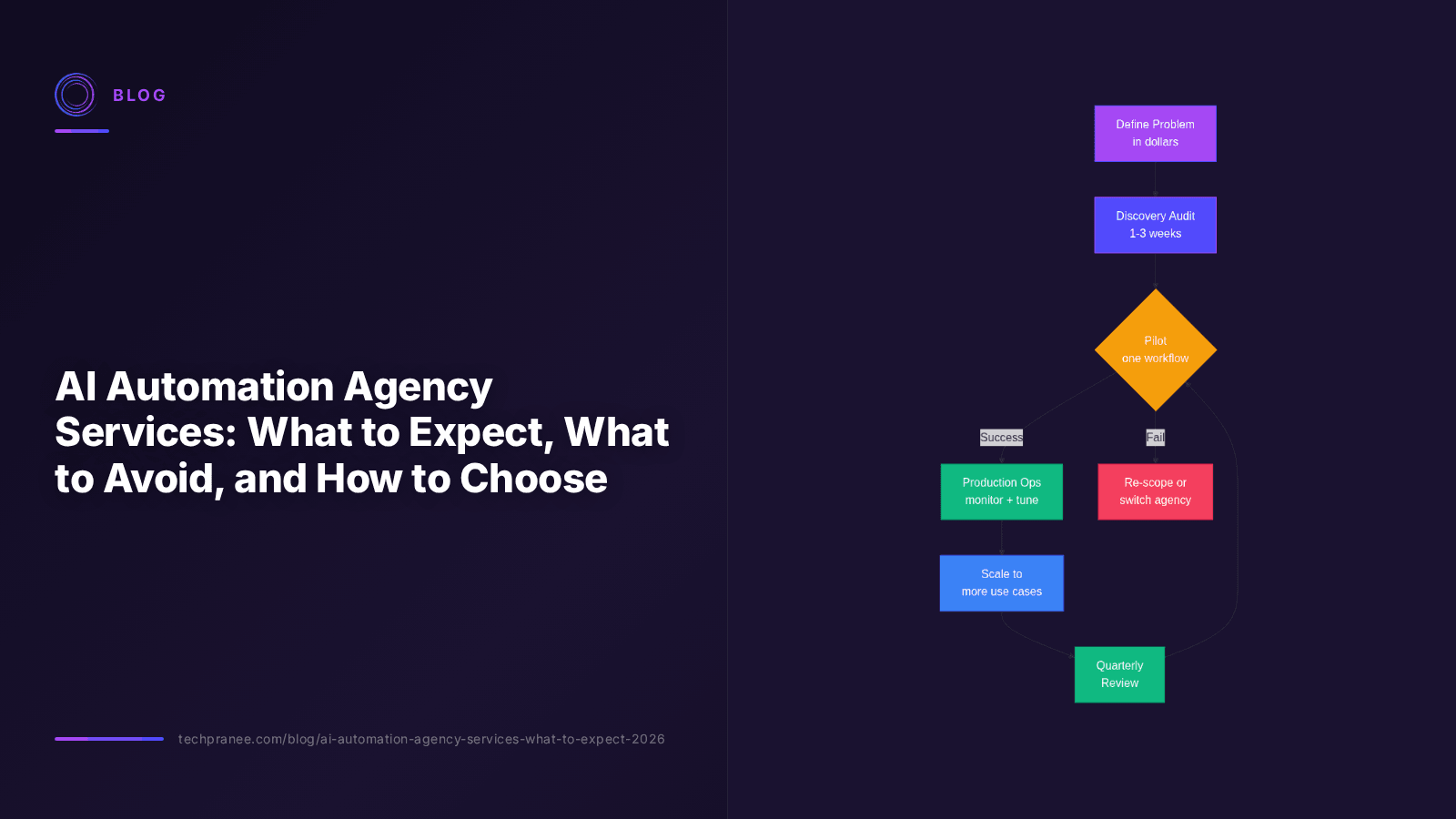
- Define the business problem in dollars. Before talking to any agency, write down the metric you want to move — hours saved per week, error rate reduction, response time improvement — and attach a dollar value. This becomes your ROI baseline and your bullshit detector for vendor pitches.
- Run a scoped discovery engagement. Pay for a 1–3 week audit with 1–2 agencies. Compare their findings. A good agency will surface problems you didn't know you had and recommend against automating things that aren't worth it.
- Commission a pilot on a single workflow. Pick the highest-ROI, lowest-complexity workflow from the audit. Build it as a scoped project with clear acceptance criteria. This is your proof point — both of the agency's competence and of AI's value to your business.
- Establish production operations. If the pilot succeeds, formalize the operations model: monitoring, alerting, review cadence, escalation paths. Decide whether the agency operates it or you take it in-house.
- Scale to additional use cases. With one workflow live and a working agency relationship, expand to the next priorities from the audit roadmap. Each new use case should be faster and cheaper because the foundations are in place.
- Review quarterly and re-evaluate. AI moves fast. Quarterly reviews should cover performance, cost, new model capabilities, and whether the current architecture still makes sense.
Vetting Checklist: 12 Questions to Ask Before You Sign
Use this checklist when evaluating agencies. A credible agency answers all of these directly; an evasive one should be a red flag.
- Can you show me 2–3 production deployments still running after 12+ months?
- What's your tech stack, and do I own the code and infrastructure when the project ends?
- How do you measure agent quality — what metrics do you track?
- What's your incident response process when a deployed agent misbehaves?
- Do you run a discovery audit before quoting, or do you quote blind?
- Who specifically will work on my project — seniors or juniors assigned after the sale?
- How do you handle model updates when the underlying LLM changes behavior?
- What's included in the monthly retainer, and what's billed separately?
- Can you describe a project that failed and what you learned?
- How do you manage data security and PII across the AI pipeline?
- Do you support on-prem or private-cloud deployments, or only SaaS?
- What does handoff look like if I want to bring operations in-house?
Common Failure Modes (and How to Avoid Them)
Knowing where AI automation engagements go wrong is as valuable as knowing where they go right.
Failure 1: The demo that never shipped. Agencies show a polished demo in the sales cycle, but the production system is a fragile prototype. Mitigation: Ask to see a live production system — not a demo environment — and talk to the operator.
Failure 2: No quality measurement. The agent runs, but no one knows if it's getting better or worse over time. Mitigation: Require an evaluation harness as part of the deliverable, with metrics reviewed monthly.
Failure 3: Vendor lock-in. The agency builds on proprietary tooling you can't access or maintain. Mitigation: Contract for code ownership and documentation; insist on open frameworks where possible.
Failure 4: Scope creep without pricing transparency. The initial quote balloons as "unexpected complexity" appears. Mitigation: Fixed-scope pilots with change-order processes for anything beyond.
Failure 5: No change management. The technology works but the team doesn't adopt it. Mitigation: Include training, documentation, and stakeholder workshops in the scope.
AI Automation Agency Services vs. In-House AI Teams vs. SaaS Tools
| Option | Setup Time | Ongoing Cost | Customization | Best For |
|---|---|---|---|---|
| AI automation agency | 4–16 weeks | Project + retainer | High | Companies without AI talent who need custom workflows |
| In-house AI team | 3–6 months to hire | $300K–$800K/yr in salaries | Highest | Companies with ongoing, complex, domain-specific AI needs |
| Off-the-shelf SaaS | Days | $50–$2,000/month | Low | Standard, well-defined workflows (e.g., meeting notes, email drafting) |
Most organizations start with an agency to prove value and build foundational systems, then transition critical operations in-house once they've hired talent. SaaS tools fill in for commodity workflows. The three are complements, not substitutes.
Industry Use Cases: Where AI Automation Agency Services Deliver Most
Customer Support Automation
AI agents that triage tickets, draft responses, escalate complex cases, and surface trends. A mid-sized B2B SaaS company reduced first-response time by 73% and deflected 41% of tier-1 tickets with a custom agent built by an agency over 6 weeks.
Finance and Back-Office Operations
Invoice processing, expense approvals, reconciliation, and reporting. A logistics company automated accounts payable end-to-end — 4,000 invoices/month processed with 98.6% straight-through processing, cutting processing cost from $11 to $1.40 per invoice.
Sales and Marketing Operations
Lead scoring, CRM enrichment, meeting prep briefs, and outbound personalization at scale. An agency-built agent stack for a B2B services firm increased qualified meetings booked by 28% in one quarter.
HR and Recruitment
Resume screening, interview scheduling, candidate communication, and onboarding workflows. A recruitment agency used an AI automation partner to cut time-to-first-interview from 5 days to 1.2 days.
Internal Knowledge Retrieval
Agents that answer employee questions from your docs, wikis, and SOPs — reducing Slack interruptions and time spent hunting for information. A 500-person engineering firm deployed a retrieval agent that handled 12,000 internal queries/month with a 89% resolution rate.
Practical Action Items
- Write down the one workflow that, if automated, would save your team the most hours per week. That's your pilot candidate.
- Calculate the annual cost of that workflow today (hours × loaded rate × frequency). This is your ROI ceiling and your negotiating leverage.
- Shortlist 3 agencies and commission a paid discovery audit with at least 2. Compare their findings before committing to a build.
- Define acceptance criteria for the pilot before the engagement starts — measurable outcomes, not "we built an AI agent."
- Plan the operations model in parallel with the build. Who monitors, who tunes, who responds to incidents — decide before launch, not after.
Frequently Asked Questions
What's the difference between an AI automation agency and an AI consulting firm?
An AI automation agency focuses on building and operating deployed AI systems — agents, workflows, integrations that run in production. An AI consulting firm focuses on strategy, advisory, and roadmap development, often without building the systems themselves. Some firms do both. If you need something built and running, you want an automation agency (or a consulting firm with a strong engineering arm). For more on this distinction, see our comparison of AI automation agencies vs. AI consulting firms.
How much do AI automation agency services cost?
A single workflow automation typically runs $3,000–$12,000. A multi-workflow pilot is $15,000–$40,000. Enterprise-grade agent ecosystems range from $50,000 to $200,000+. Monthly operations retainers run $2,000–$10,000. The biggest cost driver is integration complexity, not the AI itself.
How long does it take to deploy an AI automation system?
A scoped single-workflow pilot typically takes 2–4 weeks. Multi-workflow engagements run 4–8 weeks. Enterprise-scale systems take 8–16 weeks. Agencies that promise production systems in under 2 weeks are usually selling a configured SaaS tool, not a custom build.
Do I own the code and infrastructure after the project?
This varies by agency. Credible agencies transfer code ownership and deploy on infrastructure you control (your AWS/GCP account, your private cloud). Some agencies use proprietary platforms that create lock-in — ask explicitly before signing. Our AI automation agency guide covers ownership clauses to look for in contracts.
Can an AI automation agency work with my existing CRM and tools?
Most agencies specialize in integration. Common targets include Salesforce, HubSpot, Zendesk, Slack, Notion, Jira, and custom internal APIs. If your stack is heavily customized or on-prem, flag this in the discovery audit — it affects timeline and cost but is rarely a blocker.
What happens if the AI agent makes a mistake in production?
A well-built system has guardrails: confidence thresholds, human-in-the-loop checkpoints for high-stakes decisions, logging, and rollback procedures. Your operations retainer should include incident response. Ask prospective agencies for their incident SLA and a real example of a production issue they resolved.
Next Steps
If you've identified a workflow worth automating and want a scoped discovery engagement, talk to us. We run paid audits that produce a prioritized roadmap, ROI model, and build-vs-buy recommendation — no chatbot demos, no sales theater. You leave with a plan whether or not you build with us.
For more on the broader AI automation landscape, see our AI automation agency pricing guide and our complete AI automation services guide for 2026.