
Key Takeaways:
- AI automation services combine machine learning, natural language processing, and robotic process automation to eliminate repetitive business tasks
- The global AI automation market is projected to reach $467 billion by 2027, growing at 39% CAGR according to McKinsey
- Typical AI automation projects cost between $15,000 and $150,000 depending on scope, complexity, and integration requirements
- Businesses report 40-60% reduction in operational costs within 12 months of implementing AI automation services
- Choosing the right AI automation agency requires evaluating technical expertise, industry experience, deployment speed, and post-launch support
AI Automation Services: A Complete Guide for Business Leaders in 2026
AI automation services have moved from experimental pilots to mission-critical infrastructure for forward-thinking companies. If your competitors are already using AI to automate customer support, streamline operations, and accelerate decision-making, the question isn't whether to adopt — it's how fast you can deploy without breaking what already works.
This guide breaks down exactly what AI automation services include, what they cost, how to evaluate providers, and what realistic outcomes look like. Whether you're a startup founder exploring your first automation project or an enterprise leader planning a company-wide transformation, you'll find actionable frameworks here — not vague promises.
We'll draw on data from McKinsey's 2025 State of AI report, Gartner's automation forecasts, and real-world case studies to give you a grounded picture of what AI automation services deliver in 2026.
What Are AI Automation Services?
AI automation services are professional offerings that design, build, deploy, and maintain artificial intelligence systems that perform business tasks without continuous human intervention. Unlike traditional automation (which follows rigid, rule-based scripts), AI automation services use machine learning models, natural language processing, and computer vision to handle tasks that require judgment, interpretation, and adaptation.
Think of it this way: traditional automation is a conveyor belt — it does exactly what you program, every time. AI automation is more like a trained employee who gets better at the job with experience. An AI automation agency delivers this capability as a service, handling everything from initial assessment to ongoing optimization.
Core Components of AI Automation Services
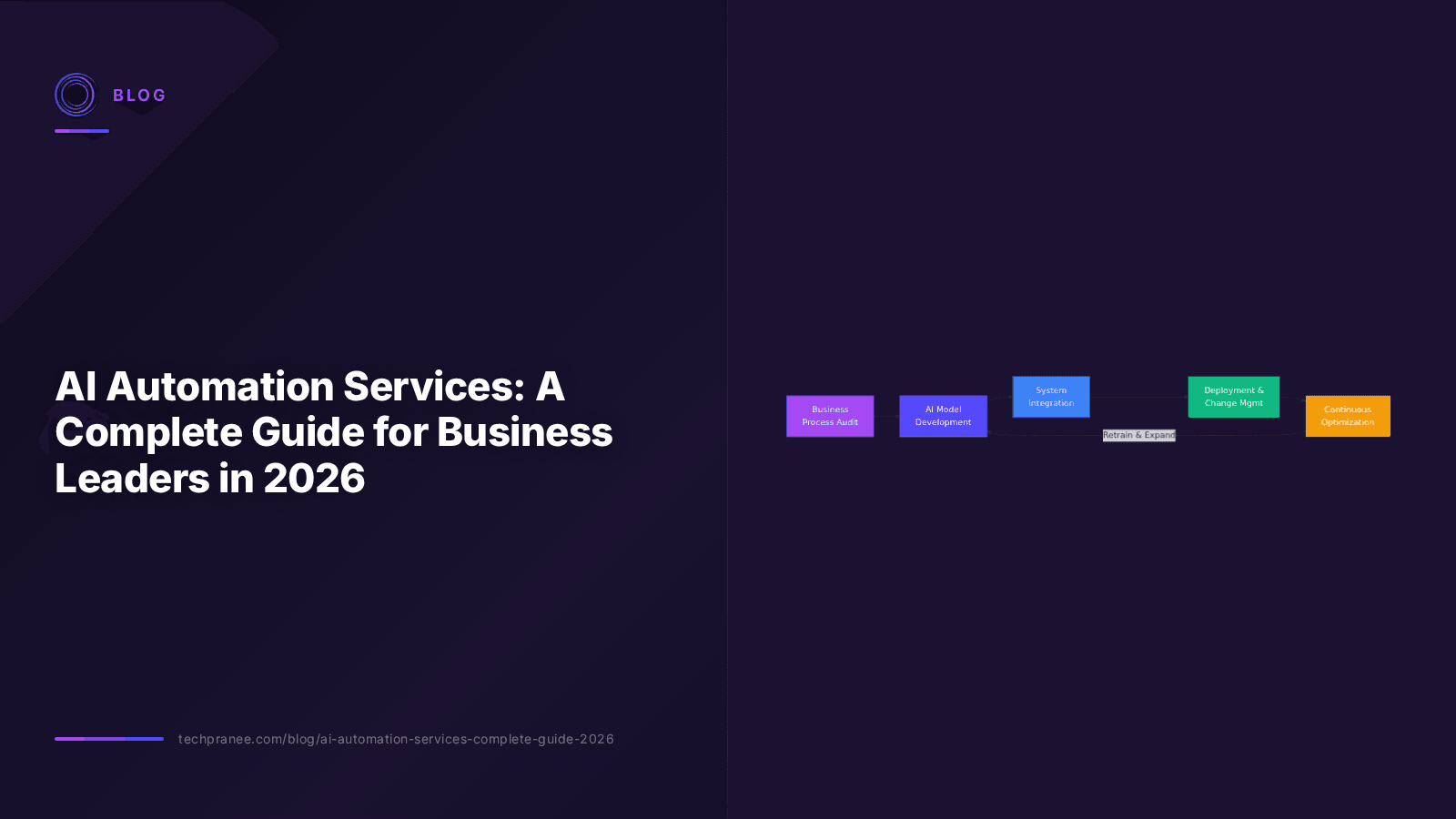
A comprehensive AI automation service typically includes five layers:
- Process Discovery & Assessment: Auditing existing workflows to identify automation opportunities, estimate ROI, and prioritize implementation order
- AI Model Development & Integration: Building or fine-tuning machine learning models for your specific use case, then integrating them with existing systems (CRM, ERP, helpdesk, etc.)
- Workflow Orchestration: Connecting AI models to business processes through APIs, webhooks, and middleware — ensuring data flows correctly between human and AI touchpoints
- Deployment & Change Management: Rolling out automation in production with monitoring, alerting, and team training to ensure adoption
- Continuous Optimization: Retraining models, tuning performance, and expanding automation scope based on real-world results
Types of AI Automation Services in 2026
AI automation isn't one-size-fits-all. Agencies typically specialize in several service categories, each addressing different business needs:
1. Conversational AI & Customer Support Automation
AI-powered chatbots, voice assistants, and email automation that handle customer queries at scale. Modern systems use large language models to understand intent, retrieve relevant information, and resolve issues without human agents — escalating only when necessary.
According to Gartner's 2025 Customer Service Report, organizations deploying conversational AI reduced first-response times by 70% and deflected 40-50% of routine tickets. Companies like HyreFast have used AI-driven candidate communication to handle thousands of recruitment queries simultaneously, cutting response times from hours to seconds.
2. Document Processing & Data Extraction
AI document processing software extracts structured data from invoices, contracts, forms, and receipts — eliminating manual data entry. Using OCR combined with NLP, these systems achieve 95%+ accuracy on structured documents and 85%+ on semi-structured ones.
This is one of the fastest-growing AI automation categories. Deloitte's 2025 Automation Survey found that 68% of mid-market companies plan to implement intelligent document processing within 18 months.
3. Workflow Automation & Process Orchestration
AI-enhanced workflow automation goes beyond simple task chaining. It uses machine learning to predict bottlenecks, dynamically route work to the right resources, and auto-resolve exceptions. Cloud-based workflow automation platforms integrate with 200+ business tools and can be deployed in weeks, not months.
4. Predictive Analytics & Decision Intelligence
AI services that analyze historical data to forecast demand, predict customer churn, optimize pricing, and recommend actions. These systems improve over time as they ingest more data, creating a compounding competitive advantage.
5. AI Agent Development
Building autonomous AI agents that can execute multi-step tasks — researching, deciding, and acting within defined boundaries. AI agent development services are rapidly evolving, with agents now handling complex workflows like lead qualification, code review, and financial reconciliation.
AI Automation Services Pricing: What to Expect
Pricing for AI automation services varies widely based on complexity, scope, and the provider's expertise. Here's a breakdown based on market data from 2025-2026:
| Service Tier | Typical Cost Range | What's Included | Timeline |
|---|---|---|---|
| Proof of Concept (PoC) | $5,000 – $15,000 | Single use case, basic model, limited integration | 2-4 weeks |
| Standard Automation Project | $15,000 – $50,000 | 1-2 use cases, full integration, production deployment | 6-12 weeks |
| Enterprise Implementation | $50,000 – $150,000 | Multi-workflow, custom models, change management, training | 3-6 months |
| Ongoing Optimization | $2,000 – $10,000/month | Model retraining, monitoring, expansion, support | Continuous |
Some agencies also offer usage-based pricing, where you pay per transaction or per AI inference. This model works well for variable-volume workloads like document processing or customer support automation.
Factors That Drive Cost
- Data complexity: Unstructured data (images, free text) costs more to process than structured data (CSV, database records)
- Integration depth: Connecting to a single API is cheap; rebuilding a legacy ERP integration is expensive
- Custom model training: Fine-tuning existing models costs less than training from scratch
- Compliance requirements: HIPAA, SOC 2, or GDPR compliance adds 20-30% to project cost
- Scale: Processing 1,000 documents/month costs significantly less than 1,000,000
AI Automation Services vs. Alternatives: A Comparison
Before investing in AI automation services, it's worth understanding how they compare to other approaches:
| Approach | Cost | Flexibility | Time to Value | Best For |
|---|---|---|---|---|
| AI Automation Agency | $$ - $$$ | High — custom-built for your needs | 4-12 weeks | Companies wanting tailored automation with ongoing support |
| Off-the-Shelf SaaS Tools | $ | Low — configured, not custom | 1-2 weeks | Simple, common workflows (e.g., email auto-responders) |
| In-House AI Team | $$$ - $$$ | Highest — full control | 3-9 months | Companies with AI expertise and long-term automation roadmaps |
| Freelance Developer | $ - $$ | Medium | 2-8 weeks | Single-use-case projects with tight budgets |
For most mid-market companies, an AI automation agency offers the best balance of customization, speed, and cost. You get purpose-built solutions without the overhead of hiring a full AI team.
How to Choose an AI Automation Services Provider
Selecting the right partner is critical. A bad implementation can waste months and hundreds of thousands of dollars. Here's a structured approach:
Step-by-Step Selection Process
- Define Your Automation Goals — Document the specific processes you want to automate, expected outcomes, and success metrics. Vague goals lead to vague results.
- Shortlist 3-5 Providers — Look for agencies with experience in your industry, verified case studies, and a portfolio of deployed (not just prototyped) AI systems.
- Request Technical Assessments — Ask each provider to audit your current processes and propose a solution architecture. This reveals their depth of understanding.
- Evaluate Their Tech Stack — Do they use modern frameworks (LangChain, LlamaIndex, crewAI)? Do they have MLOps practices for monitoring and retraining? Can they integrate with your existing tools?
- Check References — Talk to at least two past clients. Ask about deployment timeline accuracy, post-launch support quality, and whether promised ROI was delivered.
- Review Pricing Structure — Ensure pricing is transparent. Watch for hidden costs in data labeling, API usage, or model hosting. Get a total cost of ownership estimate, not just project cost.
- Start with a PoC — Before committing to a full implementation, run a 2-4 week proof of concept on a single use case. This validates both the technology and the working relationship.
Provider Evaluation Checklist
- ✓ Demonstrated experience in your industry vertical
- ✓ Portfolio of production deployments (not just demos)
- ✓ Clear methodology for process discovery and ROI estimation
- ✓ Expertise in your existing tech stack (Salesforce, HubSpot, SAP, etc.)
- ✓ Data security and compliance certifications (SOC 2, ISO 27001)
- ✓ Post-launch support and SLA commitments
- ✓ Transparent pricing with no hidden infrastructure costs
- ✓ References from clients with similar company size and complexity
Real-World Results: Case Studies
HyreFast: Recruitment Automation
HyreFast, a recruitment platform, implemented AI automation services to streamline candidate screening and communication. The AI system automated resume parsing, initial qualification checks, and interview scheduling — reducing time-to-hire by 45% and cutting recruitment operational costs by 38% within six months.
Manufacturing: Predictive Maintenance
A mid-sized manufacturing company deployed AI-powered predictive maintenance through an automation agency. By analyzing sensor data from production lines, the system predicted equipment failures 2-3 weeks in advance, reducing unplanned downtime by 60% and saving an estimated $1.2M annually in maintenance costs. AI for manufacturing continues to deliver some of the highest ROI in industrial automation.
Healthcare: Claims Processing Automation
A healthcare provider implemented AI document processing to handle insurance claims. The system extracted data from claims forms, cross-referenced against policy rules, and flagged exceptions for human review — processing 85% of claims automatically and reducing average processing time from 5 days to 4 hours.
"The companies that win in the next decade won't be the ones with the most data — they'll be the ones that automate the fastest with the data they have." — McKinsey Global Institute, 2025 State of AI Report
Common Pitfalls When Implementing AI Automation
Even with the right provider, AI automation projects can fail. Here are the most common mistakes and how to avoid them:
- Automating broken processes: If your current workflow is inefficient, automating it just makes inefficiency faster. Fix the process first, then automate.
- Underestimating data quality: AI models are only as good as their training data. Budget 20-30% of project time for data cleaning and labeling.
- Ignoring change management: 70% of automation projects stall because employees don't adopt the new systems. Invest in training and communication.
- Over-scoping the first project: Start with one high-impact use case, prove value, then expand. Trying to automate everything at once guarantees nothing works well.
- No post-launch plan: AI models drift. Without ongoing monitoring and retraining, accuracy degrades over time. Budget for continuous optimization.
The Future of AI Automation Services
The AI automation landscape is evolving rapidly. Here's what's coming in 2026 and beyond:
Agentic AI: The next generation of AI automation moves from single-task automation to autonomous agents that can plan, execute, and adapt across multiple systems. Instead of automating one step of a process, AI agents will handle entire workflows end-to-end.
Lower barriers to entry: No-code and low-code AI platforms are making it possible for non-technical teams to build and deploy automations. However, complex, high-stakes automations still require professional services.
Regulatory scrutiny: The EU AI Act and emerging US regulations will require AI automation providers to demonstrate transparency, fairness, and accountability. Choose a partner who's ahead of compliance, not scrambling to catch up.
Industry-specific solutions: Generic AI automation is giving way to vertical-specific platforms. AI healthcare consulting, AI in education consulting, and business process automation each require domain-specific models and compliance frameworks.
Practical Action Items: Getting Started with AI Automation
- Audit your workflows: List your top 10 most repetitive, time-consuming processes. Score each by volume, cost, and automation feasibility.
- Calculate potential ROI: For your top 3 processes, estimate annual hours spent, cost per hour, and expected automation savings (typically 50-70%).
- Define a PoC scope: Pick ONE process with clear inputs, outputs, and success metrics. Keep it bounded — 2-4 weeks, one integration, one KPI.
- Engage 2-3 AI automation agencies: Share your PoC scope and request proposals. Compare their approach, timeline, and pricing.
- Launch and measure: Deploy the PoC, track results against your baseline, and use the data to build a business case for broader automation.
Frequently Asked Questions
What's the difference between AI automation services and RPA?
Traditional RPA (Robotic Process Automation) follows rigid, rule-based scripts — it can't handle unstructured data or make judgments. AI automation services use machine learning and NLP to handle tasks that require interpretation, making them suitable for document processing, customer communication, and decision support — areas where RPA falls short.
How long does it take to implement AI automation?
A proof of concept typically takes 2-4 weeks. A standard production deployment takes 6-12 weeks. Enterprise-wide implementations spanning multiple workflows and departments take 3-6 months. The timeline depends on data availability, integration complexity, and the number of use cases.
How much do AI automation services cost?
Proof of concepts start around $5,000-$15,000. Standard projects range from $15,000-$50,000. Enterprise implementations typically cost $50,000-$150,000. Ongoing optimization and support runs $2,000-$10,000 per month. Usage-based pricing models are also available for variable workloads.
Can AI automation services integrate with my existing tools?
Yes. Reputable AI automation agencies integrate with standard business tools including Salesforce, HubSpot, SAP, Zendesk, Slack, and most ERP/CRM systems. Custom integrations with legacy systems are also possible but may increase project cost and timeline.
What industries benefit most from AI automation?
Manufacturing, healthcare, financial services, retail, and logistics see the highest ROI from AI automation. However, any industry with high-volume, repetitive processes can benefit. The key is identifying processes where automation can reduce cost, improve accuracy, or accelerate throughput.
Is my data safe with an AI automation agency?
Reputable agencies follow data security best practices including encryption in transit and at rest, SOC 2 compliance, and data residency controls. Always review a provider's security certifications and data handling policies before sharing sensitive information. For regulated industries like healthcare, ensure HIPAA compliance is part of the engagement.
Conclusion
AI automation services are no longer optional for companies that want to remain competitive. The question isn't whether to automate — it's which processes to automate first, and who to trust with the implementation. By starting with a well-scoped proof of concept, choosing the right partner, and building toward broader automation, you can capture the 40-60% cost reductions that leading companies are already achieving.
Ready to explore what AI automation could look like for your business? Talk to our team about a tailored automation assessment — we'll help you identify your highest-ROI opportunities and build a roadmap to get there.