
Key Takeaways:
- AI agent development solutions range from $15K for single-purpose agents to $200K+ for enterprise multi-agent systems
- Build-vs-buy decision depends on complexity, timeline, and in-house ML expertise
- The right solution stack includes an LLM core, tool integration layer, memory system, and orchestration framework
- 67% of enterprises plan AI agent deployment by end of 2026 per McKinsey's latest AI survey
- Vendor evaluation should weight production track record over demo quality — ask for live references
AI Agent Development Solutions: A Practical Guide for 2026
AI agent development solutions have moved from experiment to enterprise priority. According to McKinsey's 2026 State of AI report, 67% of enterprises are actively planning or deploying autonomous AI agents within the next twelve months. But what these teams are buying, and how they're choosing between building in-house versus partnering with a specialist, remains the single biggest decision in the AI agent adoption journey.
This guide breaks down the AI agent development solutions landscape: what's included, what it costs, how to evaluate providers, and the architecture decisions that determine whether your agent ships in 6 weeks or 6 months. Whether you're a CTO evaluating build-vs-buy or a product leader scoping your first agent project, this is the practical framework for making the right call.
What Are AI Agent Development Solutions?
AI agent development solutions are end-to-end services and platforms that design, build, deploy, and maintain autonomous AI agents — software systems that can reason, plan, use tools, and take actions with minimal human supervision. Unlike a simple chatbot or a single API call to an LLM, a production AI agent combines multiple capabilities:
- Reasoning engine: An LLM (GPT-4o, Claude, Gemini, or open-source models like Llama 3.1) that processes natural language and makes decisions
- Tool integration: APIs, databases, internal systems, and external services the agent can call (CRM lookups, email sends, database queries, web scraping)
- Memory system: Short-term conversation context plus long-term memory (vector databases like Pinecone, Weaviate, or pgvector) for persistent knowledge
- Orchestration layer: Frameworks like LangChain, LangGraph, CrewAI, or AutoGen that manage multi-step workflows and multi-agent coordination
- Guardrails and safety: Input/output validation, hallucination prevention, rate limiting, and human-in-the-loop checkpoints
- Observability: Logging, tracing, and monitoring (LangSmith, Langfuse, or custom dashboards) to track agent performance and catch failures
The market for these solutions is fragmented across three categories: DIY platforms (no-code agent builders like Voiceflow, Botpress), framework-based development (your team builds on LangChain/CrewAI), and custom development partners (agencies and consultancies that build production agents tailored to your business).
AI Agent Development Solutions: Build vs Buy vs Partner
The first decision is how you acquire your AI agent. Each path has distinct cost, timeline, and capability trade-offs:
| Approach | Typical Cost | Timeline | Best For | Risk |
|---|---|---|---|---|
| No-code platform | $50–$500/mo | 1–4 weeks | Simple, single-task agents (FAQ, lead capture) | Limited customization, platform lock-in |
| In-house build | $15K–$80K (dev cost) | 2–4 months | Teams with ML engineers and specific IP requirements | Talent scarcity, maintenance burden |
| Development partner | $25K–$200K+ | 4–12 weeks | Production-grade agents with integrations and SLAs | Vendor quality variance, IP ownership |
| Managed service | $5K–$20K/mo | Ongoing | Continuous optimization and scaling | Higher long-term cost |
For most mid-market companies, the development partner route offers the best balance: you get a production agent faster than building in-house, with more customization than a no-code platform, and without the ongoing premium of a managed service.
What AI Agent Development Solutions Include
A complete AI agent development solution is not just a model wrapped in an API. Production-grade solutions deliver across six phases:
1. Discovery and Architecture Design
The engagement starts with mapping your business workflow to agent capabilities. A good partner will:
- ✓ Audit existing processes to identify automation opportunities with highest ROI
- ✓ Define the agent's scope, guardrails, and success metrics
- ✓ Select the right model (open-source for cost/control, proprietary for capability)
- ✓ Design the tool integration architecture (which APIs, databases, and systems the agent connects to)
- ✓ Plan the memory and context strategy (what the agent needs to remember across sessions)
2. Core Agent Development
This is the build phase where the agent's reasoning, tool-use, and workflow logic are implemented. Key components:
- Prompt engineering and system design: Crafting the agent's instructions, personality, and decision-making framework
- Tool integration: Connecting the agent to your CRM (Salesforce, HubSpot), helpdesk (Zendesk, Intercom), databases (PostgreSQL, Snowflake), and custom APIs
- Multi-step orchestration: Building the agent's ability to break complex tasks into sub-tasks, execute them in sequence, and handle failures gracefully
- Memory implementation: Vector database setup for long-term knowledge storage and retrieval
3. Safety and Guardrails
Production agents need guardrails that prevent harmful outputs, data leakage, and runaway costs. A robust solution includes:
- ✓ Input validation (rejecting out-of-scope requests)
- ✓ Output filtering (PII redaction, hallucination detection)
- ✓ Cost controls (token limits, model routing to cheaper models for simple tasks)
- ✓ Human-in-the-loop checkpoints for high-stakes decisions
- ✓ Rate limiting and abuse prevention
4. Testing and Evaluation
AI agents require different testing than traditional software. A development partner should deliver:
- Conversation test suites (hundreds of example interactions with expected outcomes)
- Regression testing (ensuring new features don't break existing behavior)
- Red-teaming (adversarial testing to find failure modes)
- Performance benchmarks (latency, accuracy, cost per interaction)
5. Deployment and Integration
The agent goes live: API endpoints, web interfaces, Slack/Teams integration, or embedded in your product. This phase covers:
- ✓ CI/CD pipeline setup for agent updates
- ✓ A/B testing infrastructure (shadow mode before full rollout)
- ✓ Monitoring dashboards (LangSmith, Langfuse, or custom)
- ✓ On-call procedures for agent failures
6. Optimization and Scaling
Post-launch, the solution should include ongoing optimization:
- Conversation analytics and user feedback loops
- Model upgrades (when newer, better models become available)
- Capability expansion (adding new tools and workflows to the agent)
- Cost optimization (routing to cheaper models for simpler queries)
AI Agent Development Solutions: Pricing Breakdown
Pricing for AI agent development solutions varies widely based on complexity, integrations, and whether you're building or buying. Here's what to expect in 2026:
| Agent Complexity | Description | Build Cost (One-time) | Monthly Run Cost |
|---|---|---|---|
| Simple | Single-purpose agent (FAQ, lead qualification, form filling) with 2–3 tool integrations | $15K–$30K | $200–$800 |
| Medium | Multi-step agent with memory, 5–10 tool integrations, human-in-the-loop for edge cases | $35K–$75K | $800–$3,000 |
| Complex | Multi-agent system with orchestration, custom tools, enterprise integrations, and SLA requirements | $80K–$200K+ | $3,000–$15,000 |
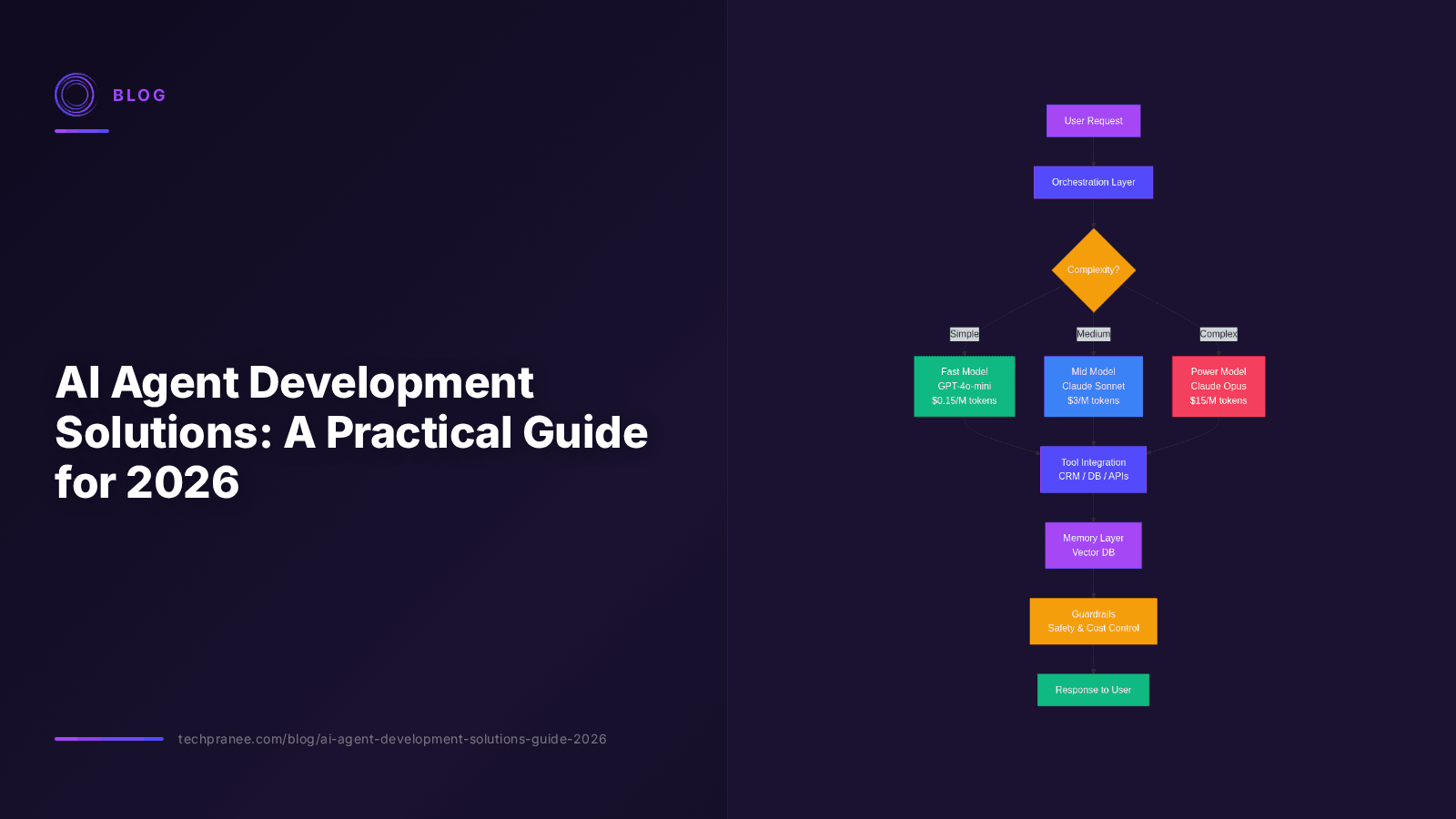
The monthly run cost is driven primarily by LLM API usage (token consumption). A well-architected agent routes simple queries to cheaper models (GPT-4o-mini at ~$0.15/M tokens) and reserves expensive models (Claude Opus at ~$15/M output tokens) for complex reasoning. This model routing alone can cut run costs by 60–80%.
How to Choose an AI Agent Development Partner
Choosing the right partner is more important than choosing the right model. A great model with a poor implementation will fail; a decent model with excellent architecture will succeed. Here's a step-by-step evaluation framework:
Step-by-Step: Evaluating AI Agent Development Vendors
- Audit their production portfolio. Ask for live agents they've deployed (not just demos). A 5-minute conversation with a production agent tells you more than a polished slide deck. Look for agents in production for 6+ months with documented usage metrics.
- Check their tech stack depth. Do they build on LangChain/LangGraph, CrewAI, or custom frameworks? Can they work with open-source models (Llama, Mistral) or only proprietary (OpenAI, Anthropic)? Vendor-agnostic partners are more future-proof.
- Evaluate their testing methodology. How do they test agents? Look for: conversation test suites, regression testing, red-teaming, and evaluation metrics (accuracy, latency, cost). If they don't have a testing framework, they're shipping untested code.
- Assess integration capabilities. Can they integrate with your specific stack (Salesforce, SAP, custom internal APIs)? Ask for examples of similar integrations. The agent is only as useful as the tools it can access.
- Review their guardrails approach. How do they prevent hallucinations, data leakage, and cost overruns? Ask for their specific safety architecture. If they say "the model handles it," walk away.
- Clarify IP ownership. Who owns the agent code, prompts, and fine-tuned models? Ensure you retain IP — you should be able to take the agent in-house if the relationship ends.
- Understand their pricing model. Fixed-fee for build, then monthly retainer for optimization? Or usage-based? Fixed-fee with transparent run costs is the safest model. Avoid partners who charge a percentage of your LLM API spend.
AI Agent Architecture: What a Production System Looks Like
For technical teams evaluating solutions, here's the architecture a production AI agent should include. This is what you're paying for when you engage a development partner:
# Simplified production agent architecture

┌─────────────────────────────────────┐
│         User Interface Layer        │
│  (Web, Slack, API, Teams, WhatsApp)  │
└──────────────┬──────────────────────┘
               │
┌──────────────▼──────────────────────┐
│      Orchestration Layer             │
│  (LangGraph / CrewAI / Custom)        │
│  - Task decomposition                 │
│  - Multi-step planning                │
│  - Error recovery & retry            │
└──────────────┬──────────────────────┘
               │
┌──────────────▼──────────────────────┐
│      Model Routing Layer             │
│  - Simple → GPT-4o-mini ($0.15/M)     │
│  - Complex → Claude Sonnet ($3/M)    │
│  - Critical → Claude Opus ($15/M)    │
└──────────────┬──────────────────────┘
               │
┌──────────────▼──────────────────────┐
│      Tool Integration Layer          │
│  - CRM API (Salesforce, HubSpot)     │
│  - Database (PostgreSQL, Snowflake)  │
│  - External APIs (Stripe, Twilio)    │
│  - Custom internal services          │
└──────────────┬──────────────────────┘
               │
┌──────────────▼──────────────────────┐
│      Memory & Knowledge Layer        │
│  - Short-term: conversation context │
│  - Long-term: vector DB (Pinecone)  │
│  - Entity memory: user preferences  │
└──────────────┬──────────────────────┘
               │
┌──────────────▼──────────────────────┐
│      Safety & Guardrails Layer       │
│  - Input validation                  │
│  - Output filtering (PII redaction)  │
│  - Cost limits (token budgets)       │
│  - Human-in-the-loop checkpoints    │
└──────────────┬──────────────────────┘
               │
┌──────────────▼──────────────────────┐
│      Observability Layer             │
│  - LangSmith / Langfuse tracing      │
│  - Performance metrics dashboard     │
│  - Alerting on failures/cost spikes  │
└─────────────────────────────────────┘
This architecture is what separates a production agent from a hackathon prototype. If a development partner can't articulate each layer and how they implement it, they're not ready for production work.
Real-World AI Agent Use Cases
To ground this in reality, here are three production AI agent deployments and what they cost:
Case 1: Customer Support Agent (SaaS Company)
A B2B SaaS company deployed an AI agent to handle Tier-1 support tickets. The agent connects to their helpdesk (Zendesk), knowledge base (Notion), and CRM (HubSpot). It resolves 64% of incoming tickets without human intervention, cutting average response time from 4 hours to under 30 seconds. Build cost: $42K. Monthly run cost: $1,200. ROI achieved in 3 months through reduced support headcount.
Case 2: Sales Research Agent (Enterprise)
An enterprise software vendor built an AI agent that researches prospects before sales calls — pulling company data from LinkedIn, financials from public filings, and tech stack from their website. The agent generates a pre-call brief for each sales rep. Build cost: $65K. Monthly run cost: $2,800. The sales team reports 23% higher meeting-to-demo conversion rates because reps arrive prepared.
Case 3: Multi-Agent Operations System (Logistics)
A logistics company deployed a multi-agent system where one agent monitors shipment delays, another reroutes affected deliveries, and a third notifies customers with updated ETAs. The agents coordinate through an orchestration layer with human oversight for high-cost decisions. Build cost: $180K. Monthly run cost: $8,500. Reduced delayed-shipment penalties by 31% in the first quarter.
Common Pitfalls in AI Agent Development
Based on industry data from Deloitte's 2026 AI Agent Adoption report, here are the most common reasons AI agent projects fail:
- Scope creep: Starting with a narrow use case and expanding to "an agent that does everything" — this kills 40% of projects. Ship a narrow agent first, then expand.
- No testing framework: Shipping without conversation test suites means every model update is a gamble. 28% of failed projects had no evaluation pipeline.
- Ignoring cost: Using GPT-4 for every query when 80% could be handled by GPT-4o-mini. This inflates run costs 5–10x. Model routing is non-negotiable.
- Over-automation: Removing human oversight from high-stakes decisions. The best agents escalate to humans, they don't replace them.
- Single model dependency: Building tightly to one provider (OpenAI) without an abstraction layer. When the provider has an outage or changes pricing, you're stuck. Build with model-agnostic frameworks.
AI Agent Development Solutions Checklist
Before signing with any AI agent development partner, verify:
- ✓ They have production agents running for 6+ months (not just demos)
- ✓ They provide conversation test suites and evaluation metrics
- ✓ They implement model routing for cost optimization
- ✓ They have a guardrails architecture (input validation, output filtering, cost limits)
- ✓ They integrate with your specific tech stack (ask for proof)
- ✓ You retain IP ownership of the agent code and prompts
- ✓ They offer post-launch optimization (not just build-and-leave)
- ✓ They provide observability dashboards (tracing, metrics, alerting)
- ✓ Their pricing is transparent (fixed build fee + transparent run costs)
- ✓ They can work with multiple model providers (OpenAI, Anthropic, open-source)
Practical Action Items
- Define one narrow use case. Pick a single, measurable problem (e.g., "reduce Tier-1 support tickets by 50%"). Don't start with a general-purpose agent.
- Audit your integration landscape. List the APIs, databases, and tools the agent will need. Integration complexity drives 60% of build cost.
- Set a budget ceiling. Know your max build cost ($30K? $75K?) and monthly run cost tolerance ($1K? $5K?). This filters vendors immediately.
- Request live demos of production agents. Not slide decks — actual agents you can interact with. If they can't show you a live agent, they haven't built one.
- Plan for post-launch optimization. Budget 15–20% of build cost annually for improvements. Agents degrade without maintenance as models and tools evolve.
Frequently Asked Questions
How much do AI agent development solutions cost?
AI agent development solutions range from $15K for simple single-purpose agents to $200K+ for enterprise multi-agent systems. Monthly run costs (LLM API usage) range from $200 for simple agents to $15,000 for complex systems. The largest cost variable is the number of tool integrations and the complexity of the orchestration logic.
How long does it take to build an AI agent?
A production AI agent takes 4–12 weeks to build, depending on complexity. Simple agents with 2–3 integrations ship in 4–6 weeks. Complex multi-agent systems with enterprise integrations take 8–12 weeks. The timeline is driven primarily by integration work, not model development.
Should I build AI agents in-house or hire a development partner?
Build in-house if you have ML engineers on staff and need to retain all IP for competitive reasons. Hire a development partner if you want to ship in under 12 weeks, lack dedicated ML talent, or need enterprise integrations that require specialized expertise. Most mid-market companies benefit from a partner for their first agent, then build in-house for subsequent projects.
What's the difference between an AI agent and a chatbot?
A chatbot follows pre-defined conversation flows and can't take actions beyond responding. An AI agent can reason about tasks, use tools (API calls, database queries, email sends), maintain memory across sessions, and execute multi-step workflows autonomously. If your use case only needs canned responses, a chatbot is cheaper. If you need the system to do things, you need an agent.
What models should my AI agent use?
Most production agents use a routing strategy: GPT-4o-mini or Claude Haiku for simple queries ($0.15–$0.25/M tokens), Claude Sonnet or GPT-4o for medium complexity ($3–$5/M tokens), and Claude Opus or GPT-4o (full) for complex reasoning ($15/M tokens). Open-source models (Llama 3.1 70B, Mistral Large) are viable for cost-sensitive deployments with self-hosting infrastructure.
How do I measure AI agent success?
Define metrics before building. Common KPIs: task completion rate (% of tasks the agent resolves without human escalation), accuracy (correct outcomes vs total), cost per interaction (LLM spend per conversation), latency (time to first response and time to resolution), and user satisfaction (CSAT or thumbs-up/down ratings). Track these from day one in an observability dashboard.
Conclusion
AI agent development solutions in 2026 are no longer experimental — they're a defined market with clear pricing tiers, established architectures, and proven ROI. The companies winning with AI agents aren't the ones with the most advanced models; they're the ones with the best architecture, the tightest guardrails, and the clearest use cases.
If you're evaluating AI agent development solutions for your business, the decision framework is straightforward: define one narrow use case, set a budget ceiling, demand production references (not demos), and ensure you own the IP. Start small, prove ROI, then expand.
For a deeper comparison of AI consulting approaches, see our guides on AI Agent Development Services and AI Automation Services. If you're ready to scope your first agent, talk to our team — we'll help you map the use case, estimate costs, and build a production agent in 4–12 weeks.