
Key Takeaways:
- AI agent development services help businesses build autonomous software agents that handle complex workflows — from customer support to data processing — without constant human oversight.
- The global AI agent market is projected to reach $52.6 billion by 2030, growing at 45% CAGR, driven by enterprise demand for automation that goes beyond simple chatbots.
- Custom AI agent development costs range from $15,000 for a focused single-task agent to $200,000+ for multi-agent systems with deep enterprise integrations.
- Choosing the right AI agent development partner requires evaluating their framework expertise (LangChain, CrewAI, AutoGen), deployment infrastructure, and post-launch support model.
- Businesses report 40-70% reduction in operational costs after deploying custom AI agents, according to 2025 McKinsey data on enterprise AI adoption.
AI Agent Development Services: A Complete Guide to Building Custom AI Agents in 2026
AI agent development services have become one of the most sought-after categories in enterprise technology. As businesses move beyond chatbots and simple automation, the demand for autonomous AI agents — software that can reason, decide, and execute multi-step tasks independently — is accelerating rapidly. If you're searching for AI agent development services, you're likely trying to understand what these services include, how much they cost, and how to choose the right development partner.
According to McKinsey's 2025 State of AI report, 72% of enterprises have adopted AI in at least one business function, and autonomous agents are the fastest-growing category within that adoption. Gartner predicts that by 2028, 33% of enterprise software applications will include agentic AI, up from less than 1% in 2024. This guide breaks down everything you need to know about AI agent development services — what they include, the development process, cost structures, and how to evaluate providers.
Whether you're a CTO evaluating build-vs-buy decisions, a founder looking to automate operations, or an enterprise leader planning your AI roadmap, this guide will help you make informed decisions about AI agent development for your organization.
What Are AI Agent Development Services?
AI agent development services encompass the end-to-end process of designing, building, testing, and deploying autonomous AI agents tailored to specific business workflows. Unlike traditional software development, AI agent development involves creating systems that can perceive their environment, make decisions based on those perceptions, and take actions to achieve defined goals — all with varying degrees of autonomy.
Core Components of AI Agent Development
A comprehensive AI agent development service typically includes:
- Agent Architecture Design — Defining the agent's reasoning framework, memory systems, tool integration points, and decision-making boundaries
- LLM Selection and Fine-Tuning — Choosing the right foundation model (GPT-4, Claude, Llama, Gemini) and fine-tuning it for domain-specific tasks
- Tool and API Integration — Connecting the agent to internal systems (CRM, ERP, databases) and external APIs (email, calendar, web search)
- Memory and State Management — Implementing short-term conversation memory, long-term knowledge storage, and context window optimization
- Safety and Guardrails — Building input/output validation, content filtering, human-in-the-loop checkpoints, and rollback mechanisms
- Deployment and Monitoring — Containerization, cloud deployment, performance monitoring, and continuous improvement loops
Types of AI Agents You Can Build
AI agent development services cover a spectrum of agent complexity:
| Agent Type | Complexity | Typical Use Case | Example |
|---|---|---|---|
| Single-Task Agent | Low | One focused workflow | Email triage and response drafting |
| Multi-Tool Agent | Medium | Multiple integrations, branching logic | Customer support with CRM + knowledge base |
| Multi-Agent System | High | Collaborative agents with role specialization | Sales pipeline: research agent + outreach agent + CRM agent |
| Autonomous Workflow Agent | Very High | End-to-end process ownership with minimal oversight | Invoice processing: extraction + validation + approval + ERP entry |
The AI Agent Development Process: Step-by-Step
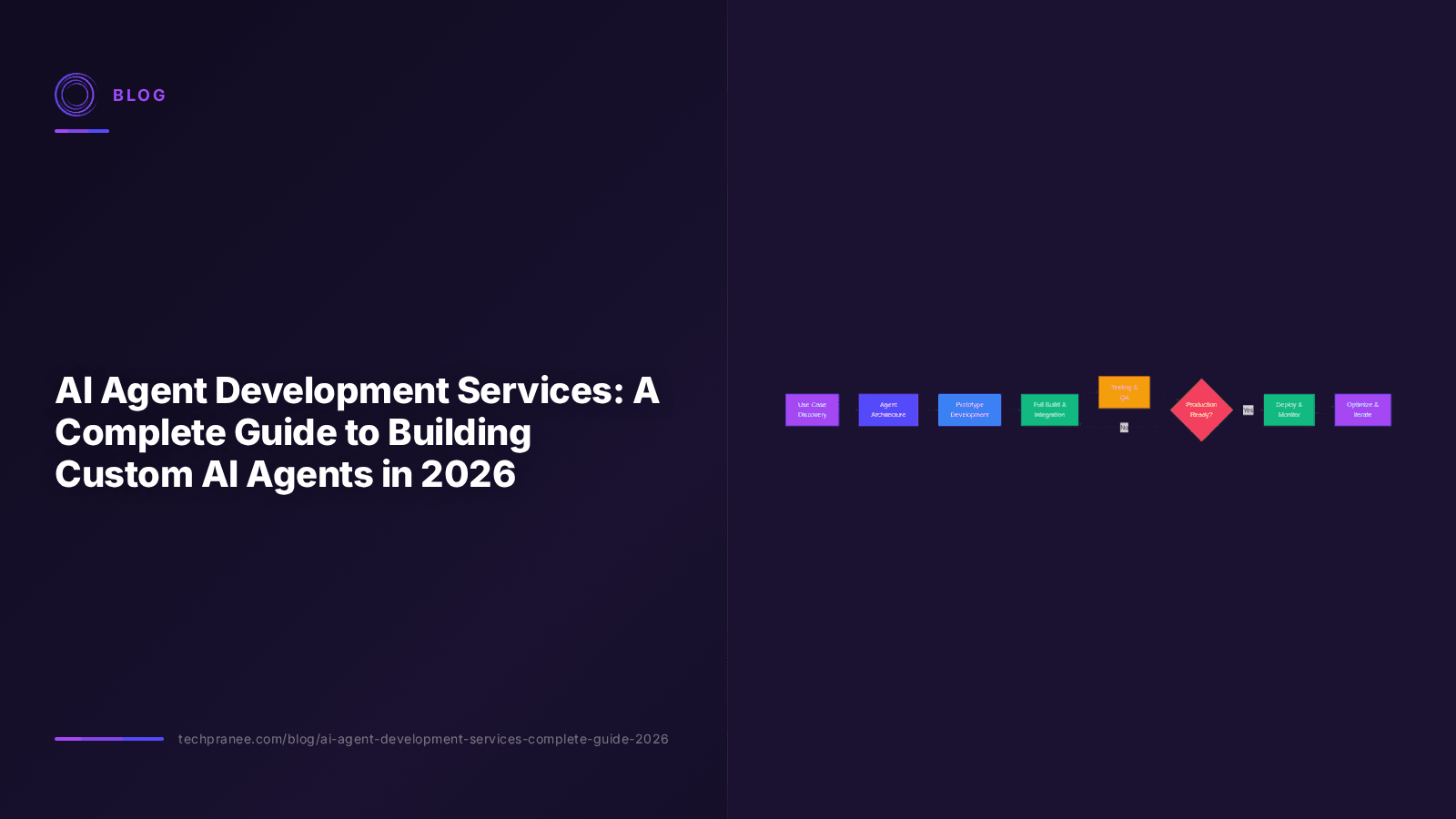
A professional AI agent development service follows a structured methodology. Here's what the process looks like from engagement to deployment:
Step 1: Use Case Discovery and Feasibility Assessment
The development team works with your stakeholders to identify the highest-impact use case for an AI agent. This involves mapping current workflows, identifying bottlenecks, and assessing whether an AI agent is the right solution (vs. traditional automation or workflow automation). The output is a feasibility document with ROI projections.
Step 2: Agent Architecture and Design
Based on the use case, the team designs the agent's architecture — selecting the reasoning framework (ReAct, Plan-and-Execute, Tree of Thoughts), defining the tool set, designing the memory system, and establishing guardrails. This phase produces technical specs and interaction diagrams.
Step 3: Prototype Development
A working prototype is built using established frameworks like LangChain, CrewAI, or Microsoft AutoGen. The prototype demonstrates core functionality — the agent can perform its primary task, interact with one or two tools, and handle basic edge cases. This is where you validate the approach before investing in full development.
Step 4: Full Development and Integration
The agent is built out with all planned tools, integrations, and safety mechanisms. This phase includes:
- Connecting to your internal systems (CRM, ERP, databases, internal APIs)
- Implementing the full reasoning pipeline with error handling and retries
- Building the memory system (vector database for long-term memory, context management for conversations)
- Adding guardrails: input validation, output filtering, rate limiting, human-in-the-loop approval for sensitive actions
- Performance optimization: prompt engineering, context window management, caching strategies
Step 5: Testing and Quality Assurance
AI agents require specialized testing beyond traditional software QA:
- Functional testing — Does the agent complete its task correctly across various inputs?
- Edge case testing — How does the agent handle ambiguous, malformed, or adversarial inputs?
- Integration testing — Do all tool connections work reliably under load?
- Safety testing — Can the agent be prompt-injected? Does it stay within defined boundaries?
- Performance testing — Response latency, token consumption, and cost per interaction
Step 6: Deployment and Production Setup
The agent is deployed to production infrastructure — typically containerized (Docker) on cloud platforms (AWS, GCP, Azure) with:
# Example deployment architecture
Agent API (FastAPI) → LLM Provider (OpenAI/Anthropic)
                   → Vector DB (Pinecone/Weaviate)
                   → Tool APIs (CRM, Email, Slack)
                   → Monitoring (LangSmith/Prometheus)
                   → Guardrails (NeMo Guardrails/Presidio)
Step 7: Monitoring, Optimization, and Iteration
Post-launch, the development service includes ongoing monitoring and optimization. This tracks agent performance metrics (task success rate, average steps to completion, cost per task), identifies failure patterns, and iterates on prompts, tools, and guardrails to improve performance over time.
AI Agent Development Services: Cost Breakdown
Understanding the cost of AI agent development services is critical for budgeting and ROI assessment. Costs vary significantly based on agent complexity, integration depth, and the development partner's expertise. Here's a detailed breakdown:
| Agent Complexity | Typical Cost Range | Development Time | Best For |
|---|---|---|---|
| Single-Task Agent | $15,000 – $35,000 | 4-8 weeks | One focused workflow, 1-2 integrations |
| Multi-Tool Agent | $35,000 – $80,000 | 8-16 weeks | Multiple integrations, branching logic, medium complexity |
| Multi-Agent System | $80,000 – $150,000 | 16-24 weeks | Collaborative agents, enterprise integrations, custom training |
| Enterprise Autonomous System | $150,000 – $300,000+ | 24-40 weeks | Full process automation, compliance requirements, multi-region deployment |
What Drives Cost?
Several factors influence the total cost of AI agent development services:
- Number of integrations — Each API connection (CRM, ERP, email, calendar) adds development and testing time
- Reasoning complexity — Simple task execution vs. multi-step planning with branching logic
- Custom model fine-tuning — Using off-the-shelf LLMs vs. fine-tuning a domain-specific model
- Compliance and security requirements — HIPAA, SOC 2, GDPR compliance adds 20-40% to development cost
- Deployment infrastructure — Cloud hosting, vector database costs, LLM API usage (ongoing operational cost)
- Post-launch support — Monitoring, optimization, and maintenance (typically 15-25% of development cost annually)
"The businesses seeing the highest ROI from AI agents aren't those building the most complex agents — they're those starting with a focused, high-frequency workflow and expanding incrementally. A $25,000 email-triage agent that saves 200 hours/month often outperforms a $150,000 system that tries to do everything at once." — BCG AI Strategy Practice, 2025
How to Choose an AI Agent Development Service Provider
Selecting the right AI agent development partner is arguably more important than the technology choices themselves. A misaligned partner can waste months of development time and hundreds of thousands of dollars. Here's a framework for evaluating providers:
Evaluation Checklist
- ✓ Framework expertise — Can they demonstrate production work in LangChain, CrewAI, AutoGen, or LlamaIndex (not just tutorials)?
- ✓ Production deployments — Do they have live AI agents in production with measurable business outcomes?
- ✓ Domain experience — Have they built agents in your industry (healthcare, finance, e-commerce, manufacturing)?
- ✓ Full-stack capability — Can they handle both the AI layer AND the integration/deployment infrastructure?
- ✓ Safety and compliance — Do they build guardrails, human-in-the-loop, and audit trails by default?
- ✓ Transparent pricing — Do they offer fixed-scope pricing or clear T&M estimates with milestone-based billing?
- ✓ Post-launch support — What's included after deployment? Monitoring, optimization, SLA response times?
- ✓ IP ownership — Do you own the agent code, prompts, and fine-tuned models, or is it locked to their platform?
Red Flags to Watch For
Be cautious of providers who:
- Promise unrealistic timelines (full agent in under 4 weeks for complex use cases)
- Can't show production examples — only demos and prototypes
- Lock you into their proprietary platform with no path to self-hosting
- Don't discuss guardrails, safety, or failure modes proactively
- Quote prices without understanding your integrations and compliance needs
AI Agent Development Frameworks: What Your Provider Should Know
The framework landscape for AI agent development is evolving rapidly. A competent AI agent development service should have hands-on experience with the leading frameworks:
| Framework | Best For | Strengths | Maturity |
|---|---|---|---|
| LangChain / LangGraph | Complex reasoning pipelines | Large ecosystem, extensive tool integrations, graph-based agent workflows | Production-ready |
| CrewAI | Multi-agent collaboration | Role-based agent design, simple syntax, good for team-like workflows | Maturing |
| Microsoft AutoGen | Enterprise multi-agent systems | Microsoft ecosystem integration, strong code execution capabilities | Production-ready |
| LlamaIndex | RAG-heavy agents | Best-in-class data ingestion and retrieval, strong for knowledge-based agents | Production-ready |
| OpenAI Agents SDK | OpenAI-native agents | Tight integration with GPT models, simpler for OpenAI-centric stacks | New but backed |
Your development partner should recommend the right framework based on your use case — not default to whichever they're most comfortable with. The framework choice impacts long-term maintainability, cost, and flexibility.
Real-World AI Agent Use Cases and Results
Case Study: HyreFast — Recruitment Agent Automation
HyreFast deployed a multi-agent system for recruitment automation, combining a candidate research agent, an outreach agent, and a pipeline management agent. The system automated 70% of recruiter touchpoints, reducing time-to-first-contact from 48 hours to under 2 hours. The development investment was recovered within 4 months of deployment.
Case Study: Enterprise Invoice Processing
A mid-market manufacturing company deployed an autonomous invoice processing agent that extracted data from invoices, validated against PO records, flagged discrepancies, and entered approved invoices into their ERP. The agent reduced processing time from 12 minutes per invoice to 45 seconds, with 98.7% accuracy — compared to the 94% accuracy of the previous manual process.
Industry-Specific Agent Applications
- Healthcare — Patient intake agents that collect symptoms, verify insurance, and schedule appointments (AI healthcare consulting)
- Manufacturing — Predictive maintenance agents that monitor sensor data and schedule maintenance autonomously (AI for manufacturing)
- E-commerce — Product recommendation and order management agents that handle the full post-purchase journey
- Professional Services — Document analysis and contract review agents that flag risk clauses and suggest revisions (AI consulting for professional services)
Build vs. Buy: Should You Develop Custom AI Agents or Use Platforms?
One of the most common questions businesses ask is whether to use a no-code/low-code AI agent platform or invest in custom AI agent development services. The answer depends on your specific situation:
| Factor | Platform (No-Code) | Custom Development |
|---|---|---|
| Time to Launch | Days to weeks | 4-24 weeks |
| Initial Cost | $50-$500/month | $15,000-$300,000 |
| Customization | Limited to platform capabilities | Unlimited |
| Integration Depth | Pre-built connectors only | Any API or system |
| IP Ownership | Platform owns the agent | You own everything |
| Scalability | Platform-dependent | Full control |
| Compliance | Platform's compliance posture | Customizable to your requirements |
| Best For | Simple, standard workflows | Complex, proprietary, or regulated workflows |
The recommended approach: start with a platform to validate your use case quickly, then migrate to custom development once you've proven the ROI and identified the limitations you need to overcome.
Practical Action Items: Getting Started with AI Agent Development
Ready to explore AI agent development services for your business? Here are concrete next steps:
- Audit your workflows — Identify 3-5 repetitive, rule-based processes that consume significant human hours. Look for tasks with clear inputs, defined outputs, and measurable outcomes.
- Calculate potential ROI — For each candidate workflow, estimate hours saved monthly, error reduction value, and speed improvement. Target workflows where an agent could save 100+ hours/month.
- Define success metrics — Before engaging a developer, know what "success" looks like: task completion rate, accuracy threshold, cost per task, time savings.
- Request scoped proposals — Engage 2-3 AI agent development service providers with a clear use case brief. Compare their proposed architecture, timeline, cost, and post-launch support.
- Start with a pilot — Begin with a single, focused agent (not a multi-agent system). Validate the approach, measure results, then expand. Connect with our AI agent development team to scope your pilot.
Frequently Asked Questions
What is the difference between an AI chatbot and an AI agent?
An AI chatbot responds to user messages within a conversation — it's reactive. An AI agent proactively takes actions to achieve goals: it can call APIs, update databases, send emails, make decisions, and execute multi-step workflows autonomously. Chatbots answer questions; agents complete tasks.
How long does it take to develop a custom AI agent?
Development timelines range from 4 weeks for a simple single-task agent to 6+ months for complex multi-agent enterprise systems. Most business-use agents take 8-16 weeks from discovery to production deployment.
How much do AI agent development services cost?
Costs range from $15,000 for a focused single-task agent to $300,000+ for enterprise multi-agent systems. The median investment for a mid-market business agent with 3-5 integrations is typically $40,000-$80,000. See our AI agent development cost guide for detailed pricing.
Do I need to fine-tune my own AI model for a custom agent?
In most cases, no. Modern LLMs (GPT-4, Claude 3.5, Llama 3) are capable enough for the majority of agent use cases with good prompt engineering and retrieval-augmented generation (RAG). Fine-tuning is recommended when you need domain-specific language, specialized reasoning, or when you want to reduce API costs for high-volume tasks.
Can AI agents work with my existing CRM and ERP systems?
Yes. AI agent development services include API integration with your existing systems. Most modern CRMs (Salesforce, HubSpot), ERPs (SAP, Oracle), and business tools (Slack, Gmail, Jira) have APIs that agents can interact with. The development team handles authentication, rate limiting, and error handling for each integration.
What happens if an AI agent makes a mistake?
Professional AI agent development includes guardrails and human-in-the-loop checkpoints for sensitive actions. Agents can be configured to pause and request human approval before executing irreversible actions (sending payments, modifying records, sending external communications). Additionally, audit logs track every action the agent takes, enabling quick identification and correction of errors.
How do I ensure my AI agent is secure and compliant?
Reputable AI agent development services build security into the architecture: encrypted data transmission, PII detection and redaction, role-based access control, audit trails, and compliance with relevant regulations (GDPR, HIPAA, SOC 2). Discuss your compliance requirements upfront — they impact both architecture and cost.
Conclusion
AI agent development services represent a fundamental shift in how businesses automate work. Unlike traditional automation that follows rigid scripts, AI agents can reason, adapt, and handle the edge cases that make real-world workflows messy. The key to success is starting focused — identify one high-impact workflow, build a pilot agent, measure results, and expand from there.
The market is moving fast. Gartner predicts that by 2028, a third of enterprise software will include agentic AI. Businesses that start building AI agent capabilities now will have a significant advantage — not just in cost savings, but in the organizational learning and infrastructure that compounds over time. If you're ready to explore what a custom AI agent could do for your business, talk to our team about scoping a pilot project.