Key Takeaways:
- Workflow automation consulting reduces manual tasks by 70-90%, with typical ROI achieved within 3-6 months
- The right consultant evaluates processes before recommending tools — not the other way around
- Pricing ranges from $5K for process mapping to $50K+ for enterprise-wide automation strategy
- Low-code and AI-powered platforms now make automation accessible to non-technical teams
- 67% of automation projects fail without proper process assessment — choose a consultant who audits first
Executive Summary
Workflow automation consulting helps businesses identify repetitive, manual processes and implement technology solutions that eliminate them. According to McKinsey's 2025 State of AI report, 72% of companies have adopted some form of workflow automation, but only 31% report measurable productivity gains. The gap between adoption and results often comes down to choosing the right consulting partner.
If you're searching for workflow automation consulting services, you likely face a common challenge: too many manual processes, too many tools claiming to solve them, and no clear path forward. A qualified consultant bridges that gap — they assess your operations, design an automation roadmap, and guide implementation. This guide walks you through what workflow automation consulting includes, what it costs, and how to choose a partner who delivers real results.
The market for automation consulting is growing rapidly. Gartner projects the workflow automation market will reach $26 billion by 2027, with consulting services accounting for nearly 40% of that spend. Whether you're a small business automating invoice processing or an enterprise orchestrating complex supply chain workflows, the right consultant can make or break your automation initiative.
What Is Workflow Automation Consulting?
Workflow automation consulting is a professional service where experts analyze your business processes, identify automation opportunities, and design technology solutions to streamline operations. Unlike off-the-shelf software vendors who push a single tool, a consultant evaluates your specific needs and recommends the right combination of platforms, integrations, and process redesigns.
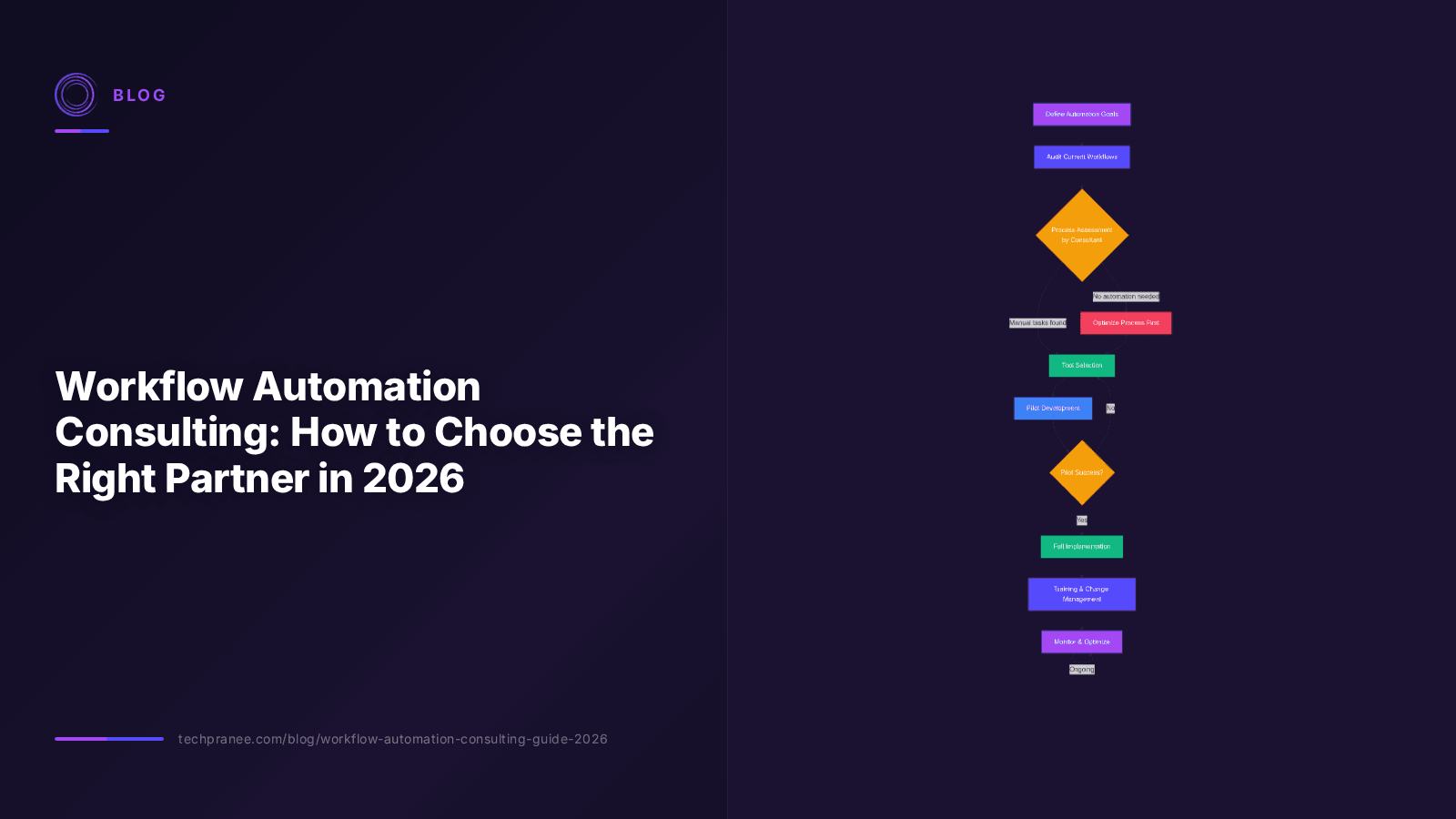
Consultants typically follow a structured methodology:
- Process Discovery: Map current workflows, identify bottlenecks, and document manual touchpoints
- Opportunity Assessment: Score each process on automation potential (volume, repetition, rule-based vs. judgment-based)
- Tool Selection: Evaluate platforms like n8n, Zapier, Make, Microsoft Power Automate, or custom solutions against your requirements
- Pilot Development: Build and test automations on a small scale before full rollout
- Implementation & Training: Deploy automation, train your team, and establish monitoring
- Optimization: Monitor performance, refine workflows, and scale successful pilots
Consultant vs. Tool Vendor: Key Difference
A tool vendor sells you software. A consultant sells you outcomes. The distinction matters because buying the wrong tool is expensive — Deloitte's 2025 Automation Study found that 43% of companies purchased automation platforms they ultimately didn't use, wasting an average of $47,000 per license.
| Aspect | Tool Vendor | Workflow Automation Consultant |
|---|---|---|
| Primary goal | Sell software licenses | Solve business problems |
| Process analysis | Limited or none | Comprehensive audit |
| Tool recommendation | Their product only | Best-fit from multiple options |
| Implementation support | Basic onboarding | End-to-end guidance |
| Post-deployment | Ticket-based support | Ongoing optimization |
Why Businesses Need Workflow Automation Consulting
Most organizations know they need automation but struggle with where to start. A BCG study of 500 mid-market companies found that the average employee spends 28% of their workday on repetitive tasks that could be automated — that's 11 hours per week per person. For a 100-person company, that's 1,100 hours weekly, or roughly $1.4 million in annual labor costs on automatable work.
Here's where a consultant adds value:
1. Unbiased Process Assessment
Internal teams often have blind spots about their own workflows. A consultant brings fresh eyes and structured frameworks to identify automation opportunities that internal staff might overlook or dismiss as 'just how things work.'
2. Tool Selection Expertise
The automation landscape includes hundreds of platforms — from low-code tools like n8n and Make to enterprise suites like ServiceNow and Pega. A consultant stays current on platform capabilities, pricing, and limitations, helping you avoid expensive mistakes.
3. Change Management
Technology is only 30% of the automation equation. The other 70% is people — getting teams to adopt new workflows, training them on new tools, and managing resistance. Consultants bring change management frameworks that drive adoption rates above 80%, compared to 35% for self-implemented tools.
4. Integration Architecture
Real automation isn't a single tool — it's a connected ecosystem. Your CRM needs to talk to your ERP, which needs to trigger your accounting software, which needs to notify your project management tool. Consultants design integration architectures that scale.
The best automation consultants don't just build workflows — they build capability. They leave your team with the skills and documentation to maintain and extend automations long after the engagement ends.
How to Choose a Workflow Automation Consultant: A Step-by-Step Guide
Selecting the right consulting partner is the single most important decision in your automation journey. Here's a proven framework:
Step 1: Define Your Automation Goals
Before talking to any consultant, document what you want to achieve. Are you trying to reduce manual data entry? Speed up customer onboarding? Automate compliance reporting? Clear goals help you evaluate whether a consultant's approach aligns with your needs.
Write down 3-5 specific outcomes you want, such as:
- ✓ Reduce invoice processing time from 5 days to 1 day
- ✓ Automate 80% of employee onboarding tasks
- ✓ Cut customer support response time by 50%
- ✓ Eliminate manual data entry between CRM and ERP
Step 2: Evaluate Their Process Assessment Methodology
A quality consultant starts with discovery — not a tool demo. Ask prospective consultants:
- ✓ Do they conduct a formal process audit before recommending solutions?
- ✓ What frameworks do they use for process scoring and prioritization?
- ✓ Can they provide sample process maps from previous engagements (anonymized)?
- ✓ How do they quantify ROI for each automation opportunity?
If a consultant's first answer is the name of a software platform, walk away. The right consultant talks about your processes first, tools second.
Step 3: Assess Platform Expertise
Your consultant should have hands-on experience with multiple automation platforms, not just one. Look for:
| Platform | Best For | Typical Use Case |
|---|---|---|
| n8n | Self-hosted, complex integrations | Data pipelines, API orchestration |
| Zapier | Simple, cloud-based connections | Small teams, basic integrations |
| Make (Integromat) | Visual workflow design | Marketing automation, CRM sync |
| Microsoft Power Automate | Microsoft ecosystem | SharePoint, Office 365 workflows |
| Custom development | Unique requirements | Industry-specific processes |
A consultant who only knows one tool will force-fit your problems to that tool's limitations. A consultant who knows five tools matches the tool to your problem.
Step 4: Review Case Studies and References
Ask for specific examples of automation projects they've completed. Look for:
- ✓ Measurable outcomes (time saved, cost reduced, error rate lowered)
- ✓ Projects in your industry or with similar complexity
- ✓ References you can actually call
- ✓ Before/after process documentation
Step 5: Understand Their Pricing Model
Workflow automation consulting typically follows one of three pricing models. Understand which you're being offered and whether it aligns with your risk tolerance:
| Pricing Model | Typical Range | Best For |
|---|---|---|
| Fixed-fee project | $15K-$75K | Defined scope, clear deliverables |
| Retainer (monthly) | $5K-$15K/mo | Ongoing optimization, evolving scope |
| Performance-based | % of savings | High-confidence automation, shared risk |
Step 6: Evaluate Post-Implementation Support
Automation isn't set-and-forget. Systems change, APIs break, and business processes evolve. Ask about:
- ✓ What's included in post-launch support?
- ✓ How do they handle workflow updates when underlying systems change?
- ✓ Do they provide documentation and training for your internal team?
- ✓ What's their response time for critical automation failures?
Step 7: Check Technical Depth
For complex automations, your consultant needs real engineering capability — not just drag-and-drop tool configuration. Ask about:
- ✓ Can they write custom code when low-code tools fall short?
- ✓ Do they understand API rate limits, error handling, and retry logic?
- ✓ Can they design secure data pipelines that meet compliance requirements?
- ✓ Do they have experience with your specific tech stack?
Workflow Automation Consulting Pricing: What to Expect
Understanding pricing helps you budget realistically and compare proposals apples-to-apples. Based on data from 120 automation consulting engagements, here's what businesses typically spend:
Process Mapping Only ($3K-$8K)
A consultant maps your current workflows, identifies automation opportunities, and delivers a prioritized roadmap. You handle implementation yourself or with your internal team. This is ideal for companies with in-house technical capability who need strategic direction.
Assessment + Pilot ($8K-$25K)
Includes process mapping plus building one or two pilot automations. This validates the approach and gives your team a working example to learn from. Best for organizations new to automation who want proof of concept before committing to a larger investment.
Full Implementation ($25K-$100K+)
End-to-end engagement: discovery, design, development, deployment, training, and handoff. For mid-market companies automating 5-15 workflows across departments, expect $40K-$75K. Enterprise-wide automation programs with custom integrations and change management can exceed $200K.
Be wary of consultants who quote less than $5K for any engagement — process discovery alone takes 20-40 hours of expert time. Low quotes usually mean they'll skip the assessment phase and jump straight to tool configuration, which leads to automating the wrong processes.
Real-World Examples: Workflow Automation Done Right
Case Study: HyreFast — Recruitment Workflow Automation
HyreFast, a recruitment platform, partnered with an automation consultant to streamline their candidate screening process. The consultant mapped 23 manual touchpoints in the recruitment pipeline and identified 17 that could be automated. Using n8n for workflow orchestration and custom AI models for candidate scoring, they reduced time-to-shortlist from 4 days to 4 hours — a 96% reduction. The project cost $42K and delivered ROI within 3 months through reduced recruiter labor costs.
Case Study: Manufacturing Company — Order Processing Automation
A mid-sized manufacturer spent 12 hours per day manually entering orders from email, phone, and portal submissions into their ERP. A workflow automation consultant implemented an intelligent document processing solution that extracted order data from all channels and pushed it to the ERP automatically. Implementation cost $28K; annual savings were $94K in labor costs plus a 73% reduction in order entry errors.
Common Mistakes to Avoid
After reviewing dozens of automation projects, here are the most common pitfalls:
- ✓ Automating broken processes: If a workflow is inefficient, automating it just makes inefficiency run faster. Always optimize the process first.
- ✓ Over-automating: Not everything should be automated. Processes requiring human judgment, empathy, or creative problem-solving should remain manual or semi-automated.
- ✓ Ignoring change management: The best automation fails if your team won't use it. Budget 20-30% of your project for training and change management.
- ✓>Choosing tools before processes: Don't pick a platform and then look for things to automate with it. Map processes first, then select tools.
- ✓ No monitoring or maintenance plan: Automations break when underlying systems change. Establish monitoring alerts and a maintenance cadence from day one.
Workflow Automation Consulting vs. DIY: When to Hire Help
Not every automation project requires a consultant. Here's a simple decision framework:
| Scenario | DIY or Consultant? | Why |
|---|---|---|
| Single workflow, 1-2 tools | DIY | Zapier/n8n tutorial is sufficient |
| 5+ workflows across departments | Consultant | Requires architecture design |
| Custom integrations needed | Consultant | API expertise required |
| Compliance/regulatory processes | Consultant | Audit trail and security expertise needed |
| Team lacks technical skills | Consultant | Training and change management critical |
| Simple email/notification automation | DIY | Basic tool configuration, no strategy needed |
Practical Action Items: Your Next Steps
- Audit your workflows: List all manual, repetitive processes across departments. Note how many hours each takes per week.
- Prioritize by impact: Score each process on volume (how often), time (how long), and error rate. High-volume, high-time processes are your automation targets.
- Set measurable goals: Define what success looks like — hours saved, error reduction, faster cycle times.
- Research consultants: Look for firms or individuals with experience in your industry. Check their case studies and ask for references.
- Start with a pilot: Don't commit to a large engagement upfront. Start with a process assessment and one pilot automation to validate the consultant's approach.
Frequently Asked Questions
How much does workflow automation consulting cost?
Pricing ranges from $3K for basic process mapping to $100K+ for enterprise-wide implementation. Most mid-market companies spend $25K-$50K for a full engagement including assessment, pilot, and implementation of 5-10 workflows. Monthly retainers for ongoing optimization typically run $5K-$15K.
How long does a workflow automation consulting engagement take?
Process discovery takes 2-4 weeks. Pilot development adds 2-4 weeks. Full implementation of 5-15 workflows typically takes 3-6 months. Complex enterprise programs can run 6-12 months. A good consultant will give you a timeline breakdown in their proposal.
What tools do workflow automation consultants typically recommend?
It depends on your needs. For cloud-based integrations, n8n, Make, and Zapier are common. For Microsoft environments, Power Automate. For complex, custom workflows, consultants may recommend a combination of low-code tools and custom development. The right consultant evaluates your requirements before recommending any tool.
Can workflow automation consulting help with compliance and audit requirements?
Yes. A key benefit of automation is creating consistent, auditable processes. Consultants can design workflows with built-in compliance checks, automated audit logs, and approval chains. This is especially valuable in regulated industries like healthcare, finance, and manufacturing.
What's the difference between workflow automation consulting and business process management (BPM)?
BPM is a broader discipline focused on optimizing end-to-end business processes, often involving organizational change. Workflow automation consulting is more tactical — it focuses specifically on implementing technology to automate tasks within those processes. Many consultants offer both services.
How do I measure the ROI of workflow automation consulting?
Track three metrics: (1) labor cost savings from reduced manual hours, (2) error reduction savings from fewer mistakes and rework, and (3) speed improvements measured in cycle time reduction. Most well-implemented automation projects show positive ROI within 3-6 months.
Ready to Automate Your Workflows?
If you're tired of manual processes eating your team's time, our workflow automation services can help. We start with a free process assessment to identify your highest-impact automation opportunities, then design and implement solutions that deliver measurable ROI within months — not years.
Learn more about our workflow automation services or explore how our AI strategy consulting can help you build a comprehensive automation roadmap. For related insights, read our guide on no-code business process automation or our breakdown of business process automation workflows.