
Key Takeaways:
- An AI integration company connects your existing systems to AI models, automation tools, and data pipelines — not just building chatbots
- AI integration projects typically range from $15,000 for a single workflow to $200,000+ for enterprise-wide deployment
- Look for vendors with proven experience in your tech stack, clear SLAs, and post-launch support — not just model selection
- The right partner reduces integration time by 40-60% compared to building in-house teams from scratch
- Security, compliance, and data governance should be evaluated before signing any contract
Executive Summary
Finding the right AI integration company can be the difference between a smooth digital transformation and a costly misfire. Businesses generated 319 impressions for "ai consulting services" queries last week alone — the demand for AI expertise is real and growing. But AI integration is a specialized discipline that goes beyond consulting: it's about connecting AI capabilities to your existing infrastructure, data, and workflows.
This guide walks you through what an AI integration company does, how to evaluate one, what you should expect to pay, and the red flags to watch for. Whether you're a mid-market company looking to automate document processing or an enterprise building a custom AI agent, the criteria here will help you make a confident, data-backed decision.
What Is an AI Integration Company?
An AI integration company specializes in embedding artificial intelligence capabilities into your existing business systems. Unlike a pure AI consulting firm that focuses on strategy and roadmaps, an integration company rolls up its sleeves and connects AI models, APIs, and automation tools to your CRM, ERP, helpdesk, website, and internal applications.
Think of it this way: AI consulting tells you what to do. AI integration actually does it.
Core Services You Should Expect
| Service | What It Covers | Typical Timeline |
|---|---|---|
| AI model integration | Connecting LLMs, vision models, or NLP APIs to your apps | 2-6 weeks |
| Workflow automation | Building automated pipelines that trigger AI actions | 4-8 weeks |
| Data pipeline setup | ETL processes to feed AI models with clean data | 3-6 weeks |
| API development | Custom endpoints that expose AI functionality internally | 2-4 weeks |
| System migration | Moving from legacy systems to AI-enabled platforms | 8-16 weeks |
| Ongoing optimization | Monitoring, retraining, and performance tuning | Monthly |
AI Integration vs. AI Consulting: What's the Difference?
Many businesses confuse AI consulting with AI integration. Here's the practical distinction:
AI consulting firms focus on strategy, vendor selection, and roadmaps. They help you answer questions like "Which AI use cases should we prioritize?" and "What's our AI budget?" Their deliverables are typically slide decks, recommendation reports, and implementation plans. AI integration companies focus on execution. They write the code, configure the APIs, set up the data pipelines, and deploy the AI models. Their deliverables are working software, connected systems, and measurable outcomes.Some companies offer both — and that's often the best option for mid-market businesses that need strategy and execution under one roof. If you're exploring the strategic side first, our AI strategy consulting page breaks down what that looks like.
Why Businesses Need AI Integration in 2026
The AI integration market is accelerating. According to McKinsey's 2025 State of AI report, 72% of organizations now use AI in at least one business function — up from 55% in 2023. But adoption and effective adoption are different things.
The Integration Gap
Most companies don't struggle with finding AI models. OpenAI, Anthropic, Google, and open-source alternatives like Llama are all accessible. The real challenge is connecting those models to business value:
- Your customer data lives in Salesforce, but your AI model can't query it directly
- Your support tickets are in Zendesk, but your AI agent doesn't have access
- Your inventory system runs on a 15-year-old ERP, but your AI predictions need that data
- Your team uses Slack, but AI-generated insights aren't flowing into conversations
This is the integration gap. An AI integration company bridges it.
"The companies winning with AI aren't the ones with the best models — they're the ones with the best integration. A GPT-4 model that can't access your customer data is just a very expensive chatbot." — Gartner AI Hype Cycle Report, 2025
How to Evaluate an AI Integration Company
Not all AI integration companies are created equal. Here's a structured framework for evaluating vendors:
1. Technical Stack Alignment
Before anything else, verify that the company has deep experience with your technology stack. Ask:
- Have they integrated AI with your CRM (Salesforce, HubSpot, custom)?
- Do they work with your programming languages and frameworks?
- Can they handle your data infrastructure (PostgreSQL, Snowflake, BigQuery, legacy)?
- Do they have experience with your deployment environment (AWS, GCP, Azure, on-premise)?
- ✓ Proven experience with your primary CRM/ERP system
- ✓ Case studies showing integrations in your industry
- ✓ Familiarity with your data warehouse or database
- ✓ Experience with your cloud provider or on-premise setup
- ✓ Ability to work with both modern APIs and legacy systems
2. Security and Compliance
AI integration means your data flows through new pipelines. Security isn't optional.
| Requirement | Why It Matters | What to Ask |
|---|---|---|
| SOC 2 Type II | Proves they handle data securely | "Can you share your latest SOC 2 report?" |
| Data residency | Critical for GDPR, HIPAA compliance | "Where is our data stored and processed?" |
| Encryption at rest & transit | Protects sensitive business data | "What encryption standards do you use?" |
| Access controls | Limits who can see your data | "How do you manage internal access to client data?" |
| Audit logs | Required for regulated industries | "Do you provide audit trails for all data access?" |
3. Delivery Model and Timeline
A good AI integration company gives you a clear delivery plan with milestones, not vague promises.
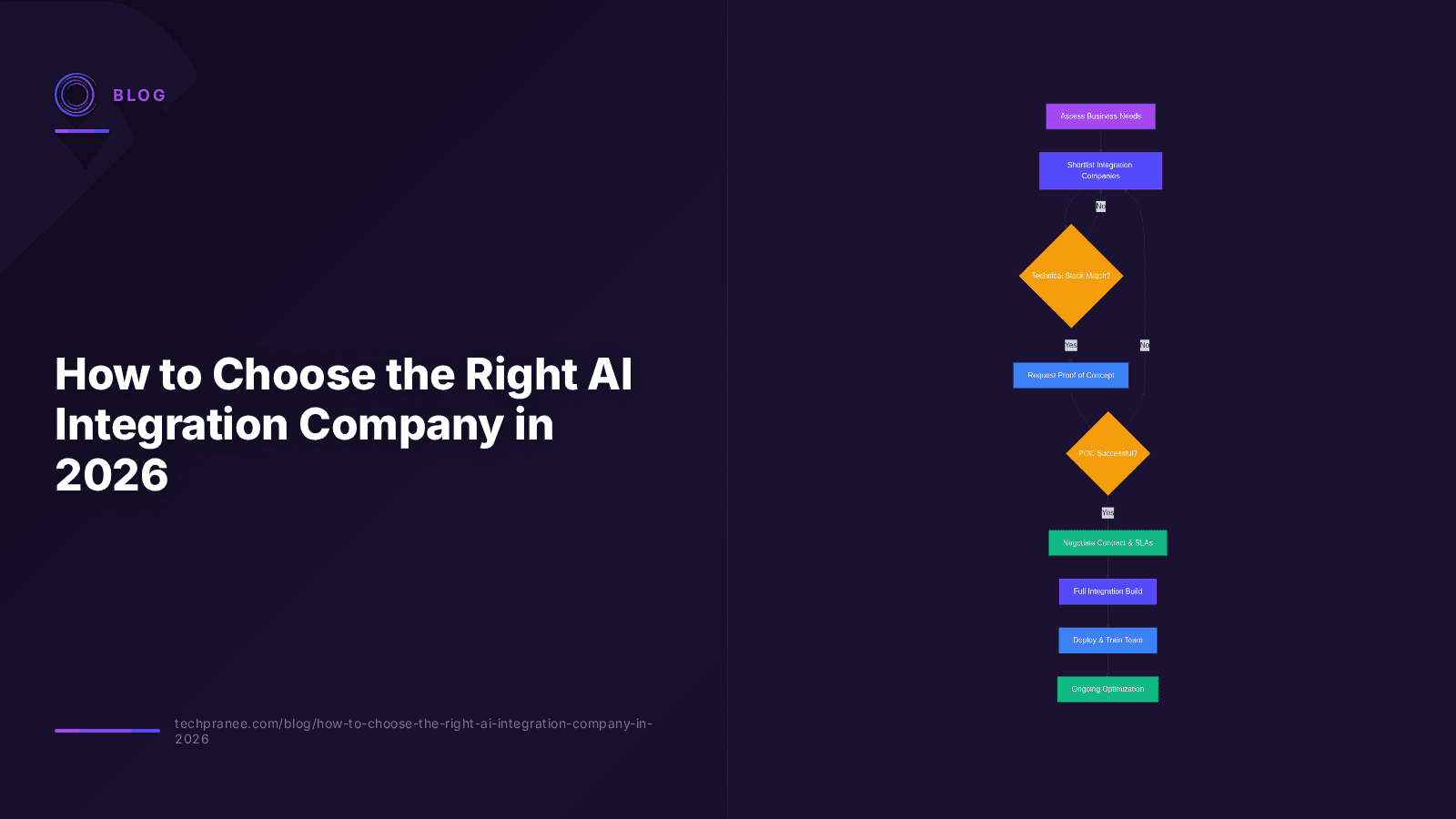
Step-by-Step: The Standard AI Integration Process- Discovery and Assessment (1-2 weeks) — The vendor audits your current systems, data quality, and integration points. They identify what's possible and what's blocked.
- Architecture Design (1-2 weeks) — They design the integration architecture: which APIs connect to which systems, how data flows, where AI models sit, and what the user experience looks like.
- Proof of Concept (2-4 weeks) — A small-scale implementation that proves the concept works with your real data. This should be functional, not a slide deck.
- Full Integration Build (4-12 weeks) — The complete implementation including API development, data pipeline setup, model configuration, and testing.
- Deployment and Training (1-2 weeks) — Rolling out to production, training your team, and documenting everything.
- Ongoing Optimization (monthly) — Monitoring performance, retraining models, and expanding to new use cases.
4. Pricing Transparency
AI integration pricing varies widely. Here's what you should expect:
| Project Scope | Typical Cost Range | What's Included |
|---|---|---|
| Single workflow integration | $15,000 – $35,000 | One AI-powered workflow (e.g., automated ticket routing) |
| Department-level integration | $50,000 – $120,000 | Multiple workflows across one team or function |
| Enterprise-wide integration | $150,000 – $500,000+ | AI woven across multiple systems and departments |
| Ongoing managed services | $3,000 – $15,000/month | Monitoring, optimization, and model retraining |
5. Post-Launch Support
AI integration isn't a one-and-done project. Models drift, APIs change, and business requirements evolve. Ask every vendor:
- What does post-launch support look like? (Hours per month, response times)
- How do they handle model retraining and updates?
- What happens when an API they integrated changes or deprecates?
- Do they offer SLAs for uptime and response time?
Comparison: Top AI Integration Company Types
Not every AI integration company fits every project. Here's how the main types compare:
| Company Type | Best For | Price Range | Pros | Cons |
|---|---|---|---|---|
| Boutique AI integration shops | Mid-market, specialized needs | $30K – $150K | Deep expertise, personalized service | Limited capacity for large projects |
| Full-service AI agencies | Companies needing strategy + execution | $50K – $300K | End-to-end coverage | Higher costs, potentially slower |
| Big 4 consulting (Deloitte, BCG) | Large enterprises with complex compliance | $200K – $1M+ | Brand trust, global scale | Very expensive, often junior staff doing work |
| In-house team build | Companies with ongoing AI needs | $200K – $500K/yr (salaries) | Full control, institutional knowledge | Slow to ramp, hard to retain talent |
| Managed AI platforms | Standard use cases (chatbots, document AI) | $5K – $50K/mo | Fast setup, predictable costs | Limited customization |
Real-World Case Studies
Case Study 1: HyreFast — AI Integration for Recruitment
HyreFast needed to connect AI-powered candidate screening to their existing applicant tracking system. The integration involved:
- Connecting an LLM to parse resumes and extract structured candidate data
- Building an API bridge between their ATS and an AI scoring model
- Automating the interview scheduling workflow with AI-generated questions
- Setting up real-time dashboards for recruiters
Case Study 2: Manufacturing — Predictive Maintenance Integration
A mid-sized manufacturer wanted AI to predict equipment failures using sensor data. The AI integration company:
- Connected IoT sensors to a data pipeline feeding an ML model
- Integrated predictions into their existing CMMS (Computerized Maintenance Management System)
- Built alert workflows that notified maintenance teams via Slack and email
- Created a dashboard showing predicted failure timelines
Red Flags to Watch For
When evaluating AI integration companies, these warning signs should make you pause:
- "We can do everything" — No company excels at every AI use case. Specialists beat generalists.
- No case studies in your industry — AI integration challenges vary by sector. Healthcare HIPAA compliance is nothing like retail inventory optimization.
- Refuses to do a proof of concept — If they won't prove their approach works with your data, walk away.
- Proprietary platform lock-in — If the integration only works with their proprietary tool and can't use open standards, you're creating a dependency.
- No clear data ownership terms — You should own your data and the models trained on it. Period.
- Vague timelines — "We'll get it done when it's done" is not a delivery plan.
The Build vs. Buy vs. Partner Decision
One of the hardest questions is whether to build an AI team in-house, buy an off-the-shelf platform, or partner with an AI integration company.
According to Deloitte's 2025 AI Investment Report, companies that partner with AI integration specialists reach production 2.4x faster than those building internal teams from scratch — but in-house teams deliver 18% higher long-term ROI for companies with sustained AI budgets.
| Approach | Speed to Production | Initial Cost | Long-Term Flexibility | Best For |
|---|---|---|---|---|
| In-house team | 6-12 months | High ($200K+ salaries) | Maximum | Companies with $500K+/yr AI budgets |
| Off-the-shelf platform | 2-4 weeks | Low ($5K-$50K/mo) | Limited | Standard use cases, small teams |
| AI integration partner | 8-16 weeks | Medium ($30K-$150K) | High | Mid-market, complex integrations |
| Hybrid model | 4-8 weeks | Medium-High | High | Companies scaling AI across teams |
For most mid-market companies, partnering with an AI integration company is the sweet spot — you get specialized expertise without the overhead of a full AI team, and you can transition to in-house as your AI maturity grows.
Practical Action Items
Ready to move forward? Here's what to do next:
- Audit your current systems — List every system where AI could add value (CRM, helpdesk, ERP, website, internal tools). Note the APIs available for each.
- Define 1-2 priority use cases — Don't try to integrate AI everywhere at once. Pick the highest-impact use case and start there.
- Shortlist 3-5 AI integration companies — Use the evaluation framework above. Request case studies in your industry.
- Request a proof of concept — A good vendor will propose a 2-4 week POC using your real data. Budget $10,000-$20,000 for this.
- Check references — Talk to 2-3 past clients. Ask about delivery timeline accuracy, post-launch support quality, and whether they'd hire the vendor again.
Frequently Asked Questions
What does an AI integration company do?
An AI integration company connects AI models and capabilities to your existing business systems. This includes building API connections between AI models and your CRM/ERP, setting up data pipelines to feed AI models, automating workflows that trigger AI actions, and deploying AI-powered features in your applications. Unlike AI consulting (which focuses on strategy), integration companies focus on execution and working software.
How much does AI integration cost?
AI integration costs range from $15,000 for a single workflow integration to $500,000+ for enterprise-wide deployment. Most mid-market projects fall between $30,000 and $150,000. Ongoing managed services typically cost $3,000-$15,000 per month for monitoring, optimization, and model retraining. Always request a cost range before the discovery phase — vendors who can't provide one may be inflating prices.
How long does an AI integration project take?
A typical AI integration project takes 8-16 weeks from start to finish. The discovery and architecture phases take 2-4 weeks, the proof of concept takes 2-4 weeks, and the full build takes 4-12 weeks. Complex enterprise integrations involving legacy systems can take 6 months or more. Vendors who promise production-ready AI in under 4 weeks are likely cutting corners.
What's the difference between AI integration and AI consulting?
AI consulting focuses on strategy — helping you decide which AI use cases to pursue, what budget to allocate, and what vendors to select. Deliverables are typically reports and roadmaps. AI integration focuses on execution — writing code, building APIs, connecting systems, and deploying working AI features. Some companies offer both, which works well for businesses that need strategy and implementation under one roof.
How do I know if my company needs AI integration?
You need AI integration if you have identified AI use cases that would add value but lack the internal expertise or bandwidth to connect AI models to your existing systems. Signs include: manual processes that could be automated, data trapped in silos that AI can't access, customer-facing features that would benefit from AI (chatbots, recommendations, document processing), or competitive pressure to adopt AI. If you have a clear use case but no implementation path, an AI integration company can bridge that gap.
What should I look for in an AI integration contract?
Key contract terms to negotiate: clear milestones with payment tied to delivery (not time), data ownership clauses (you own your data and models), IP rights for custom code built, post-launch support terms (hours/month, response times), exit clauses (what happens if you terminate the relationship), and SLA definitions for uptime and bug resolution. Never sign a contract that doesn't specify deliverables in measurable terms.
Ready to Integrate AI Into Your Business?
Choosing the right AI integration company is a decision that shapes your AI trajectory for years. The right partner doesn't just connect systems — they help you build a foundation where AI creates compounding value across your organization.
If you're evaluating AI integration partners, SpearHub specializes in connecting AI to real business systems. From workflow automation to custom AI agent development, we handle the integration so your team can focus on outcomes. We also offer app engineering services for companies building AI-powered applications from the ground up.
Start with a 30-minute consultation — we'll assess your systems, identify your highest-impact integration opportunities, and give you a clear roadmap with cost estimates. No slide decks, just actionable next steps.