
Key Takeaways:
- Conversational AI consulting bridges the gap between off-the-shelf chatbot tools and institution-specific AI deployments that actually move enrollment and retention metrics
- Education institutions see 30-50% reduction in routine student support queries after implementing consultant-guided conversational AI
- The right consulting engagement covers use case discovery, platform selection, NLU training, integration with SIS/LMS, and ongoing optimization — not just chatbot setup
- Pricing ranges from $8,000 for a focused pilot to $75,000+ for a full-campus conversational AI transformation
- Privacy compliance (FERPA, GDPR) and human-in-the-loop handoff are non-negotiable design principles for education deployments
Executive Summary
Conversational AI consulting is the fastest-growing segment within AI strategy consulting for education. As schools, universities, and EdTech companies race to deploy chatbots and virtual assistants, many discover that building a bot is easy — but building one that students trust, that integrates with existing systems, and that complies with privacy regulations is hard. That gap is where conversational AI consulting delivers measurable ROI.
This guide breaks down what conversational AI consulting covers for education institutions, how it differs from generic chatbot implementation, what a typical engagement looks like, and how to choose a consulting partner. Whether you're a university admissions director looking to automate applicant queries or an EdTech product leader building AI tutoring into your platform, you'll find actionable frameworks here.
The global conversational AI market is projected to reach $41.4 billion by 2027, with education among the top three verticals driving adoption (Gartner, 2025). Yet a McKinsey study found that 70% of AI pilots fail to scale — and the primary reason isn't technology, it's the lack of strategic guidance in deployment. That's the gap conversational AI consulting fills.
What Is Conversational AI Consulting?
Conversational AI consulting is a specialized consulting service that helps organizations design, implement, and optimize AI-powered conversation systems — chatbots, voice assistants, virtual tutors, and automated support agents. Unlike generic AI automation services, conversational AI consulting focuses specifically on the interaction layer: how humans and AI communicate through natural language.
Core Components of a Conversational AI Engagement
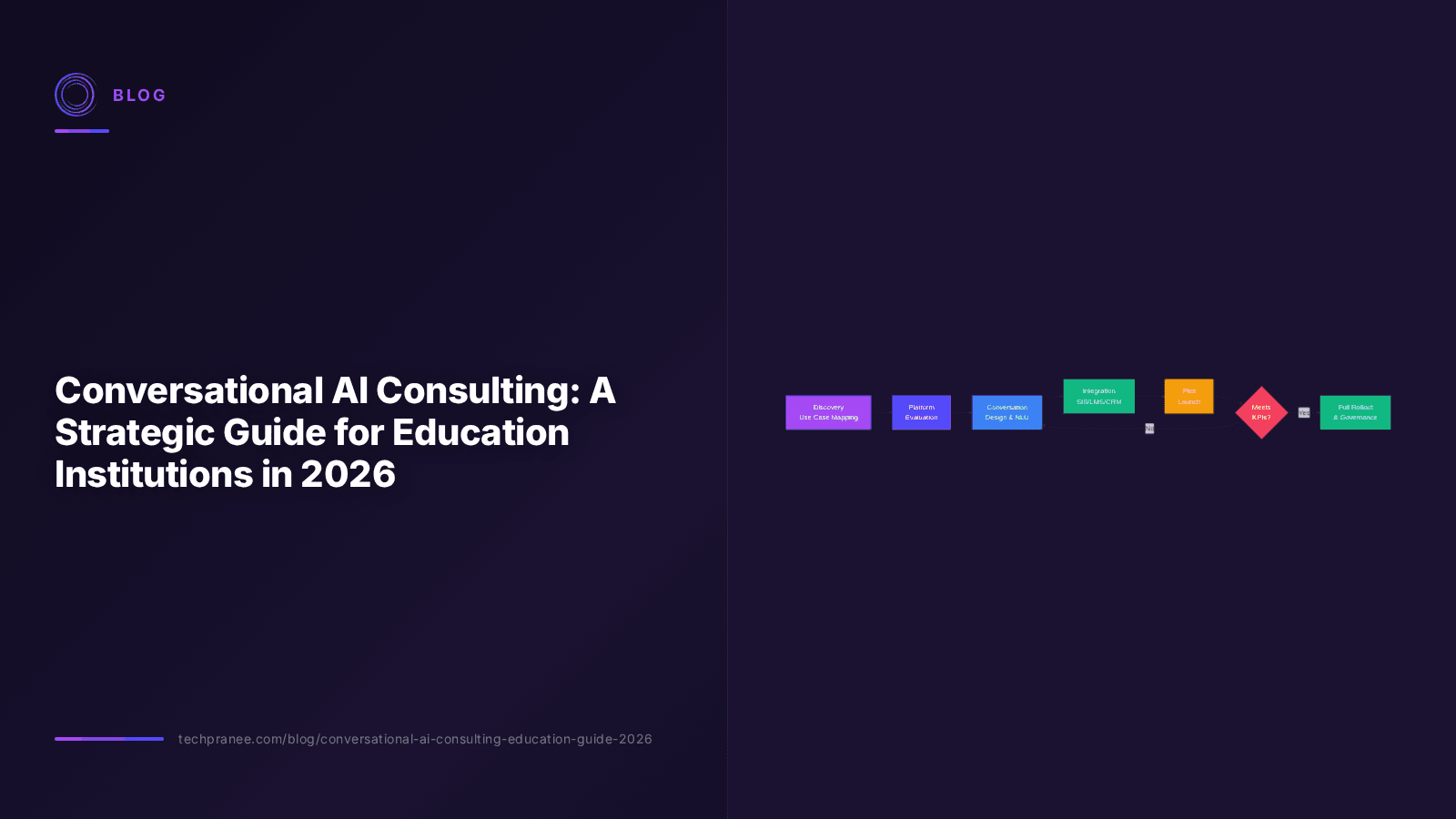
A thorough consulting engagement covers five distinct phases:
- Discovery & Use Case Mapping: Identifying where conversational AI creates the most value — student support, admissions, IT helpdesk, library services, tutoring, alumni engagement
- Platform Selection & Architecture: Evaluating build-vs-buy decisions across platforms like Dialogflow, Microsoft Bot Framework, Rasa, and custom LLM-based solutions
- Conversation Design & NLU Training: Crafting dialogue flows, training intent models, and designing personality and tone that matches your institution's brand
- Integration & Deployment: Connecting the conversational AI to your SIS (Student Information System), LMS (Learning Management System), CRM, and knowledge base
- Optimization & Governance: Monitoring conversation quality, retraining models, setting up human escalation, and ensuring FERPA/GDPR compliance
How It Differs from Generic Chatbot Implementation
Many institutions try the DIY route: they sign up for a chatbot platform, spend a weekend building flows, and launch. Three months later, the bot is answering 40% of queries incorrectly, students are frustrated, and the IT team is burned out. Conversational AI consulting prevents this by addressing the strategic and technical dimensions that DIY approaches miss:
| Dimension | DIY Chatbot Setup | Conversational AI Consulting |
|---|---|---|
| Use Case Strategy | "Let's add a chatbot to our website" | Prioritized use case map tied to enrollment, retention, and cost metrics |
| Platform Choice | Whatever was cheapest or had a free tier | Evaluated against 15+ criteria: scalability, NLU quality, integration capability, cost, compliance |
| Integration | Standalone — doesn't connect to SIS/LMS | Deep integration with SIS, LMS, CRM, and knowledge base |
| Compliance | Rarely considered | FERPA, GDPR, and data residency baked into architecture |
| Ongoing Optimization | Set and forget | Monthly conversation reviews, model retraining, performance dashboards |
Why Education Institutions Need Conversational AI Consulting
The education sector faces a unique set of pressures that make conversational AI both urgently needed and particularly challenging to implement correctly.
The Student Support Bottleneck
According to a 2025 EDUCAUSE survey, the average university IT helpdesk handles 45,000+ tickets per year, with 60% being repetitive password resets, LMS access issues, and routine policy questions. Admissions offices field thousands of similar queries about application deadlines, requirements, and financial aid. Front-line staff spend the majority of their time on questions a well-trained AI assistant could handle — leaving less time for the complex, high-touch interactions where human staff add real value.
Conversational AI consulting helps institutions identify exactly which query types to automate (the 60% that are repetitive) and which to keep human (the 40% that require judgment, empathy, or exception handling). This isn't about replacing staff — it's about freeing them to do work that matters.
24/7 Student Expectations
Today's students — Gen Z and Gen Alpha — expect instant answers. A 2025 Deloitte Digital Education report found that 78% of students prefer self-service options for routine questions over waiting for business-hours support. International students across time zones especially benefit from round-the-clock AI support for admissions, course registration, and campus information.
Personalized Learning at Scale
Conversational AI in education goes beyond support. AI tutors and learning assistants can provide personalized explanations, adapt to individual learning paces, and offer practice questions based on a student's performance data. A BCG study on AI in education found that institutions implementing AI-assisted tutoring saw a 23% improvement in course completion rates among at-risk students. But building these systems requires deep expertise in both AI and pedagogy — exactly what conversational AI consulting provides.
Conversational AI Use Cases in Education
A good consulting engagement starts with a use case discovery workshop. Here are the highest-impact use cases we see across education institutions:
1. Admissions & Enrollment Chatbots
Automate responses to common admissions questions: deadlines, requirements, program details, tuition, scholarships. Prospective students get instant answers 24/7, while admissions staff focus on high-value outreach and personalized follow-ups. Impact: Institutions report 25-40% reduction in admissions call volume and 15% increase in application completion rates when chatbots proactively guide applicants through each step.
2. Student Support & IT Helpdesk
Handle password resets, LMS access issues, WiFi connectivity, printing, and policy questions. Integrate with ticketing systems so complex issues automatically escalate to human agents with full context. Impact: 50-60% deflection rate for Tier-1 support queries.
3. AI Tutoring & Learning Assistants
Provide 24/7 tutoring support for common subjects. AI tutors can explain concepts, generate practice problems, provide hints, and adapt difficulty based on student responses. Impact: 20-30% improvement in student engagement metrics, especially for large enrollment courses where human TA availability is limited.
4. Financial Aid & Billing Support
Answer questions about FAFSA, scholarships, payment plans, billing cycles, and refund policies. Route sensitive financial discussions to human counselors. Impact: Faster resolution of billing disputes, fewer delayed payments.
5. Campus Navigation & Student Life
Help students find buildings, dining options, event schedules, club information, and campus services. Voice-enabled assistants can guide visually impaired students through campus. Impact: Improved student satisfaction scores, especially for first-year and transfer students.
6. Alumni Engagement
Automate alumni outreach, event invitations, donation campaigns, and career services matching. Conversational AI can maintain personalized relationships with thousands of alumni simultaneously. Impact: Increased alumni engagement rates and donation conversion.
The Conversational AI Consulting Process: Step-by-Step
A structured consulting engagement ensures your conversational AI deployment is strategic, not reactive. Here's what a well-run engagement looks like:
Step 1: Discovery & Stakeholder Alignment (Weeks 1-2)
The consultant conducts interviews with admissions, IT, student services, financial aid, and academic departments. They map current query volumes, response times, satisfaction scores, and pain points. Output: a prioritized use case matrix with estimated ROI for each.
Step 2: Platform Evaluation & Architecture Design (Weeks 2-4)
Based on use cases, integration requirements, and budget, the consultant evaluates platforms against a weighted scoring model. Build-vs-buy analysis for custom NLU components. Output: architecture diagram, platform recommendation, and integration plan.
Step 3: Conversation Design & NLU Training (Weeks 4-8)
Dialogue flows are designed for each use case. Intents are defined, training phrases are collected from real student queries, and the NLU model is trained and tested. Personality, tone, and escalation rules are established. Output: production-ready conversation flows and trained NLU models.
Step 4: Integration & Testing (Weeks 8-12)
The conversational AI is integrated with SIS (Banner, Workday, PeopleSoft), LMS (Canvas, Blackboard, Moodle), CRM (Salesforce, Slate), and knowledge bases. End-to-end testing with real students in a staging environment. Security review and FERPA compliance audit. Output: deployed and tested system ready for pilot launch.
Step 5: Pilot Launch & Optimization (Weeks 12-16)
Phased rollout to a subset of students. Conversation logs are reviewed daily, misclassifications are corrected, and the NLU model is retrained weekly. Human escalation paths are tested and refined. Output: performance dashboard, optimization report, and scale-up plan.
Step 6: Full Rollout & Governance (Ongoing)
Campus-wide deployment. Monthly conversation quality reviews, quarterly model retraining, and ongoing compliance monitoring. A governance committee reviews AI behavior, handles edge cases, and approves changes. Output: sustainable, continuously improving conversational AI system.
Conversational AI Consulting Pricing for Education
Pricing varies based on scope, institution size, and engagement depth. Here's what education institutions can expect:
| Engagement Type | Scope | Price Range | Timeline |
|---|---|---|---|
| Focused Pilot | Single use case (e.g., admissions bot), one platform, basic integration | $8,000 - $20,000 | 4-8 weeks |
| Department-Wide Deployment | 2-3 use cases, SIS/LMS integration, NLU training, pilot + optimization | $25,000 - $50,000 | 12-16 weeks |
| Full-Campus Transformation | 5+ use cases, custom AI tutor, multi-platform architecture, governance setup | $50,000 - $150,000+ | 6-12 months |
| Ongoing Optimization Retainer | Monthly conversation reviews, model retraining, performance reporting | $2,000 - $8,000/month | Ongoing |
Many consulting firms offer education-specific pricing or discounts for public institutions. Some structure engagements as performance-based, where a portion of fees is tied to deflection rate or student satisfaction improvements.
Critical Considerations for Education Deployments
FERPA and Privacy Compliance
Conversational AI in education must comply with FERPA (Family Educational Rights and Privacy Act) in the US, GDPR in Europe, and relevant state privacy laws. A qualified consultant ensures:
- ✓ No personally identifiable educational records stored in conversational AI logs without consent
- ✓ Data residency requirements met (student data stays within approved geographic boundaries)
- ✓ Conversation logs are encrypted, access-controlled, and retained per institutional policy
- ✓ Students are informed when they're interacting with AI vs a human
- ✓ Opt-out mechanisms for students who prefer human-only interactions
Human-in-the-Loop Design
"The most successful conversational AI deployments in education aren't the ones that replace humans — they're the ones that make human staff more effective by handling the repetitive 60% and escalating the complex 40% with full context." — EDUCAUSE 2025 AI in Higher Education Report
Every conversation should have a clear escalation path to a human. The AI should recognize when it doesn't know an answer, when a student is frustrated, or when the query involves sensitive topics (mental health, financial distress, academic integrity). The handoff should be seamless — the human agent should see the full conversation history so the student doesn't have to repeat themselves.
Accessibility and Inclusive Design
Conversational AI in education must be accessible to all students, including those with disabilities. This means:
- ✓ Screen reader compatibility for chatbot interfaces
- ✓ Voice input for students with motor impairments
- ✓ Multiple language support for international students
- ✓ Plain language options for students with cognitive disabilities
- ✓ WCAG 2.1 AA compliance for all conversational interfaces
How to Choose a Conversational AI Consulting Partner
Not all AI consultants are equipped to handle education's unique requirements. Here's what to look for:
Education Experience
Look for consultants who have worked with educational institutions before. They should understand SIS/LMS ecosystems, FERPA compliance, academic calendars, and the cultural dynamics of education institutions. Ask for case studies and references from similar institutions.
Technical Depth
Your consultant should have expertise in NLU platforms (Rasa, Dialogflow, Lex), LLM integration (OpenAI, Anthropic, open-source models), and integration middleware. They should be able to build custom components, not just configure a SaaS tool. Ask about their approach to model training, evaluation, and continuous improvement.
Conversation Design Expertise
Conversation design is a specialized skill — it's not just writing scripts. Look for consultants who understand persona design, tone calibration, error recovery patterns, and accessibility. Ask to see sample conversation flows from previous projects.
Partnership Approach
The best consultants transfer knowledge to your team, not just deliver a black box. They should include training for your staff, documentation of all decisions, and a clear handoff plan. Avoid consultants who want to keep you dependent on their ongoing services.
Real-World Impact: Case Study
Consider the case of a mid-sized public university (15,000 students) that engaged a conversational AI consulting firm to transform their student support operations:
- Before: IT helpdesk handling 52,000 tickets/year, 3-day average response time, student satisfaction score of 3.2/5
- Engagement: 16-week consulting engagement covering discovery, platform selection (Rasa + custom LLM integration), SIS/LMS integration, conversation design for 12 use cases, and staff training
- After (6 months): 58% ticket deflection rate, 4-hour average response time for escalated issues, student satisfaction score of 4.4/5, $180,000 annual savings in support costs
The key success factor wasn't the technology — it was the strategic approach to identifying which queries to automate, designing conversations that felt natural to students, and setting up governance for continuous improvement. That's the value conversational AI consulting delivers.
Practical Action Items
Ready to explore conversational AI for your institution? Here are concrete next steps:
- Audit your current query volume: Pull 3 months of support tickets, admissions calls, and student surveys. Categorize by type and frequency. This data is your use case foundation.
- Form a cross-functional stakeholder group: Include IT, admissions, student services, financial aid, and academic departments. Conversational AI touches every student-facing function.
- Define success metrics upfront: What does "working" look like? Ticket deflection rate? Application completion rate? Student satisfaction score? Set targets before you start.
- Start with a focused pilot: Don't try to automate everything at once. Pick one high-volume, low-complexity use case (admissions FAQ is a common starting point) and prove the model.
- Engage a consultant early: The biggest ROI comes from getting the strategy right before you invest in technology. A discovery engagement costs a fraction of a full deployment and prevents expensive mistakes.
Frequently Asked Questions
How much does conversational AI consulting cost for education institutions?
A focused pilot engagement starts around $8,000-$20,000. Department-wide deployments range from $25,000-$50,000. Full-campus transformations with custom AI tutors can reach $50,000-$150,000+. Many consultants offer education discounts or performance-based pricing tied to deflection rates and student satisfaction improvements.
Can conversational AI integrate with our existing SIS and LMS?
Yes. A qualified conversational AI consultant will design integrations with your Student Information System (Banner, Workday, PeopleSoft), Learning Management System (Canvas, Blackboard, Moodle), and CRM (Salesforce, Slate). This integration is what separates a strategic deployment from a standalone chatbot.
Is conversational AI compliant with FERPA?
Conversational AI can be FERPA-compliant when designed correctly. This means no storage of educational records in conversation logs without consent, encrypted data handling, proper access controls, and clear disclosure when students interact with AI. Your consultant should conduct a FERPA compliance review as part of the architecture design.
How long does it take to deploy conversational AI in an education setting?
A focused pilot can launch in 4-8 weeks. A department-wide deployment typically takes 12-16 weeks. Full-campus transformations with custom AI tutors span 6-12 months. The timeline depends on integration complexity, number of use cases, and stakeholder availability.
Will conversational AI replace our student support staff?
No. The goal is to automate repetitive queries (60% of volume) so your staff can focus on complex, high-touch interactions (40%) where human expertise matters. Most institutions find that conversational AI improves staff satisfaction by reducing burnout from repetitive tasks, not by eliminating jobs.
What's the difference between conversational AI and a chatbot?
A chatbot typically follows predefined rules and scripts. Conversational AI uses natural language understanding (NLU) and large language models (LLMs) to understand intent, handle variations in how people ask questions, and maintain context across a conversation. Conversational AI is more flexible, accurate, and capable of handling complex multi-turn interactions.
Conclusion
Conversational AI consulting is the strategic bridge between AI technology and education outcomes. Institutions that invest in professional consulting — rather than DIY chatbot tools — see higher deflection rates, better student satisfaction, and faster time to value. The key is treating conversational AI as a strategic initiative, not a technology project. Start with use case discovery, choose the right platform, design conversations that feel natural to students, integrate deeply with your existing systems, and build governance for continuous improvement.
Ready to explore conversational AI for your institution? Talk to our AI consulting team about a discovery engagement tailored to your education use cases. We'll help you map the highest-impact opportunities, evaluate platforms, and build a roadmap that delivers measurable results.