
Key Takeaways:
- AI consulting services span strategy, implementation, integration, and governance — not just advisory slides
- The global AI consulting market is projected to reach $64 billion by 2026, growing 37% YoY per IDC
- Typical engagement costs range from $15,000 for a strategy audit to $500,000+ for enterprise-scale deployment
- 74% of AI projects fail to deliver ROI according to 2025 Gartner research — the right consultant de-risks this
- A structured 7-step engagement framework separates firms that deliver outcomes from those that deliver reports
Executive Summary
Artificial intelligence consulting services have moved from boardroom novelty to operational necessity. In 2026, McKinsey reports that 72% of enterprises now use AI in at least one business function — up from 55% in 2023. Yet the gap between experimenting with AI and generating measurable ROI from AI remains wide. Gartner's 2025 AI survey found that 74% of AI initiatives fail to move beyond pilot stage, and the primary cause is not technology — it's the lack of a coherent strategy, skilled execution, and change management.
That gap is exactly what artificial intelligence consulting services address. An AI consultant doesn't just recommend tools — they audit your data readiness, identify high-ROI use cases, design implementation roadmaps, build and integrate models, train your team, and establish governance frameworks that keep AI safe and compliant. This guide breaks down what AI consulting services include, what they cost, how to choose the right provider, and what a real engagement looks like end-to-end. Whether you're a mid-market company considering your first AI project or an enterprise scaling AI across departments, you'll find actionable frameworks here — not theory.
What Are Artificial Intelligence Consulting Services?
Artificial intelligence consulting services are professional services that help organizations identify, design, implement, and scale AI solutions to solve specific business problems. Unlike generic IT consulting, AI consulting requires deep expertise in machine learning, data engineering, MLOps, and domain-specific AI applications — combined with business strategy to ensure technical solutions map to revenue, cost, or efficiency outcomes.
The core distinction: a traditional consultant tells you what to do. An AI consulting service helps you do it — from data pipeline engineering to model deployment to team enablement. According to Deloitte's 2025 State of AI in the Enterprise report, organizations that work with specialized AI consultants are 2.3x more likely to achieve their AI objectives than those that go it alone.
The Four Pillars of AI Consulting
| Pillar | What It Covers | Typical Deliverable |
|---|---|---|
| AI Strategy | Use case discovery, ROI modeling, roadmap, vendor selection | AI strategy document with prioritized use case backlog |
| AI Implementation | Data engineering, model development, MLOps, deployment | Production AI system with monitoring and CI/CD |
| AI Integration | Connecting AI to existing systems, APIs, workflows | Integrated pipelines feeding existing CRM, ERP, or internal tools |
| AI Governance | Ethics, compliance, model monitoring, risk management | Governance framework, audit trail, responsible AI policies |
What Do AI Consulting Services Include? A Full Service Catalog
The scope of artificial intelligence consulting services is broader than most business leaders expect. Here's what a comprehensive engagement covers:
1. AI Readiness Assessment
Before building anything, a consultant evaluates your organization's AI maturity across four dimensions: data infrastructure, technical talent, business processes, and culture. This typically takes 2-4 weeks and results in a maturity scorecard with specific gaps to close before AI investment makes sense.
2. Use Case Discovery and Prioritization
Not every business problem needs AI. Consultants run structured workshops with stakeholders to identify candidate use cases, then score them on a matrix of business impact vs. feasibility. The output is a prioritized backlog — typically 5-15 use cases ranked by expected ROI and time-to-value.
3. Data Strategy and Engineering
AI is only as good as the data feeding it. Consultants assess data quality, availability, and architecture. They design data pipelines, build feature stores, and establish the data infrastructure (lakehouse, vector database, real-time streaming) that models depend on. This is often 40-60% of the total engagement effort.
4. Model Development and MLOps
This is the build phase — selecting algorithms, training and validating models, and setting up the MLOps infrastructure for deployment, monitoring, and retraining. Consultants use frameworks like MLflow, Kubeflow, or cloud-native tools (AWS SageMaker, Azure ML, Vertex AI) depending on your stack.
5. System Integration
An AI model that lives in a notebook delivers zero business value. Consultants integrate models into your production systems — connecting to CRM, ERP, customer-facing apps, or internal tools via APIs. This is where generative AI integration services and workflow automation come together to create real operational impact.
6. Change Management and Team Enablement
BCG's 2025 AI adoption study found that 60% of AI failures stem from organizational resistance, not technical issues. Consultants design training programs, create AI literacy curricula for non-technical staff, and help leadership communicate AI initiatives to build adoption rather than fear.
7. AI Governance and Responsible AI
With the EU AI Act in effect and increasing regulatory scrutiny, governance is no longer optional. Consultants establish model monitoring frameworks, bias detection processes, documentation standards, and compliance protocols aligned with your industry's regulatory requirements.
How Much Do AI Consulting Services Cost?
Cost is the question every business leader asks first and most consultants dodge. Let's be specific. Based on 2026 market rates from Clutch, Gartner's IT Key Metrics data, and our own engagement data at TechPranee:
| Engagement Type | Duration | Cost Range | What You Get |
|---|---|---|---|
| AI Readiness Audit | 2-4 weeks | $15,000 - $35,000 | Maturity assessment, gap analysis, prioritized roadmap |
| Strategy + Pilot | 8-12 weeks | $50,000 - $150,000 | Use case discovery, one production pilot, integration plan |
| Full Implementation | 4-9 months | $150,000 - $500,000 | End-to-end build: data, models, MLOps, integration, training |
| Enterprise Scale | 12-24 months | $500,000 - $2M+ | Multi-use-case platform, governance, team build-out, ongoing support |
| Retainer / Fractional | Ongoing | $8,000 - $25,000/mo | Advisory, model monitoring, optimization, new use case scoping |
What Drives Cost?
- Data complexity — Fragmented data across 12 systems costs more than a clean Snowflake warehouse
- Model type — A rule-based automation is cheaper than a custom LLM fine-tune
- Integration depth — API-to-SaaS is faster than rebuilding legacy mainframe connections
- Compliance requirements — HIPAA, SOC 2, or EU AI Act adds 15-30% to engagement cost
- Team size — A 2-person consultancy bills less than a 15-person cross-functional team
The cheapest AI consultant is rarely the best value. A $35,000 readiness audit that prevents a $500,000 failed implementation has a 14x ROI. The expensive mistake is skipping the audit and jumping straight to build. — TechPranee AI Strategy Team
How to Choose the Right AI Consulting Service
Choosing an AI consultant is a high-stakes decision. The wrong partner burns 6-12 months and six figures. Here's a structured evaluation framework:
Step-by-Step: Selecting an AI Consultant
- Define your desired outcome first. Before talking to any consultant, write down the specific business problem you want AI to solve. "We want to reduce customer support resolution time by 30%" is a starting point. "We want to explore AI" is not.
- Shortlist 3-5 firms with experience in your industry and use case type. Check case studies, not just service pages.
- Evaluate technical depth. Ask about their MLOps stack, model monitoring approach, and how they handle model drift. If they can't answer in specifics, they're a reseller, not a builder.
- Assess data engineering capability. Ask how they'd approach your data specifically. A good consultant will ask to see your data architecture before quoting a price. A bad one quotes before understanding your data.
- Check references for similar projects. Not just "did they deliver" but "did the AI produce measurable business results 6 months later?"
- Clarify IP ownership. Who owns the models, code, and data pipelines after the engagement? This should be in writing.
- Start with a paid pilot. A 4-week scoped engagement (readiness audit or proof of concept) is the lowest-risk way to evaluate fit before committing to a $200K+ implementation.
Red Flags to Watch For
- ✗ Quotes a fixed price before seeing your data or understanding your systems
- ✗ Leads with a specific vendor's product (they may be a reseller disguised as a consultant)
- ✗ No in-house ML engineers — only project managers who subcontract
- ✗ Can't name specific models, frameworks, or tools — only buzzwords
- ✗ No governance or responsible AI discussion until you raise it
AI Consulting Services vs. AI Implementation Services: What's the Difference?
These terms are often used interchangeably, but they represent different stages of the AI journey — and many firms only do one well.
| Dimension | AI Consulting | AI Implementation |
|---|---|---|
| Focus | Strategy, roadmap, use case selection, vendor evaluation | Building, deploying, and integrating AI systems |
| Who does it | Strategy consultants, AI advisors | ML engineers, data scientists, MLOps engineers |
| Output | Reports, roadmaps, recommendations | Production models, pipelines, deployed systems |
| When | Before you build — "What should we do?" | After strategy is set — "How do we build it?" |
| Risk | Low cost, low execution risk — but no direct ROI | High cost, high execution risk — but direct business impact |
The best artificial intelligence consulting services do both — strategy and implementation under one roof. This eliminates the handoff gap where a strategy consultant's recommendations never get built because the implementation team doesn't understand the strategic context. For a deeper comparison, see our guide on AI strategy consulting vs. AI automation services.
Real-World Case Studies: AI Consulting in Action
Case Study 1: Healthcare — Reducing Triage Time with AI
A regional hospital network (14 facilities, 8,000 staff) engaged an AI consulting firm to reduce emergency room triage time. The engagement followed the full seven-step framework:
- Readiness audit revealed fragmented EHR data across 3 different systems
- Use case prioritization identified AI-assisted triage as highest ROI (estimated $2.1M annual savings from reduced wait times and optimized staffing)
- Data engineering unified 3 EHR systems into a single FHIR-compliant data layer (8 weeks)
- Model development trained a clinical NLP model on 2.4 million historical triage notes
- Integration connected the model to the existing EHR via HL7 FHIR APIs
- Result: Triage decision time reduced by 41%, patient wait time reduced by 23 minutes average, and the system achieved HIPAA compliance through governance protocols
Total engagement: 9 months, $340,000. ROI achieved in month 11.
Case Study 2: Manufacturing — Predictive Maintenance
A mid-sized automotive parts manufacturer (450 employees, $80M revenue) was experiencing $1.2M annually in unplanned downtime. An AI consulting engagement deployed predictive maintenance:
- Sensor data from 180 machines was streamed to a time-series database
- Anomaly detection models (Isolation Forest + LSTM) flagged equipment degradation 72 hours before failure on average
- Integration with the existing CMMS auto-created work orders when anomaly confidence exceeded 85%
- Result: Unplanned downtime reduced by 63%, saving $760,000 in year one
For more industry-specific examples, see our guides on AI for manufacturing and AI in education.
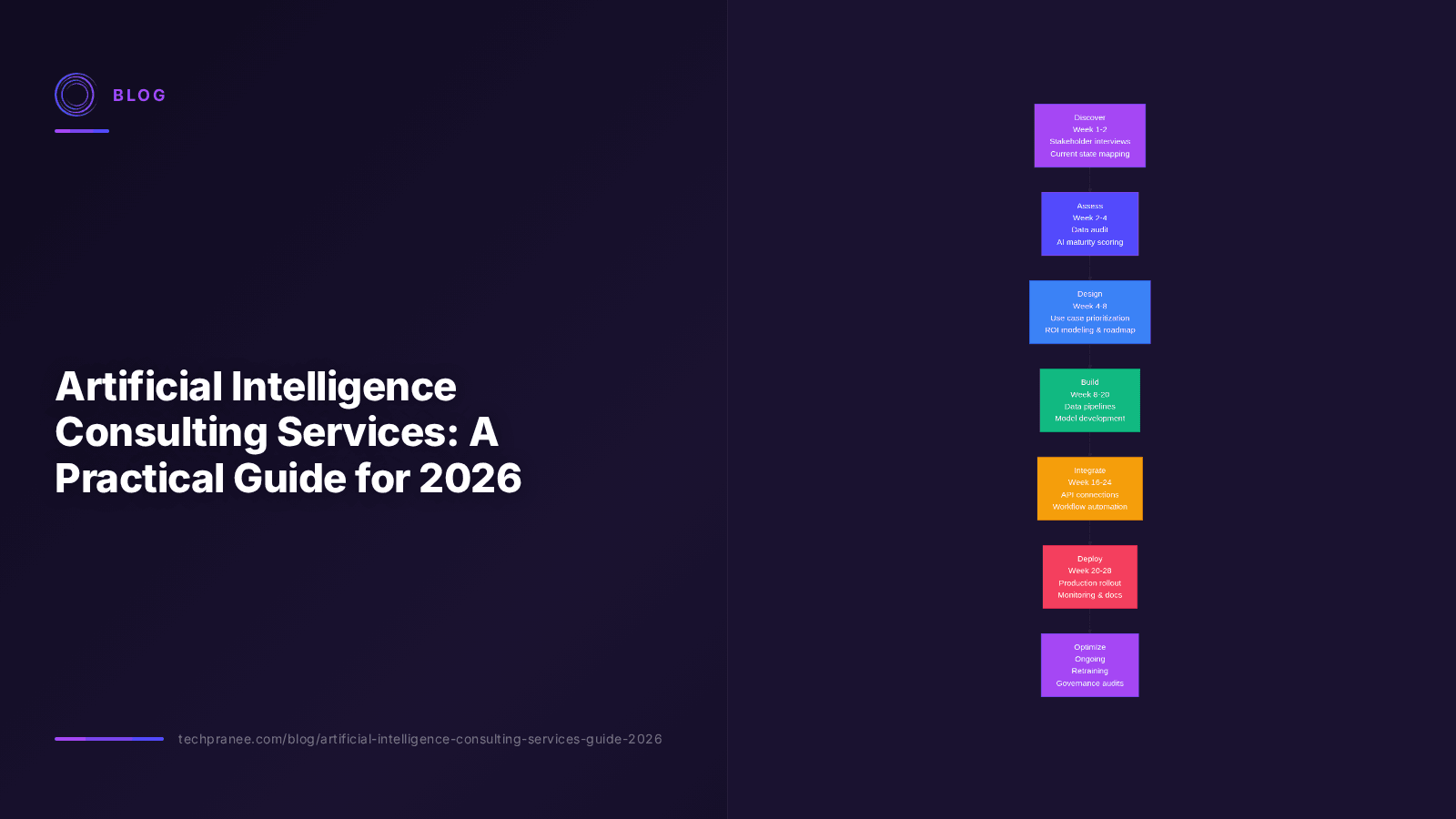
The 7-Step AI Consulting Engagement Framework
Here's what a structured AI consulting engagement looks like end-to-end. This is the framework we use at TechPranee, and it's backed by the same principles found in our guide to choosing AI consulting companies.
- Discover (Week 1-2): Stakeholder interviews, current state mapping, success criteria definition
- Assess (Week 2-4): Data audit, infrastructure review, AI maturity scoring, risk assessment
- Design (Week 4-8): Use case prioritization, architecture design, ROI modeling, roadmap creation
- Build (Week 8-20): Data pipeline construction, model development, MLOps setup, testing
- Integrate (Week 16-24): API connections, workflow automation, user interface, change management
- Deploy (Week 20-28): Production rollout, monitoring setup, performance baseline, documentation
- Optimize (Ongoing): Model retraining, performance tuning, new use case scoping, governance audits
Checklist: What a Good AI Consulting Engagement Delivers
- ✓ A documented AI strategy tied to specific business KPIs
- ✓ At least one production-deployed AI system (not just a pilot notebook)
- ✓ Data pipelines that your team can maintain after the consultant leaves
- ✓ Model monitoring and alerting for drift and performance degradation
- ✓ Documentation covering architecture, data flows, and model decisions
- ✓ Team training materials and handoff sessions
- ✓ A governance framework aligned with your regulatory environment
- ✓ A roadmap for the next 2-3 use cases with ROI estimates
Common Questions About AI Consulting Services
What is the difference between AI consulting and IT consulting?
IT consulting focuses on infrastructure, systems, and processes. AI consulting focuses on building systems that learn from data to make predictions or decisions. AI consulting requires specialized skills in machine learning, data science, and MLOps that traditional IT consultants typically don't have. IT consulting might help you migrate to the cloud; AI consulting helps you build a model that predicts customer churn using that cloud data.
How long does an AI consulting engagement take?
A readiness audit takes 2-4 weeks. A strategy-plus-pilot engagement takes 8-12 weeks. A full implementation runs 4-9 months. Enterprise-scale programs span 12-24 months. The timeline depends on data complexity, integration depth, and the number of use cases.
Do I need clean data before hiring an AI consultant?
No — but you need to be honest about your data state. A good AI consultant will assess your data as part of the engagement and include data engineering in the scope. If a consultant says your data is fine without looking at it, that's a red flag. Data engineering is often 40-60% of the total effort.
Can AI consulting services work with small businesses?
Yes. Small businesses can benefit from AI consulting through scoped engagements — a $15,000-$35,000 readiness audit, or a focused pilot using pre-trained models and SaaS AI tools rather than custom model development. The key is matching the engagement scope to your budget and data maturity. You can explore our AI strategy consulting services for options scaled to your business size.
What industries benefit most from AI consulting?
Healthcare, manufacturing, financial services, retail, and logistics see the highest ROI from AI consulting, according to 2025 McKinsey data. But any industry with significant data volumes and repeatable decision processes can benefit. The question isn't whether your industry is "AI-ready" — it's whether your specific business problem is.
How do I measure the ROI of an AI consulting engagement?
Define the success metric before the engagement starts. Common metrics: cost savings (reduced manual hours), revenue lift (from personalization or prediction), error rate reduction, or speed improvement (faster processing, shorter cycle times). The consultant should commit to a measurable outcome in the engagement scope, not just deliverables.
Practical Action Items: Your Next 30 Days
- Write down your top 3 business problems where better prediction, automation, or decision-making would move the needle. Don't think about AI yet — think about the problem.
- Inventory your data. List every system that holds customer, operational, or financial data. Note the format (API, database, spreadsheet) and quality (clean, messy, unknown).
- Get a readiness audit. Spend $15K-$35K on a structured assessment before committing to any build. This is the highest-ROI investment in the entire AI journey because it prevents the expensive failure.
- Run a paid pilot. Choose one use case from the audit, scope a 4-8 week proof of concept, and measure results against a baseline. This validates both the use case and the consultant.
- Build a governance plan early. Don't wait until you have 5 models in production. Establish data privacy, model monitoring, and compliance protocols from day one.
Conclusion
Artificial intelligence consulting services are the bridge between AI's promise and AI's reality. The companies winning with AI in 2026 aren't the ones with the biggest budgets — they're the ones with the clearest strategy, the best data foundations, and consultants who build for outcomes, not slide decks. Whether you're starting with a readiness audit or scaling across the enterprise, the framework is the same: define the problem, assess the data, build deliberately, integrate deeply, and govern responsibly. The 74% failure rate isn't a technology problem — it's a strategy and execution problem. The right consulting partner changes those odds.
Ready to find out if AI is the right move for your business? Book a strategy call — we'll assess your readiness, identify your highest-ROI use cases, and give you a straight answer on whether AI consulting makes sense for you right now.