
Key Takeaways:
- Artificial intelligence consulting helps businesses identify, design, and deploy AI solutions that solve real operational problems — not just add buzzwords
- The AI consulting market is projected to grow from $18 billion in 2024 to over $64 billion by 2028, according to Gartner
- Typical AI consulting engagements cost between $10,000 and $150,000 depending on scope, complexity, and duration
- 72% of organizations that worked with AI consultants reported measurable ROI within 12 months, per a 2025 McKinsey survey
- The right AI consultant doesn't just build models — they assess readiness, design architecture, manage change, and ensure long-term success
What Is Artificial Intelligence Consulting?
Artificial intelligence consulting is the practice of helping businesses understand, evaluate, and implement AI technologies to solve specific operational challenges. An AI consultant — or AI consulting firm — brings expertise in machine learning, natural language processing, computer vision, and automation to identify where AI can create measurable value, then designs and deploys solutions to capture that value.
Think of it this way: you wouldn't build a custom ERP system without an experienced software architect. The same logic applies to AI. The technology is powerful, but applying it incorrectly wastes money, creates unreliable systems, and erodes trust in AI across your organization. Artificial intelligence consulting bridges the gap between what AI can do in theory and what it should do for your specific business.
The field has matured significantly since 2023. What used to be "let's try ChatGPT on our data" has evolved into structured engagement models with clear deliverables, defined timelines, and measurable outcomes. In 2026, AI consulting is no longer experimental — it's a standard line item in digital transformation budgets.
What Does an Artificial Intelligence Consultant Actually Do?
The role of an AI consultant spans four core phases. Understanding these helps you evaluate whether you need consulting and what to expect from an engagement.
1. AI Readiness Assessment
Before any model gets built, a consultant evaluates your organization's readiness across three dimensions:
- ✓ Data infrastructure: Do you have clean, accessible data? Where does it live? What format is it in? Is it governed?
- ✓ Technical maturity: Does your team have the skills to maintain AI systems? Can your infrastructure support ML workloads?
- ✓ Business alignment: Are there clear use cases with quantifiable ROI? Is leadership aligned on priorities?
This phase typically takes 2-4 weeks and costs $5,000-$20,000. The output is a roadmap that prioritizes AI use cases by impact and feasibility.
2. Strategy and Solution Design
Once use cases are prioritized, the consultant designs the technical architecture. This includes selecting models (build vs. buy vs. fine-tune), defining data pipelines, choosing infrastructure (cloud, on-premise, hybrid), and designing the integration with existing systems.
A key deliverable here is the AI architecture document — a blueprint that your engineering team can execute against, whether with the consultant's help or independently.
3. Implementation and Development
This is where the actual AI system gets built. The scope varies dramatically:
- A document classification model might take 3 weeks
- A customer support agent with CRM integration might take 8 weeks
- A multi-agent system covering sales, support, and operations might take 6 months
The consultant typically works alongside your internal team, transferring knowledge so you can maintain and extend the system after the engagement ends.
4. Deployment, Monitoring, and Optimization
AI systems degrade over time. Data drifts, models lose accuracy, and business rules change. A good consultant sets up monitoring pipelines, retraining schedules, and performance dashboards before handing off. Many firms offer ongoing optimization retainers ($1,000-$5,000/month) to keep systems performing.
Types of Artificial Intelligence Consulting Engagements
Not every AI consulting project looks the same. Here are the most common engagement types and when to use each:
| Engagement Type | Best For | Typical Cost | Duration |
|---|---|---|---|
| AI Readiness Assessment | Organizations new to AI that need a roadmap | $5,000 - $20,000 | 2-4 weeks |
| Proof of Concept (PoC) | Validating a single use case before full investment | $10,000 - $30,000 | 4-6 weeks |
| Custom AI Development | Building a production AI system for a specific workflow | $25,000 - $100,000 | 8-16 weeks |
| AI Strategy Program | Multi-use-case transformation with roadmap and governance | $50,000 - $200,000 | 3-9 months |
| Ongoing AI Advisory | Continuous guidance as AI capabilities scale | $3,000 - $10,000/month | Open-ended |
How Much Does Artificial Intelligence Consulting Cost?
Pricing in AI consulting varies widely based on the firm's expertise, project complexity, and engagement model. Here's what the market looks like in 2026:
Hourly Rates
AI consultants typically charge $150-$400 per hour, depending on specialization:
- General AI consultants: $150-$250/hour
- Machine learning engineers: $200-$350/hour
- AI strategy consultants (Big 4 / boutique strategy): $300-$500/hour
- Specialized NLP/computer vision experts: $250-$400/hour
Project-Based Pricing
Most engagements are fixed-price. A typical breakdown:
- Small project (single use case, existing data): $10,000-$30,000
- Medium project (multiple integrations, custom model): $30,000-$75,000
- Large project (enterprise-scale, multi-agent, compliance): $75,000-$200,000+
Retainer Pricing
For ongoing AI advisory and optimization, expect $3,000-$15,000/month. This typically includes monitoring, model retraining, ad-hoc consulting, and quarterly strategy reviews.
"The biggest mistake businesses make with AI consulting is treating it as a one-time project. AI systems need continuous tuning — the firms that see lasting ROI are the ones that budget for ongoing optimization, not just initial deployment."
Artificial Intelligence Consulting vs. AI Development: What's the Difference?
This is one of the most common questions businesses ask. The distinction matters because it affects who you hire and what you pay.
| Dimension | AI Consulting | AI Development |
|---|---|---|
| Focus | Strategy, roadmap, architecture, use case identification | Building, testing, deploying AI systems |
| When to use | Before you know what to build | When you know what to build and need it built |
| Output | Recommendations, architecture docs, roadmaps, PoCs | Production AI systems, APIs, integrations |
| Timeline | 2-12 weeks for strategy phase | 4-24 weeks for development |
| Cost | $10,000-$50,000 for strategy | $25,000-$200,000 for development |
In practice, many firms — including those offering AI strategy consulting services — do both. They start with strategy, validate with a PoC, then move into development. The key is understanding which phase you're in so you can evaluate proposals correctly.
How to Know If Your Business Needs AI Consulting
Not every business needs an AI consultant right now. Here's a practical checklist to help you decide:
✓ You Need AI Consulting If:
- ✓ You have a specific operational problem that AI could solve, but you're not sure where to start
- ✓ Your team has tried implementing AI (e.g., a ChatGPT integration) and the results were underwhelming
- ✓ You have significant data assets but no strategy for leveraging them with AI
- ✓ Your competitors are deploying AI and you're falling behind
- ✓ You need to build a business case for AI investment to present to your board
- ✓ You have budget allocated for AI but no clear roadmap for spending it
✗ You Don't Need AI Consulting If:
- ✗ Your AI use case is simple enough that an off-the-shelf SaaS tool solves it (e.g., AI-powered email drafting in your existing CRM)
- ✗ You have an in-house ML team that's already delivering results
- ✗ Your data infrastructure is too immature — fix that first
- ✗ You're looking for AI to solve a process problem that's actually a management problem
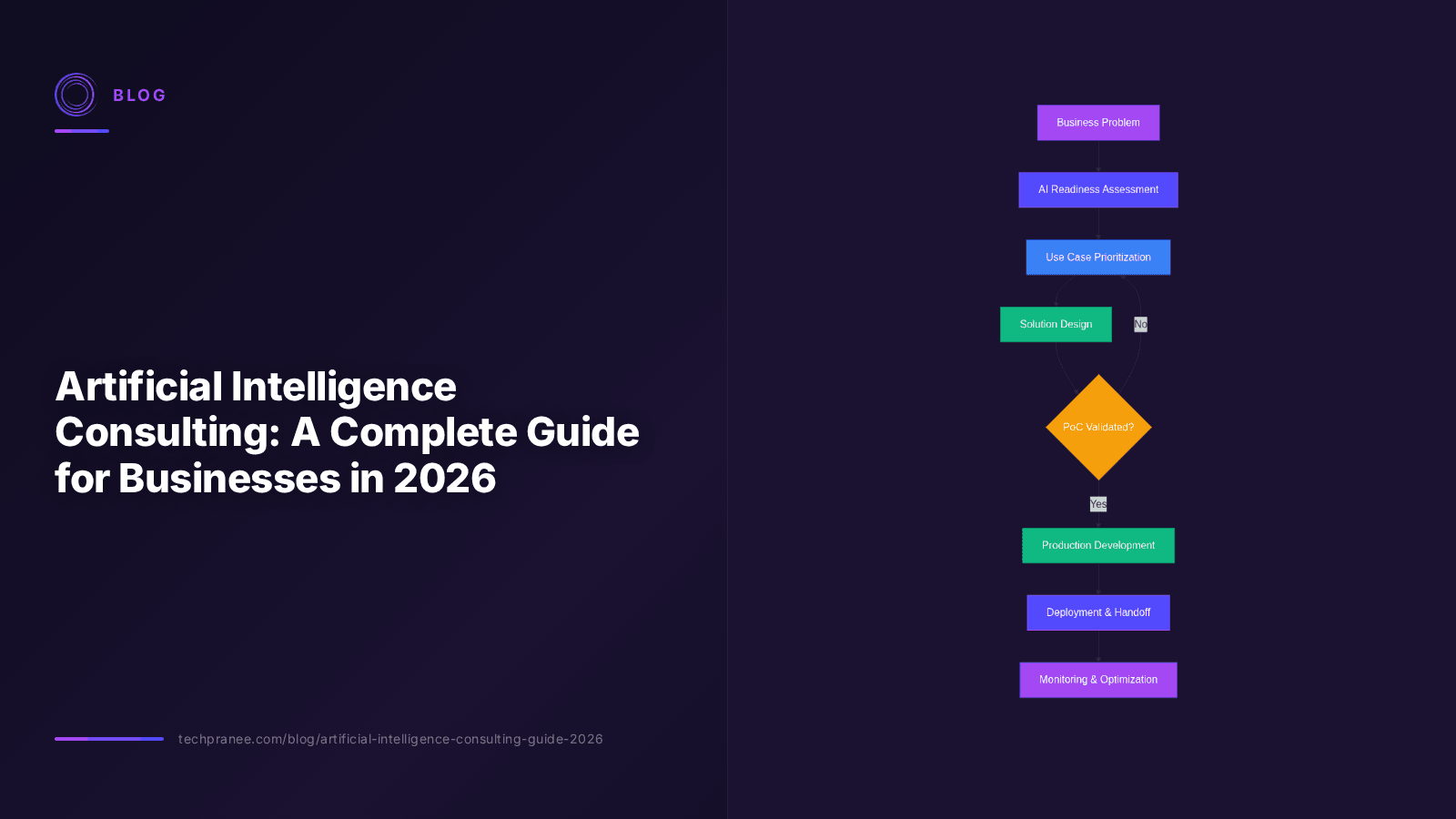
The Artificial Intelligence Consulting Process: A Step-by-Step Guide
If you decide to engage an AI consultant, here's what a well-structured engagement looks like:
- Discovery and scoping (Week 1-2): The consultant interviews stakeholders, reviews existing systems, and documents current-state processes. Output: a problem definition document.
- Data assessment (Week 2-3): Evaluate data quality, availability, and governance. Identify gaps and create a data preparation plan. This step is critical — AI projects fail most often because of data issues, not model issues.
- Use case prioritization (Week 3-4): Score potential AI use cases by business impact, technical feasibility, and data readiness. Select 1-2 high-impact use cases for the initial engagement.
- Solution design (Week 4-6): Design the technical architecture, select models and tools, define integration points, and create a development plan. Output: architecture document and project plan.
- Proof of concept (Week 6-10): Build a minimal version of the solution to validate the approach. Test on real data, measure performance, and gather feedback from end users.
- Production development (Week 10-20): If the PoC succeeds, build the production system. This includes model training/fine-tuning, API development, integration with existing systems, and deployment infrastructure.
- Deployment and handoff (Week 20-24): Deploy to production, train your team, set up monitoring, and transition to ongoing operations. The consultant should provide documentation and a maintenance plan.
Real-World Impact: What AI Consulting Delivers
Let's look at concrete examples of what AI consulting engagements have produced:
HyreFast — Recruitment AI Transformation
HyreFast, a recruitment technology company, engaged AI consultants to automate candidate sourcing and screening. The consulting engagement started with a readiness assessment that identified resume parsing and candidate-job matching as the highest-impact use cases. Over 12 weeks, the team built a custom AI system that parsed resumes, matched candidates to job descriptions using semantic search, and automated interview scheduling.
Results: 40% reduction in time-to-hire, 70% reduction in manual screening effort, and the system paid for itself within the first quarter of deployment. This is a textbook outcome of a well-scoped AI consulting engagement — clear problem, right use case, measurable ROI.
Manufacturing — Predictive Maintenance
A mid-sized manufacturer worked with AI consultants to implement predictive maintenance on their production line. The consultants assessed sensor data availability, designed a machine learning model to predict equipment failure, and integrated it with the existing CMMS. Result: 25% reduction in unplanned downtime, saving an estimated $400,000 annually. The total consulting engagement cost $80,000 — payback in under 3 months.
For more industry-specific examples, see our guide on AI for manufacturing and how smart factories are using automation.
Common Mistakes in AI Consulting Engagements
After seeing dozens of AI consulting engagements, here are the most common failure modes:
- Skipping the readiness assessment: Jumping straight to development without understanding data quality and infrastructure leads to failed projects. Always start with assessment.
- Vague success metrics: "We want to use AI to improve efficiency" is not a success metric. "Reduce invoice processing time by 60%" is. Define metrics before the engagement starts.
- Over-scoping the first project: Trying to build a comprehensive AI platform in the first engagement almost always fails. Start with one use case, prove ROI, then expand.
- Not involving end users: AI systems that don't account for how people actually work get rejected. Include end users in the PoC feedback loop.
- No plan for maintenance: AI models drift. If you don't budget for monitoring and retraining, your system will degrade within months.
How to Choose the Right AI Consulting Partner
Choosing an AI consultant is a critical decision. Here's a framework for evaluating candidates:
Step-by-Step Evaluation
- Check domain expertise: Do they have experience in your industry? AI for healthcare is very different from AI for logistics. Ask for case studies in your sector.
- Review technical depth: Can they explain their approach in terms your engineering team respects? Beware of firms that hide behind buzzwords.
- Ask about their assessment process: A good consultant starts with assessment, not development. If they want to build something in week 1, that's a red flag.
- Evaluate their model approach: Do they default to building custom models, or do they recommend off-the-shelf solutions when appropriate? The best consultants are tool-agnostic.
- Check references and ROI: Can they put you in touch with past clients? What measurable outcomes did they deliver?
You can also read our deeper guide on how to choose AI consulting companies and our analysis of the top AI consulting firms for more detail on the evaluation process.
Practical Action Items: What to Do Next
If you're considering artificial intelligence consulting, here are concrete steps you can take this week:
- Audit your data: List your top 5 data sources, their formats, quality, and accessibility. This tells you and any future consultant where you stand.
- Identify 3 repetitive processes: Write down three workflows where your team spends significant manual time. These are your AI use case candidates.
- Estimate the cost of the problem: Quantify how much time/money each repetitive process costs you monthly. This becomes your ROI baseline.
- Talk to 2-3 AI consulting firms: Get proposals from multiple firms. Compare their assessment approaches, not just their pricing.
- Start with a readiness assessment: Budget $10,000-$15,000 for a 3-week assessment. It's the highest-ROI first step you can take.
FAQ: Artificial Intelligence Consulting
What is the difference between AI consulting and AI development?
AI consulting focuses on strategy, use case identification, and architecture design — figuring out what to build and why. AI development is the actual building of the AI system. Many firms offer both, but the consulting phase should always come first.
How much does artificial intelligence consulting cost?
A typical AI consulting engagement costs between $10,000 and $150,000. Readiness assessments start at $5,000-$20,000, proof of concepts run $10,000-$30,000, and full custom development projects range from $25,000 to $200,000+.
How long does an AI consulting project take?
Strategy and assessment phases take 2-4 weeks. Proof of concepts take 4-6 weeks. Full production development typically takes 8-24 weeks depending on complexity, integrations, and data preparation needs.
Do I need AI consulting if I already use ChatGPT or Copilot?
Using off-the-shelf AI tools is different from deploying custom AI solutions. If your needs are met by existing tools, you don't need consulting. If you need AI integrated into your specific workflows, connected to your data, or compliant with industry regulations, consulting adds significant value.
What should I prepare before hiring an AI consultant?
Prepare a list of business problems you want to solve (not "we want AI" but "we spend 20 hours/week processing invoices"), documentation of your current systems and data sources, and a rough budget range. The more specific you are, the more useful the consultant's assessment will be.
Can AI consulting help if we don't have a data science team?
Yes — this is one of the most common reasons businesses hire AI consultants. A good consultant builds the initial system and transfers knowledge to your existing engineering team so they can maintain and extend it. You don't need a dedicated ML team to benefit from AI.
Start Your AI Consulting Journey
Artificial intelligence consulting isn't about chasing trends — it's about finding the specific places where AI can save your business time, money, or both. The right consultant helps you cut through the hype, identify real opportunities, and build systems that deliver measurable ROI.
If you're ready to explore what AI could do for your business, start with a free AI readiness assessment. We'll review your workflows, identify the highest-impact AI opportunities, and give you a clear roadmap — no pressure, no buzzwords.