
Key Takeaways:
- AI and machine learning consulting combines strategy, implementation, and MLOps to deliver measurable business outcomes
- The global AI consulting market is projected to reach $64B by 2025, growing at 41% CAGR (McKinsey, 2025)
- Most consulting engagements fall between $15K-$200K depending on scope, with ROI visible in 3-6 months
- Evaluate consultants on technical depth, industry experience, deployment track record, and post-launch support
- Look for partners who offer proof-of-concept phases before full-scale implementation commitments
Executive Summary
AI and machine learning consulting has become the fastest-growing segment of enterprise technology services. According to McKinsey's 2025 State of AI report, 72% of enterprises now use AI in at least one business function, up from 55% in 2023. But the gap between wanting AI and deploying it effectively is enormous — and that's where AI and machine learning consulting comes in.
Whether you're a mid-market company exploring your first ML use case or an enterprise scaling from pilot to production, the right consulting partner can be the difference between a model that sits in a notebook and one that drives $2M+ in annual savings. This guide breaks down what AI/ML consulting actually includes, what it costs, how to evaluate partners, and the specific steps to a successful engagement.
We'll cover the full lifecycle — from problem framing and data assessment to model development, deployment, and ongoing MLOps — so you can make an informed decision with real numbers, not vendor pitches.
What Is AI and Machine Learning Consulting?
AI and machine learning consulting is a professional service that helps organizations identify, design, build, and deploy AI/ML solutions to solve specific business problems. Unlike general IT consulting, it requires deep expertise in data science, statistical modeling, software engineering, and domain knowledge.
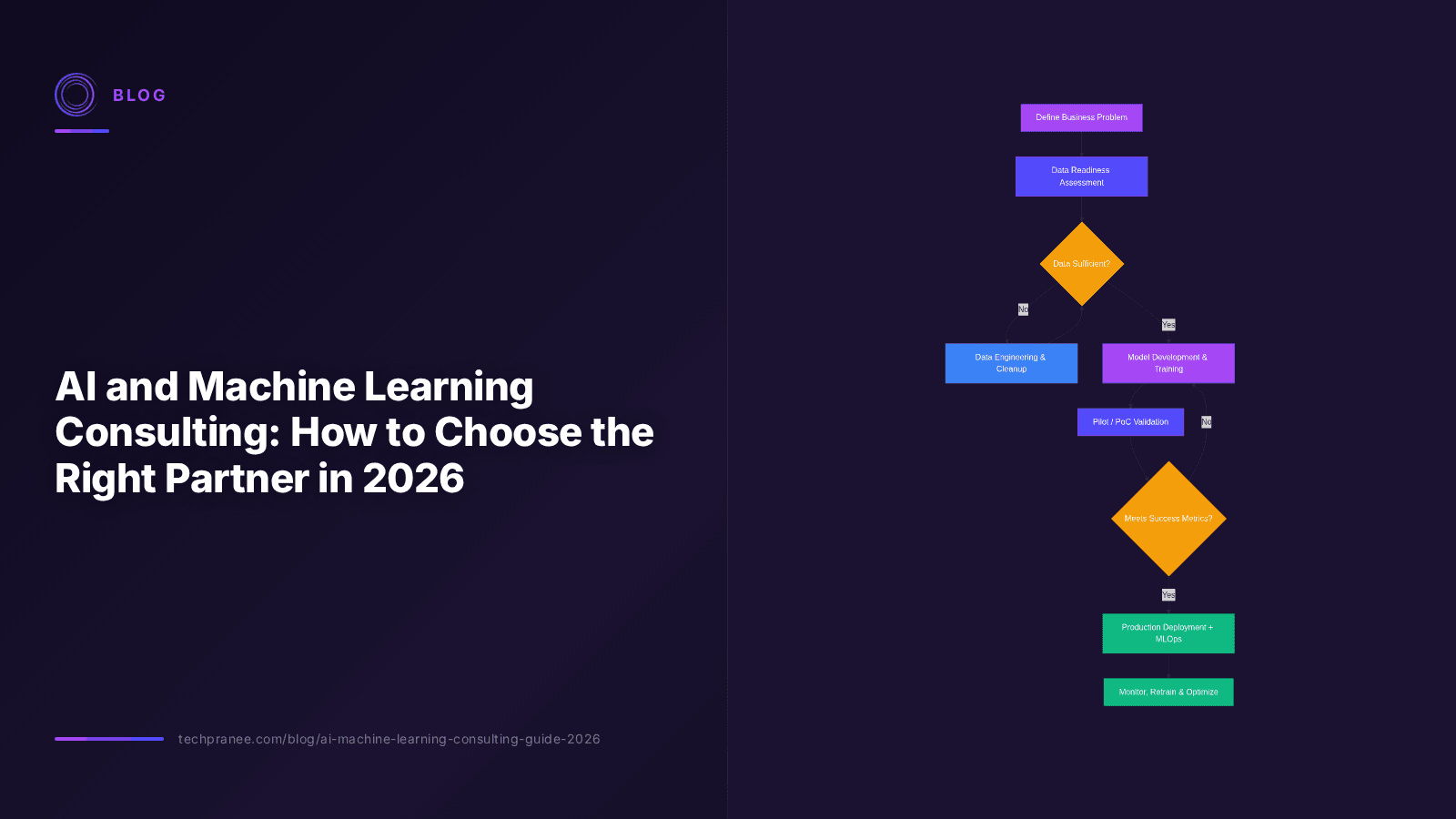
A typical AI/ML consulting engagement covers three phases:
- Discovery & Strategy — Identifying high-impact use cases, assessing data readiness, defining success metrics, and building a roadmap
- Implementation — Data engineering, model development, validation, and integration with existing systems
- Deployment & MLOps — Production deployment, monitoring, retraining pipelines, and ongoing optimization
According to Gartner's 2025 AI Hype Cycle, organizations that engage specialized AI consultants are 2.3x more likely to move from pilot to production within 12 months compared to those building in-house from scratch.
Core Services Offered by AI/ML Consultants
1. AI Strategy and Roadmap
Before writing any code, consultants help you answer: Which AI use cases will deliver the highest ROI for our specific business? This involves analyzing your data assets, workflows, and competitive landscape to prioritize initiatives.
2. Data Engineering and Readiness Assessment
Models need data. Consultants assess your data infrastructure — pipelines, storage, quality, governance — and recommend what needs to be in place before ML can work. BCG's 2025 AI Readiness Study found that 68% of AI projects stall because of data quality issues, not algorithm problems.
3. Custom Model Development
This is the core technical work: selecting algorithms, training models, hyperparameter tuning, and validation. For most business use cases, this involves supervised learning (classification, regression), NLP, or computer vision — not necessarily the latest foundation models.
4. MLOps and Production Deployment
A model in a Jupyter notebook is worthless. MLOps is the practice of deploying, monitoring, and maintaining ML systems in production. This includes CI/CD for models, drift detection, automated retraining, and rollback capabilities.
5. AI Governance and Compliance
With regulations like the EU AI Act taking effect in 2026, consultants help ensure your AI systems are auditable, fair, and compliant. This includes bias testing, model documentation, and risk classification.
AI/ML Consulting Services Comparison
| Service Type | Typical Cost | Timeline | Best For |
|---|---|---|---|
| AI Strategy Assessment | $5K-$25K | 2-4 weeks | Companies exploring AI, need direction |
| Proof of Concept (PoC) | $15K-$50K | 4-8 weeks | Validating a specific use case before scaling |
| Full Implementation Project | $50K-$200K | 3-9 months | Production-ready ML system with integration |
| Ongoing MLOps & Support | $5K-$15K/month | Continuous | Companies with deployed models needing maintenance |
| Fractional AI Team | $8K-$20K/month | 3-12 months | Companies needing embedded expertise without hiring |
How to Choose the Right AI and Machine Learning Consultant
Step 1: Define Your Problem Before Approaching Consultants
The biggest mistake companies make is asking consultants to find AI use cases. Instead, come with a specific problem: Our customer churn rate is 23% and we want to predict at-risk accounts 60 days out. This lets consultants propose concrete solutions with measurable outcomes.
Step 2: Evaluate Technical Depth
Not all AI consultants are created equal. Ask candidates:
- ✓ What ML frameworks do you use (PyTorch, TensorFlow, scikit-learn)?
- ✓ Can you show me a production ML system you've deployed (not just a PoC)?
- ✓ How do you handle model drift and retraining in production?
- ✓ What MLOps tools do you use (MLflow, Kubeflow, SageMaker, Vertex AI)?
- ✓ How do you measure model performance in business terms, not just accuracy?
Step 3: Check Industry Experience
Generic AI knowledge isn't enough. A consultant who has built demand forecasting models for retail understands different challenges than one who has worked on clinical decision support for healthcare. Look for demonstrated experience in your industry.
Step 4: Assess the Engagement Model
Be wary of consultants who push for large upfront commitments without a discovery phase. The best partners offer a structured approach:
- Discovery (1-2 weeks, fixed fee) — Data assessment, use case validation
- PoC (4-8 weeks, fixed fee) — Working prototype with real data
- Production Build (3-9 months, milestone-based) — Full deployment
- Ongoing Support (monthly retainer) — Monitoring, retraining, optimization
Step 5: Verify References and Track Record
Ask for 2-3 client references where the consultant deployed a production ML system. Specifically ask: Did the model actually get deployed? Is it still running? What was the measured business impact?
The best AI consultants don't sell you a model — they sell you a system that keeps working after they leave. If they can't explain how they'll monitor and retrain the model in production, they're not the right partner.
What Does AI and Machine Learning Consulting Cost?
Pricing varies widely based on scope, complexity, and the consultant's expertise level. Here's what you should expect:
| Engagement Type | Cost Range | What's Included |
|---|---|---|
| AI Readiness Assessment | $5K-$25K | Data audit, use case roadmap, infrastructure recommendations |
| Single Use Case PoC | $15K-$50K | Working prototype on your data, performance benchmarks |
| Production ML System | $50K-$200K | Model, pipeline, API integration, monitoring, documentation |
| Fractional Data Science Team | $96K-$240K/year | Embedded team of 2-4, flexible scaling |
According to Deloitte's 2025 AI Spending Report, companies that invest $50K-$150K in a focused AI/ML implementation see an average ROI of 3.2x within 18 months, primarily through operational efficiency and revenue optimization.
Common Use Cases for AI/ML Consulting
Predictive Analytics
Forecasting demand, churn, equipment failure, or customer lifetime value. This is the most common entry point for companies new to ML because the ROI is directly measurable.
Natural Language Processing (NLP)
Document classification, sentiment analysis, chatbot development, and contract analysis. With the rise of LLMs, NLP use cases have expanded dramatically — but production-grade NLP requires careful prompt engineering and guardrails.
Computer Vision
Quality inspection in manufacturing, medical imaging analysis, retail inventory management. These projects tend to be higher cost due to data labeling and infrastructure requirements.
Recommendation Systems
Product recommendations, content personalization, and dynamic pricing. These systems drive revenue directly and are common in e-commerce and media.
AI/ML Consulting: In-House vs. External Partner
| Factor | External Consultant | Build In-House |
|---|---|---|
| Time to First Model | 4-8 weeks | 3-6 months |
| Upfront Cost | $15K-$50K (PoC) | $200K+ (hiring + infra) |
| Ongoing Cost | $5K-$15K/month | $300K+/year (team salaries) |
| Knowledge Transfer | Limited unless contracted | Full internal capability |
| Scalability | Fast (bring team as needed) | Slow (hire and ramp) |
| Best For | 1-3 use cases, speed | 4+ use cases, long-term |
For most mid-market companies, starting with an external consultant for the first 1-2 use cases and building internal capability through knowledge transfer is the optimal path. This hybrid approach gives you speed without creating long-term dependency.
Red Flags When Evaluating AI Consultants
- ✗ No production deployments — only demos and PoCs in their portfolio
- ✗ Can't explain their methodology in plain language
- ✗ Push large contracts without a discovery phase
- ✗ No clear plan for model monitoring and maintenance
- ✗ Overpromise on accuracy metrics without seeing your data
- ✗ No experience with your industry or data type
Real-World Example: Demand Forecasting for Manufacturing
A mid-sized manufacturing company (revenue ~$80M) engaged an AI/ML consultant to build a demand forecasting model. The engagement looked like this:
- Week 1-2 (Discovery, $8K): Assessed 3 years of sales data, identified forecastable SKUs
- Week 3-8 (PoC, $25K): Built and validated a gradient boosting model achieving 87% forecast accuracy (vs. 62% with their spreadsheet approach)
- Month 3-6 (Production, $80K): Deployed model with API integration to ERP, automated retraining pipeline, dashboard for planners
- Ongoing ($6K/month): Monitoring, retraining, model updates
Result: 14% reduction in inventory carrying costs and 9% reduction in stockouts within 6 months — approximately $1.2M in annual savings on a $113K total investment. Payback period: 3.2 months.
Practical Action Items
- Audit your data first. Before engaging a consultant, inventory your data sources, quality, and accessibility. This saves weeks of discovery time.
- Pick one high-impact use case. Don't try to boil the ocean. Choose a problem with clear ROI and available data.
- Start with a PoC, not a full project. A $25K proof of concept de-risks a $150K implementation.
- Require a knowledge transfer plan. Ensure the consultant documents everything and trains your team — you don't want permanent dependency.
- Define success metrics upfront. Agree on what 'done' means in business terms before the engagement starts.
Frequently Asked Questions
What's the difference between AI consulting and ML consulting?
AI consulting is broader, covering strategy, governance, and technology selection. ML consulting is more technical, focusing on building and deploying machine learning models. In practice, most firms offer both under one umbrella — AI and machine learning consulting.
How long does an AI/ML consulting project take?
A proof of concept typically takes 4-8 weeks. A full production deployment takes 3-9 months depending on complexity, data readiness, and integration requirements.
Do I need a data scientist on staff to work with a consultant?
No. A good consultant can work with your existing technical team (engineers, analysts) and provides the ML expertise. However, if you plan to scale to multiple use cases, hiring at least one in-house data scientist is recommended for long-term sustainability.
What data do I need for a machine learning project?
At minimum, you need historical data relevant to the problem — typically 12-24 months of structured data with enough examples for the model to learn patterns. The consultant will assess data quality and recommend improvements during the discovery phase.
How do I measure ROI from an AI/ML consulting engagement?
Tie the model to a business metric: revenue increase, cost reduction, time saved, or error rate decrease. Establish the baseline before the project starts and measure at 3, 6, and 12 months post-deployment.
Can AI consultants work with cloud platforms we already use?
Yes. Most consultants are platform-agnostic and can deploy on AWS, Azure, GCP, or on-premise. If you already use a specific cloud (e.g., AWS SageMaker), look for consultants with certification on that platform.
Conclusion
AI and machine learning consulting is no longer a luxury — it's a practical pathway to competitive advantage for companies that act now. The key is choosing a partner with production experience, industry knowledge, and a structured engagement model that de-risks your investment.
Start with a defined problem, invest in a proof of concept, and build toward a production system with clear ROI metrics. The companies that succeed with AI aren't the ones with the biggest budgets — they're the ones with the clearest problems and the right partners.
Ready to explore how AI and machine learning can transform your business? Get in touch with our team for a free AI readiness assessment, or learn more about our AI strategy consulting services.