
Key Takeaways:
- AI in education consulting helps institutions identify the right AI tools for their specific pedagogical goals — not just adopt technology for its own sake.
- 78% of education leaders report AI improves student engagement, yet only 23% have a formal AI strategy (McKinsey, 2025).
- Practical AI use cases in education include personalized learning paths, automated grading, early intervention systems, and administrative workflow automation.
- A structured consulting engagement typically costs $15,000–$60,000 and delivers ROI within 12–18 months through staff time savings and improved retention.
- The biggest barrier to AI adoption in education is not cost — it is faculty readiness and data governance, which consulting addresses directly.
AI in Education Consulting: A Practical Guide for Schools and Universities in 2026
Artificial intelligence is no longer a speculative technology in education — it is actively reshaping how institutions teach, assess, and administer. From K-12 school districts to research universities, AI tools are being deployed to personalize learning, automate repetitive administrative tasks, and predict student outcomes. But here is the problem: most educational institutions do not have the in-house expertise to evaluate, select, and implement AI systems effectively. That is where AI in education consulting comes in.
In this guide, we break down what AI education consulting actually involves, what it costs, how to choose the right consultant, and the concrete use cases that deliver measurable results. Whether you are a school administrator evaluating AI tutoring systems, a university CIO planning a multi-year AI roadmap, or an EdTech leader building internal AI capability, this guide gives you the framework to make informed decisions.
What Is AI in Education Consulting?
AI in education consulting is the practice of helping educational institutions assess, select, implement, and optimize artificial intelligence technologies to improve teaching, learning, and operational efficiency. Unlike general IT consulting, AI education consulting requires deep domain expertise in both pedagogy and machine learning — you need someone who understands how learning outcomes are measured AND how to evaluate a model's accuracy, bias, and data requirements.
A qualified AI education consultant typically delivers four things:
- Needs assessment: Evaluating the institution's current technology stack, data infrastructure, and pedagogical goals to identify where AI can add measurable value.
- Use case prioritization: Ranking potential AI applications by impact, feasibility, and cost — so institutions do not waste budget on flashy tools that do not move the needle.
- Vendor evaluation and selection: Comparing AI platforms (LMS integrations, tutoring systems, analytics tools) on technical criteria like model transparency, data privacy compliance (FERPA, GDPR), and scalability.
- Implementation and change management: Piloting AI tools with real faculty and students, training staff, and establishing governance frameworks for responsible AI use.
Why Institutions Need Specialized AI Consulting
The education sector faces unique challenges that generalist AI consultants often miss. Data privacy regulations like FERPA in the US and GDPR in Europe impose strict constraints on how student data can be used to train AI models. Equity concerns mean that AI systems must be evaluated for demographic bias — a model that works well for majority populations may systematically underperform for underrepresented students. And faculty adoption is a cultural challenge, not a technical one: professors who have taught the same way for 20 years need structured support, not a software demo.
A 2025 EDUCAUSE survey found that 64% of higher education institutions have purchased at least one AI tool, but only 23% have a formal AI strategy. This gap between adoption and strategy is exactly where consulting delivers value — turning scattered tool purchases into a coherent, governed AI ecosystem.
Top AI Use Cases in Education (2026)
Based on our consulting work with educational institutions, here are the AI use cases that consistently deliver the highest ROI, ranked by impact and implementation difficulty:
| Use Case | Impact Level | Implementation Difficulty | Typical Timeline | Estimated Cost |
|---|---|---|---|---|
| Personalized Learning Paths | High | Medium | 3-6 months | $20K-$80K |
| Automated Grading & Feedback | High | Low | 1-3 months | $10K-$40K |
| Early Intervention & Dropout Prediction | Very High | Medium | 4-8 months | $30K-$100K |
| Administrative Workflow Automation | Medium | Low | 1-2 months | $5K-$25K |
| AI-Powered Content Creation | Medium | Low | 1-3 months | $5K-$20K |
| Adaptive Assessment Systems | High | High | 6-12 months | $40K-$150K |
1. Personalized Learning Paths
AI-driven personalization adapts content difficulty, pacing, and format to each student's performance and learning style. Systems like Carnegie Learning's MATHia and Khan Academy's Khanmigo use reinforcement learning to adjust problem sets in real-time. A consultant helps institutions evaluate which platform integrates with their existing LMS (Canvas, Blackboard, Moodle) and aligns with their curriculum standards.
According to a 2024 McKinsey report, schools using personalized learning platforms saw a 20-30% improvement in student achievement scores compared to traditional instruction. The key is selecting a system that integrates with your existing infrastructure rather than adding another standalone tool.
2. Automated Grading and Feedback
AI grading tools can evaluate objective assessments instantly and provide formative feedback on written assignments. For STEM subjects, tools like Gradescope use ML to group similar student responses and apply rubric-based scoring. For written work, LLM-based tools can provide initial feedback drafts that instructors review — cutting grading time by 60-70% according to a 2025 Deloitte education study.
3. Early Intervention and Dropout Prediction
Predictive analytics models analyze attendance, LMS engagement, assignment submission patterns, and demographic data to flag students at risk of failing or dropping out. Georgia State University's AI advising system, developed with consulting support, increased graduation rates by 6 percentage points and closed achievement gaps for first-generation students. This is the highest-impact use case but requires the most data infrastructure investment.
4. Administrative Workflow Automation
From admissions processing to financial aid verification, educational institutions have massive back-office workflows that AI can automate. NLP-based document processing can extract data from transcripts, recommendation letters, and financial documents — reducing manual processing time by 80%. This is typically the quickest win for institutions new to AI.
How to Choose an AI in Education Consultant
Not all AI consultants are equipped to work in education. Here is what to evaluate:
| Criteria | What to Look For | Red Flags |
|---|---|---|
| Education Domain Experience | 3+ years working with schools, districts, or universities; case studies with named institutions | Only enterprise/commercial clients; no education references |
| Technical Depth | Can evaluate model accuracy, bias, and explainability; understands FERPA/GDPR compliance | Focuses only on vendor selection without technical evaluation |
| Implementation Track Record | Has piloted and scaled AI tools in real classroom settings | Strategy-only engagements with no execution support |
| Vendor Independence | Does not receive commissions from AI platform vendors | Pushes a single platform without evaluating alternatives |
| Change Management Capability | Includes faculty training, governance frameworks, and adoption metrics | Treats AI as pure IT project, ignoring faculty culture |
Questions to Ask a Prospective Consultant
- ✓ Can you describe a successful AI implementation at an institution similar to ours?
- ✓ How do you evaluate AI models for demographic bias and equity?
- ✓ What is your approach to FERPA and student data privacy compliance?
- ✓ How do you measure the ROI of AI implementations in education?
- ✓ What does your faculty training and change management process look like?
- ✓ Do you have experience with our specific LMS (Canvas, Blackboard, Moodle, etc.)?
AI in Education Consulting: Cost Breakdown
Understanding the cost structure helps institutions budget realistically. AI education consulting engagements typically fall into three tiers:
| Engagement Type | Scope | Duration | Cost Range |
|---|---|---|---|
| Assessment & Strategy | Needs assessment, use case roadmap, vendor shortlist | 4-8 weeks | $15,000-$35,000 |
| Pilot Implementation | Single use case pilot, integration, faculty training | 3-6 months | $25,000-$60,000 |
| Full-Scale Deployment | Multi-use-case rollout, governance framework, ongoing optimization | 12-24 months | $50,000-$200,000+ |
Software licensing costs are separate from consulting fees. Most AI education platforms charge per-student or per-seat, ranging from $2 to $15 per student per month. A consultant should help you negotiate volume pricing and avoid vendor lock-in.
Step-by-Step: Implementing AI in Your Educational Institution
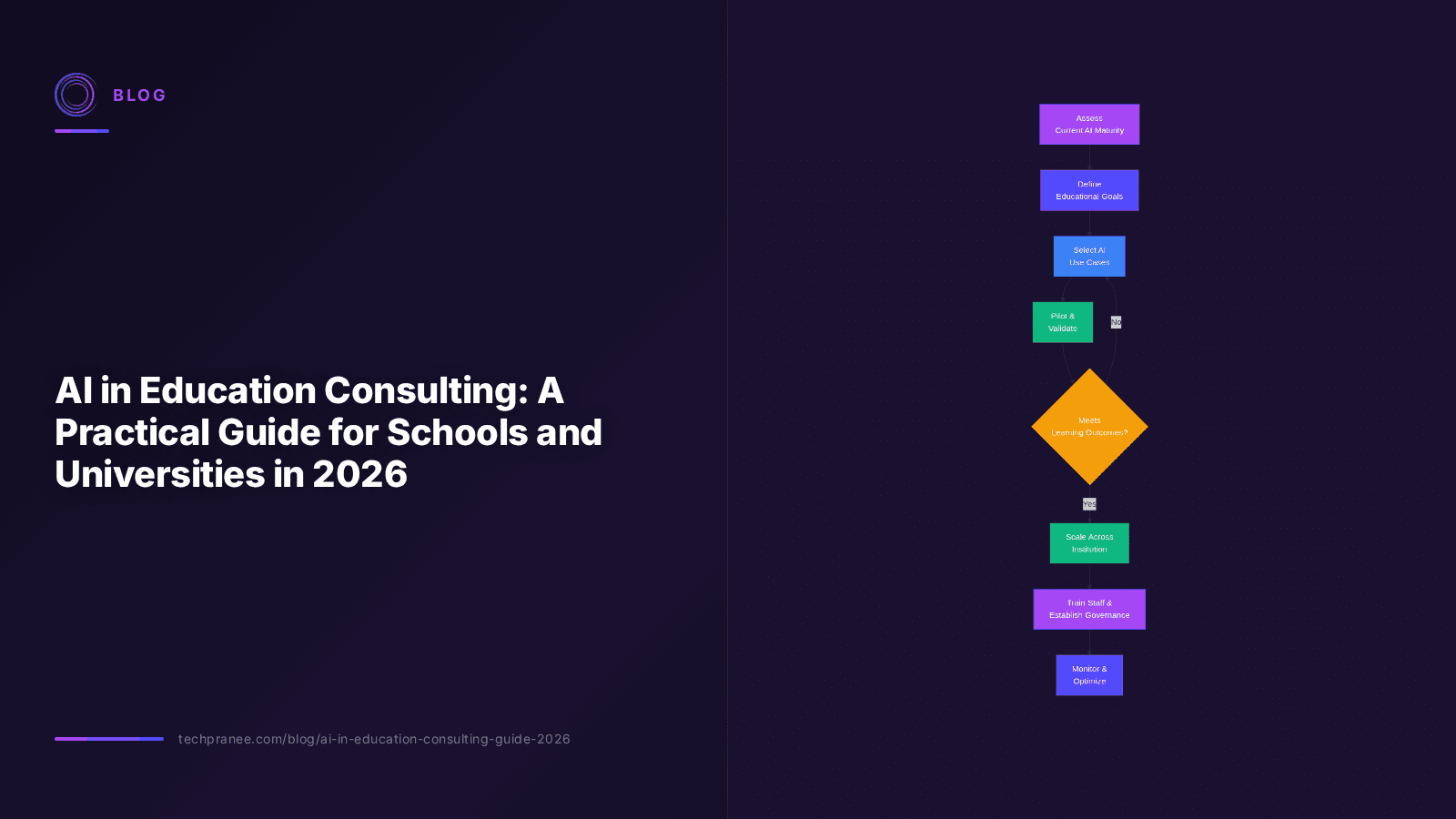
Based on our consulting methodology, here is a proven 7-step process for AI adoption in education:
- Assess Current AI Maturity: Audit your existing technology stack, data infrastructure, faculty AI literacy, and current AI tool usage. Identify gaps in data quality, integration capability, and staff skills.
- Define Educational Goals: Establish specific, measurable outcomes you want AI to impact — e.g., "reduce dropout rate by 10% in first-year students" or "cut grading time by 50% for STEM faculty." These goals drive every subsequent decision.
- Select and Prioritize Use Cases: Rank potential AI applications by educational impact, technical feasibility, and cost. Start with 1-2 high-impact, low-difficulty use cases to build momentum and institutional confidence.
- Pilot and Validate: Run a controlled pilot with a limited group of faculty and students. Measure outcomes against your baseline. Collect qualitative feedback from all stakeholders — not just technology enthusiasts.
- Evaluate Against Learning Outcomes: Did the pilot meet your defined goals? If yes, proceed to scaling. If no, iterate on the implementation or re-evaluate the use case. Do not skip this checkpoint — scaling a failed pilot wastes budget and damages faculty trust.
- Scale Across Institution: Roll out successful pilots to additional departments, courses, or campuses. Standardize processes, integrations, and training materials. Establish a center of excellence for ongoing AI support.
- Train Staff and Establish Governance: Develop faculty training programs, AI usage policies, data governance frameworks, and ongoing evaluation processes. AI is not a one-time implementation — it requires continuous oversight and optimization.
The institutions that succeed with AI are not the ones with the biggest budgets. They are the ones that invest in faculty readiness and governance from day one. Technology is the easy part; culture is the hard part. — Education AI Consulting Best Practices, EDUCAUSE 2025
Common Pitfalls in AI Education Projects
Through our consulting engagements, we have identified the most common reasons AI projects fail in educational settings:
- Starting with technology instead of pedagogy: Buying an AI tool first, then looking for a problem to solve. Always start with educational outcomes.
- Underestimating data quality issues: AI models require clean, structured data. Many institutions have fragmented, inconsistent data across siloed systems. Data infrastructure investment often precedes AI value.
- Ignoring faculty concerns: Faculty worry about job security, academic integrity, and AI's impact on critical thinking. These concerns must be addressed through transparent communication and involvement — not dismissed.
- Neglecting equity and bias: AI models trained on majority-population data can systematically underperform for underrepresented students. Every AI education implementation must include bias auditing.
- No ongoing evaluation: Deploying AI without establishing continuous monitoring of accuracy, fairness, and educational impact. AI models drift, and what worked in September may not work in February.
Real-World Case Studies
Case Study 1: Georgia State University — Predictive Advising
Georgia State University partnered with AI consulting to implement a predictive analytics system that flags at-risk students in real-time. The system analyzes over 800 risk indicators and alerts academic advisors when intervention is needed. Results: graduation rates increased by 6 percentage points, the university closed the achievement gap for first-generation and minority students, and the system is now used by 200+ advisors across campus. Total investment: approximately $2.5 million over 5 years, with estimated ROI of $12 million in retained tuition revenue.
Case Study 2: Community College District — Automated Admissions Processing
A large community college district with 12 campuses implemented AI-powered document processing for admissions and financial aid verification. The system extracts data from transcripts, tax forms, and identification documents, reducing manual processing time by 80%. Results: admissions processing time dropped from 3 weeks to 3 days, staff redeployed to student-facing roles, and enrollment increased by 8% due to faster processing. Consulting engagement: $45,000 for assessment and implementation support.
Case Study 3: K-12 District — AI-Powered Math Intervention
A suburban school district serving 15,000 students implemented an adaptive learning platform for math intervention. After a 6-month pilot in 3 schools, the district saw a 22% improvement in math proficiency scores among struggling students. The consultant helped integrate the platform with the district's existing LMS and trained 40 teachers on data-driven instruction. Total project cost: $60,000 consulting + $35,000/year software licensing.
Comparison: Top AI Education Consulting Providers
| Provider Type | Strengths | Best For | Price Range |
|---|---|---|---|
| Boutique Education AI Specialists | Deep domain expertise, personalized service, education-first approach | Schools/districts needing focused, high-touch guidance | $15K-$80K |
| Big 4 Consulting (EY, Deloitte) | Broad resources, brand trust, multi-year engagement capability | Large universities with complex, multi-stakeholder projects | $100K-$500K+ |
| EdTech Platform Consultants | Platform-specific expertise, implementation speed | Institutions already committed to a specific AI platform | $10K-$50K |
| Independent AI Strategists | Vendor-neutral, flexible, cost-effective | Small colleges, pilot projects, strategy-only engagements | $10K-$40K |
How AI in Education Consulting Will Evolve (2026-2028)
The AI education consulting landscape is shifting rapidly. Here is what we see on the horizon:
- LLM integration into LMS: Major LMS providers (Canvas, Blackboard) are embedding LLM capabilities for content generation, student Q&A, and automated feedback. Consultants will need to help institutions evaluate which LLM features to enable and which to restrict.
- AI governance becomes mandatory: Regulatory frameworks like the EU AI Act classify education as a high-risk domain, requiring impact assessments, bias testing, and human oversight. Consultants will play a key role in compliance readiness.
- Student-facing AI tutors: Platforms like Khanmigo and ChatGPT Edu are making AI tutors available directly to students. Consultants will help institutions set usage policies, integrate with curricula, and measure learning outcomes.
- Data infrastructure modernization: Before AI can deliver value, institutions need clean, integrated data. Expect a wave of consulting engagements focused on data governance and lakehouse architecture for education.
Practical Action Items
Ready to start exploring AI for your institution? Here are 5 concrete next steps:
- ✓ Conduct an internal AI readiness assessment — survey faculty on current AI tool usage, comfort levels, and concerns
- ✓ Identify your top 3 educational challenges that AI could address (e.g., dropout rate, grading time, engagement)
- ✓ Audit your data infrastructure — do you have clean, accessible data on student performance, attendance, and engagement?
- ✓ Research 2-3 AI education platforms that address your top challenges and request demos
- ✓ Engage a consultant for a scoping conversation — most offer free initial assessments to understand your needs
Frequently Asked Questions
What does an AI in education consultant do?
An AI in education consultant helps schools, universities, and educational organizations assess, select, implement, and optimize AI technologies. This includes needs assessment, vendor evaluation, implementation support, faculty training, and governance framework development. The consultant bridges the gap between pedagogical goals and technical solutions.
How much does AI education consulting cost?
Costs range from $15,000 for a strategy-only assessment to $200,000+ for full-scale multi-year deployment. A typical pilot implementation costs $25,000-$60,000. Software licensing is separate, typically $2-$15 per student per month. Most engagements start with a scoping conversation to define scope and budget.
Can AI replace teachers and professors?
No. AI in education is designed to augment, not replace, educators. AI handles repetitive tasks (grading, data analysis, content generation) so teachers can focus on high-value activities: mentoring, critical thinking facilitation, and emotional support. The most successful implementations position AI as a tool that frees faculty to do what humans do best.
Is AI in education consulting regulated?
Yes, increasingly so. FERPA governs student data privacy in the US. The EU AI Act classifies education as a high-risk AI application, requiring impact assessments and bias testing. Consultants should be familiar with these frameworks and help institutions achieve compliance as part of any AI implementation.
What are the disadvantages of AI in education?
Key concerns include algorithmic bias against underrepresented students, data privacy risks, over-reliance on technology at the expense of human judgment, academic integrity challenges (AI-generated work), and the digital divide — schools with fewer resources may be left behind. A responsible consulting engagement addresses each of these risks explicitly.
How long does an AI implementation in education take?
Timelines vary by use case. Quick wins like automated grading can be deployed in 1-3 months. More complex systems like predictive analytics or adaptive learning require 6-12 months from assessment to full deployment. A phased approach starting with pilot programs is recommended over big-bang implementations.
Get Expert AI Education Consulting Support
If your institution is ready to explore how AI can improve learning outcomes, reduce administrative burden, and better serve students, we can help. Our team provides vendor-neutral AI consulting tailored to the unique needs of educational institutions — from initial strategy to full implementation and ongoing optimization.
Contact us to schedule a free AI readiness assessment for your school or university.
Looking for broader AI strategy guidance? See our AI strategy consulting services. For AI agent development tailored to education, explore our AI agent development solutions. Already thinking about automation? Our AI automation agency services cover the full spectrum. For a deeper dive into AI implementation in education, see our AI in education implementation guide.