
Key Takeaways:
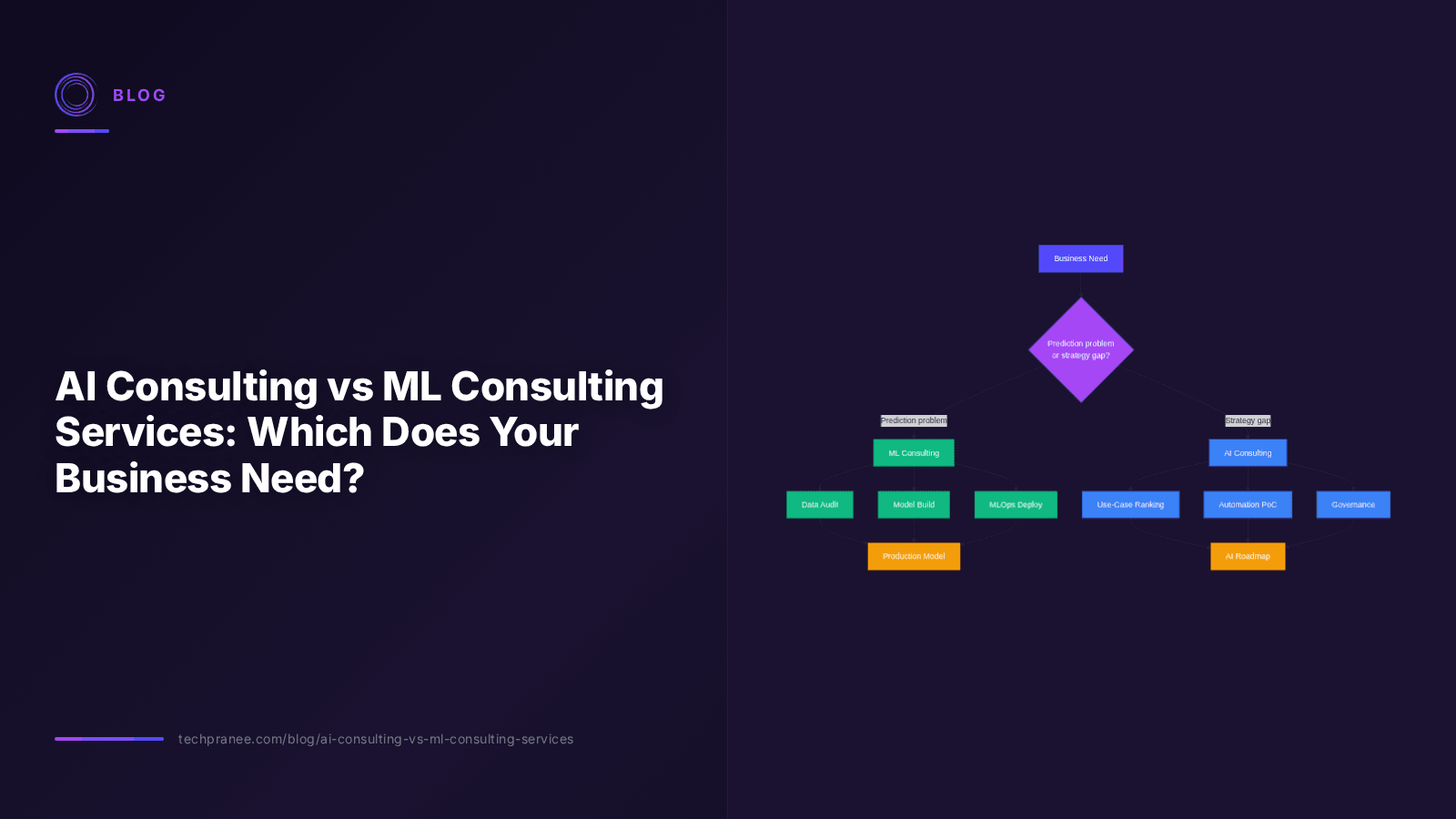
- AI consulting is broader and strategy-led — it covers automation, agents, GenAI, governance, and adoption roadmap. ML consulting is narrower and model-led — it builds predictive systems that learn from data.
- Choose AI consulting when your problem is "where do we start with AI?" Choose ML consulting when your problem is "we have data and need accurate predictions."
- Average AI strategy engagements run $25K–$150K; ML model development runs $40K–$250K depending on data complexity and model type.
- 72% of organizations now use AI in at least one business function (McKinsey, 2025), but only 18% have production-grade ML pipelines — the gap is exactly where the right consultant matters.
- Many engagements need both: AI consulting for the roadmap, ML consulting for the build. A combined AI and ML consulting partner avoids handoff loss.
Executive Summary
If you are evaluating AI and ML consulting options for your business, the first decision is not which firm to hire — it is which type of consulting you actually need. The terms get used interchangeably, but they describe two different scopes of work, two different skill sets, and two different price points. Picking the wrong one wastes budget and delays outcomes.
AI consulting is the broader discipline. It starts with strategy: identifying where artificial intelligence can create value, assessing data and infrastructure readiness, selecting the right technology, designing governance, and driving organizational adoption. ML consulting is the narrower, more technical discipline. It focuses on building, training, evaluating, and deploying machine learning models that learn from historical data to make predictions or classifications.
This article breaks down the differences across scope, deliverables, cost, timeline, team composition, and use cases — then gives you a decision framework so you can choose with confidence and avoid the most common (and expensive) mistake: hiring a strategy consultant when you need model engineers, or vice versa.
AI Consulting vs ML Consulting: The Core Difference
The distinction matters because the failure mode is different for each. An AI consulting engagement that goes wrong usually produces a strategy deck with no working system. An ML consulting engagement that goes wrong usually produces a model that works in a notebook but never ships to production. Knowing which risk you are buying helps you select the right partner.
What AI Consulting Covers
AI consulting addresses the question: where should our organization apply AI, and how do we get there? Typical deliverables include:
- AI readiness assessment — data, infrastructure, and talent audit
- Use-case prioritization ranked by business impact and feasibility
- Technology selection (build vs buy, GenAI vs traditional ML, open source vs vendor)
- Governance and responsible-AI frameworks (bias, compliance, EU AI Act alignment)
- Change management and adoption roadmap
- Proof-of-concept automation or AI agent prototypes
What ML Consulting Covers
ML consulting addresses the question: we have data and a prediction problem — can you build a system that solves it? Typical deliverables include:
- Data pipeline engineering and feature engineering
- Model selection, training, and evaluation (regression, classification, forecasting, NLP, computer vision)
- MLOps setup — CI/CD for models, monitoring, retraining schedules
- Model performance optimization (accuracy, latency, cost)
- Production deployment and integration with existing systems
- Knowledge transfer to in-house data teams
Side-by-Side Comparison
| Dimension | AI Consulting | ML Consulting |
|---|---|---|
| Primary question | Where do we start with AI? | How do we build an accurate model? |
| Scope | Broad — strategy, automation, GenAI, governance, adoption | Narrow — model development, MLOps, data pipelines |
| Typical deliverable | Roadmap, prioritized use cases, PoC, governance framework | Trained model, MLOps pipeline, production deployment |
| Core skills | Strategy, solution architecture, automation platforms, change management | Statistics, ML frameworks (PyTorch, scikit-learn), data engineering, MLOps |
| Data requirement | Often works with limited or unstructured data | Requires substantial historical labeled data |
| Engagement length | 4–12 weeks (strategy) to ongoing advisory | 8–24 weeks (build) plus ongoing MLOps |
| Cost range | $25K–$150K (strategy); retainer $8K–$25K/mo | $40K–$250K (build); MLOps retainer $10K–$30K/mo |
| When you need it | No clear AI strategy, scattered initiatives, need governance | Clear prediction problem, have data, need production-grade ML |
| Risk if wrong fit | Strategy deck, no working system | Model works in lab, never ships to production |
Cost Breakdown: What You Actually Pay For
Pricing for AI and ML consulting diverges because the work is fundamentally different. AI strategy consulting is mostly senior advisor time — you pay for experience and pattern recognition. ML consulting is engineering-heavy — you pay for data scientists, ML engineers, and compute.
According to a 2026 cross-vendor analysis, typical cost ranges are:
| Engagement Type | AI Consulting | ML Consulting |
|---|---|---|
| Discovery / assessment | $8K–$25K | $10K–$30K (data audit) |
| Strategy roadmap | $20K–$75K | Rare (usually part of build) |
| PoC / prototype | $15K–$50K | $30K–$80K |
| Full implementation | $50K–$150K (automation + agents) | $80K–$250K (model + MLOps) |
| Ongoing retainer | $8K–$25K/mo (advisory) | $10K–$30K/mo (MLOps + monitoring) |
The 10-20-70 rule from enterprise AI practice is instructive here: roughly 10% of value comes from algorithms, 20% from technology and data infrastructure, and 70% from people and process change. AI consulting tends to focus on the 90% (tech + people), while ML consulting focuses heavily on the 10% (algorithms) and 20% (infrastructure). Mature engagements balance both.
Use Cases: When Each Type Wins
AI Consulting Wins When…
You need help deciding what to build. Common scenarios:
- A mid-market manufacturer wants to explore AI but has no prioritized use cases
- A professional services firm needs business process automation but does not know which processes to automate first
- An enterprise needs an AI governance framework before deploying any system
- A company wants a GenAI assistant or chatbot scoped and prototyped
Real example: Zovia, a healthcare staffing platform, engaged AI consulting to map where automation could reduce manual scheduling overhead. The engagement produced a prioritized roadmap — automating candidate-screening first (highest impact, lowest data complexity) before touching predictive scheduling. Starting with strategy avoided sinking budget into a predictive model that the data could not yet support.
ML Consulting Wins When…
You know what to build and need help building it accurately. Common scenarios:
- An e-commerce company needs a demand forecasting model for 10,000 SKUs
- A logistics firm needs route optimization using historical delivery data
- A fintech needs a fraud-detection classifier with < 2% false-positive rate
- A manufacturer needs predictive maintenance from IoT sensor streams
Real example: HyreFast, a recruitment platform, needed a candidate-to-job matching model. They had labeled historical placement data and a clear accuracy target. This was a pure ML consulting engagement — feature engineering on candidate profiles and job descriptions, model training, and MLOps deployment — no strategy layer required because the use case was already validated.
The Decision Framework: 5 Steps to Choose
Use this step-by-step process to determine whether you need AI consulting, ML consulting, or both.
- Clarify your problem statement. If you can describe your goal as a prediction ("forecast demand," "classify churn risk," "detect defects"), lean toward ML consulting. If your goal is exploratory ("find where AI helps us," "automate operations"), lean toward AI consulting.
- Audit your data. Do you have 6+ months of labeled, structured historical data relevant to the prediction? If yes, ML consulting can build on it. If no, AI consulting can help you build the data foundation and find automation wins that do not require training data.
- Assess internal capability. If you have no data science team and no ML infrastructure, AI consulting builds the foundation first. If you have data engineers but lack ML depth, ML consulting fills the gap.
- Check the timeline expectation. Need a working automation or PoC in 4–8 weeks? AI consulting. Need a production-grade model in 3–6 months? ML consulting. Need both, fast? A combined AI and ML consulting partner.
- Validate the budget tier. Under $50K? AI consulting PoC or assessment. $50K–$150K? Either a solid ML prototype or a full AI automation rollout. Over $150K? Full ML build with MLOps, or a multi-workstream AI transformation.
Pre-Engagement Checklist
Before signing any AI or ML consulting contract, confirm the following:
- ✓ The firm has clearly stated whether the engagement is strategy-led or build-led
- ✓ A data readiness assessment is included before any model development begins
- ✓ Deliverables are defined as artifacts (model, pipeline, roadmap), not just hours
- ✓ MLOps and monitoring are scoped if the engagement includes ML models
- ✓ Knowledge transfer and documentation are included in the SOW
- ✓ The firm can show a production deployment, not just a notebook demo
- ✓ Pricing is tied to milestones, not open-ended hourly with no cap
When You Need Both: The Combined Engagement
"The most expensive mistake in AI projects is building something that was never feasible to begin with. Strategy-first engagements that validate feasibility before committing to model development consistently deliver better ROI than jumping straight to engineering."
Many mid-market and enterprise organizations need both disciplines in sequence — AI consulting to validate the use case and roadmap, then ML consulting to build the production model. The risk of splitting these across two vendors is handoff loss: the strategy consultant's context never fully transfers to the build team, and assumptions baked into the roadmap go unverified during implementation.
This is where a combined AI and ML consulting partner adds value. A single team that spans strategy, automation, and ML engineering can carry context from assessment through deployment, re-validate assumptions when the data proves different than expected, and avoid the classic "the strategy said this would work" vs "the data says it will not" conflict.
A representative combined engagement looks like this:
Week 1-3:   AI Readiness Assessment (data audit, use-case ranking)
Week 4-6:   Strategy & Roadmap (prioritize 1-2 build candidates)
Week 7-10:  Data pipeline + feature engineering (ML track begins)
Week 11-16: Model training, evaluation, iteration
Week 17-20: MLOps setup + production deployment
Week 21+:   Monitoring, retraining, knowledge transfer
What the Data Says About Adoption
The market context explains why this decision is urgent for more businesses. McKinsey's State of AI 2025 survey found that 72% of organizations now use AI in at least one business function — up from 55% a year earlier. But Gartner's 2025 AI maturity assessment found that only 18% of enterprises have production-grade ML pipelines with monitoring and retraining. The 54-point gap between adoption and operational maturity is exactly where consulting engagements create or destroy value.
Deloitte's 2025 State of GenAI report adds a further signal: 64% of executives say their biggest AI challenge is not technology but "knowing where to start." That is an AI consulting problem, not an ML problem — and it explains why strategy-led engagements have grown faster than build-led ones over the past 18 months. BCG's 2025 AI build-vs-buy analysis found that organizations that invested in a structured use-case prioritization phase before building achieved 2.3x higher ROI on their AI portfolio than those that went straight to model development.
Practical Action Items
- Write your problem as a one-sentence question. If it starts with "where" or "how do we," it is an AI consulting question. If it starts with "can you predict" or "can you classify," it is an ML consulting question.
- Inventory your data before any vendor call. List what data exists, where it lives, how clean it is, and whether it is labeled. This single step shortens every engagement.
- Ask prospective firms for a production reference. A model in a notebook is not a deployment. A working automation in production is.
- Scope a feasibility checkpoint. Build a 2–4 week assessment into the contract before committing to full build. It costs $10K–$25K and saves six-figure mistakes.
- Plan for MLOps from day one. If ML is in scope, monitoring and retraining must be in the SOW — not a phase-two afterthought.
FAQ
What is the difference between AI consulting and ML consulting?
AI consulting is broader and strategy-led — it covers use-case identification, automation, GenAI, governance, and adoption. ML consulting is narrower and model-led — it builds, trains, deploys, and maintains predictive machine learning models from historical data.
Do I need AI consulting or ML consulting?
If you have a clear prediction problem and sufficient labeled data, you need ML consulting. If you are unsure where AI can help your business or need an automation roadmap and governance, you need AI consulting. Many organizations need both in sequence.
How much does AI and ML consulting cost?
AI strategy engagements typically run $25K–$150K. ML model development runs $40K–$250K depending on data complexity, model type, and MLOps scope. Ongoing retainers range from $8K–$30K per month for advisory or MLOps support.
Can one firm do both AI strategy and ML development?
Yes — firms that span strategy, automation, and ML engineering are increasingly common. The advantage is context continuity from assessment through deployment, avoiding the handoff loss that occurs when strategy and build teams are separate vendors.
How long does an AI or ML consulting engagement take?
AI strategy engagements run 4–12 weeks. ML build engagements run 8–24 weeks plus ongoing MLOps. A combined assessment-to-deployment engagement typically runs 16–24 weeks.
What data do I need before hiring an ML consultant?
You need 6+ months of relevant historical data, ideally labeled for your prediction target. If your data is not yet ready, an AI consulting engagement focused on data readiness and use-case prioritization should come first.
Next Steps
Choosing between AI consulting and ML consulting comes down to one question: do you need to know where to apply AI, or do you need to build an AI system that is already scoped? Get that answer right and the rest — vendor selection, budget, timeline — falls into place.
If you want a partner that can handle both the strategy and the build under one roof, talk to our team. We run AI readiness assessments, build production ML models, and deploy automation — so you do not have to manage two vendors and a handoff. You can also explore our AI consulting services guide or our ML consulting firms guide for a deeper look at each discipline.