
Key Takeaways:
- AI agent development companies build autonomous software agents that handle tasks like customer support, data analysis, and workflow automation
- The global AI agent market is projected to reach $52.6 billion by 2030, with 85% of enterprises planning to deploy AI agents by 2026
- Typical engagement costs range from $15,000 for a simple chatbot agent to $200,000+ for multi-agent enterprise systems
- Key selection criteria: technical expertise, industry experience, post-launch support, and a proven portfolio of deployed agents
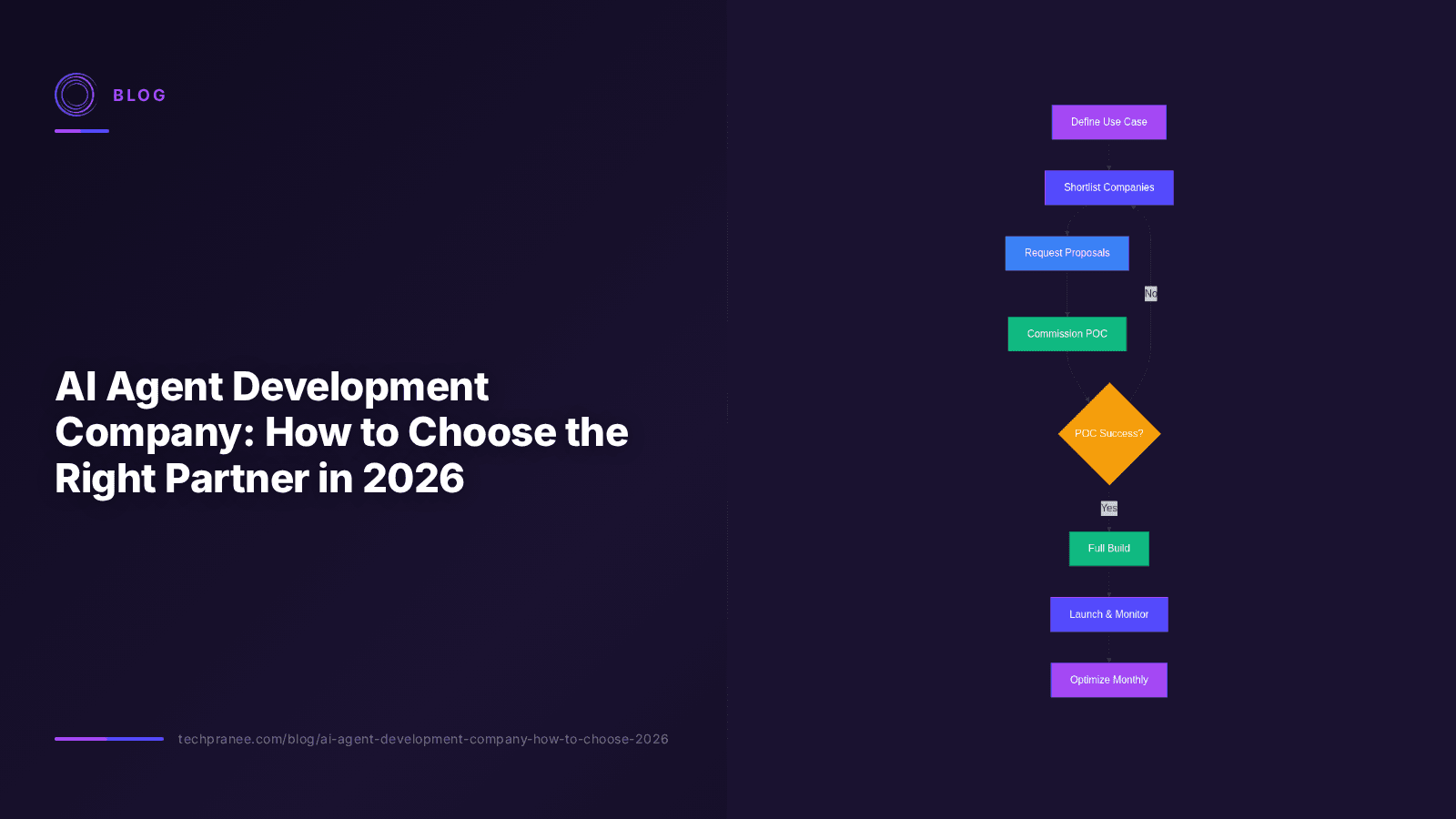
- Always request a proof-of-concept (POC) before committing to a full build — it de-risks your investment and validates the partner's capabilities
AI Agent Development Company: How to Choose the Right Partner in 2026
Finding the right AI agent development company is the single most important decision you'll make when bringing autonomous AI agents into your business. The wrong partner burns budget, misses deadlines, and delivers an agent that hallucinates in production. The right one ships a reliable, production-grade agent that your team trusts within weeks — not quarters.
The market has exploded. Gartner reports that 85% of enterprises will have deployed AI agents in some form by 2026, up from just 15% in 2024. That demand has attracted hundreds of development firms — from boutique studios to global consultancies — all claiming expertise. But most have shipped fewer than five production agents. This guide cuts through the noise: what AI agent development companies actually do, what they charge, how to evaluate them, and how to choose the right one for your use case.
Whether you're building a customer support agent that handles 70% of tier-1 tickets, a sales agent that qualifies leads 24/7, or a multi-agent system that orchestrates your supply chain, the principles below will help you pick a partner that delivers.
What Does an AI Agent Development Company Do?
An AI agent development company designs, builds, tests, and deploys autonomous AI agents — software programs that perceive their environment, make decisions, and take actions to achieve specific goals without constant human supervision. Unlike traditional chatbots that follow rigid scripts, AI agents use large language models (LLMs), tool-calling frameworks, and orchestration layers to reason, plan, and execute multi-step workflows.
Core Services Offered
Most reputable AI agent development companies offer a full lifecycle of services:
- Agent strategy & design: Identifying which business workflows are agent-ready, defining success metrics, and designing the agent's decision architecture
- Custom agent development: Building agents with frameworks like LangChain, LangGraph, CrewAI, or custom orchestration layers — including prompt engineering, tool integration, and memory systems
- Multi-agent systems: Orchestrating multiple specialized agents that collaborate (e.g., a research agent feeding a writing agent feeding a review agent)
- Integration & deployment: Connecting agents to your CRM, ERP, helpdesk, databases, and internal APIs via function calling and API bridges
- Guardrails & safety: Implementing output validation, hallucination prevention, PII filtering, and human-in-the-loop checkpoints
- Monitoring & optimization: Post-launch observability — tracking agent accuracy, latency, cost per interaction, and iterating on performance
Types of AI Agents Built
| Agent Type | Typical Use Case | Complexity | Indicative Cost |
|---|---|---|---|
| Customer Support Agent | Handles tier-1 tickets, FAQs, order status | Medium | $20K–$60K |
| Sales / SDR Agent | Lead qualification, meeting scheduling, follow-ups | Medium | $25K–$70K |
| Research Agent | Market research, competitive analysis, report generation | High | $40K–$120K |
| Workflow Automation Agent | Data entry, document processing, approval routing | Medium | $15K–$50K |
| Multi-Agent Orchestration | Multiple agents collaborating on complex business processes | Very High | $80K–$250K+ |
| Voice Agent | Inbound/outbound calls, appointment booking | High | $35K–$100K |
Why Businesses Are Hiring AI Agent Development Companies in 2026
The shift from conversational chatbots to autonomous agents is the most significant change in enterprise AI since the introduction of GPT-4. McKinsey's 2025 State of AI report found that companies deploying AI agents saw a 40% reduction in average handle time for customer queries and a 25% increase in sales conversion rates for AI-assisted leads. Deloitte's 2026 Tech Trends report predicts that 60% of enterprise AI spend will go toward agentic systems by 2027.
But building a production-grade AI agent is hard. It requires expertise in LLM orchestration, tool design, prompt engineering, evaluation frameworks, and safety engineering — skills that most internal teams don't have. That's why businesses are turning to specialized AI agent development companies rather than building in-house.
Building a demo AI agent takes a weekend. Building one that's reliable enough for production takes a team that has done it before — and done it wrong enough times to know where the failure modes are.
How to Choose an AI Agent Development Company: A Step-by-Step Guide
Selecting the right partner is a structured process. Skip steps and you'll end up with a vendor that over-promises and under-delivers.
Step 1: Define Your Agent's Purpose and Success Metrics
Before talking to any AI agent development company, write down exactly what your agent should do and how you'll measure success. Vague requirements lead to vague proposals. A good starting point:
- ✓ What specific workflow or task will the agent automate or augment?
- ✓ What systems does it need to integrate with (CRM, helpdesk, ERP, internal APIs)?
- ✓ What's the expected volume (queries per day, transactions per hour)?
- ✓ What accuracy threshold is acceptable? (e.g., 95% correct responses for support)
- ✓ What's your budget range and timeline?
Step 2: Evaluate Technical Expertise and Frameworks
Ask potential partners about their tech stack and frameworks. A competent AI agent development company should be fluent in:
- Orchestration frameworks: LangChain, LangGraph, CrewAI, AutoGen, or custom orchestration
- LLM providers: OpenAI, Anthropic, Google, open-source models (Llama, Mistral)
- Tool calling: Function calling, API integration, MCP (Model Context Protocol)
- Memory systems: Short-term conversation memory, long-term vector storage (Pinecone, Weaviate, pgvector)
- Evaluation: LLM-as-judge, human evaluation pipelines, A/B testing frameworks
Step 3: Review Their Portfolio of Production Agents
This is where most companies fail the test. Ask for case studies of agents that are live in production — not demos, not POCs. Specifically:
- How many agents have they deployed to production?
- What's the daily interaction volume on those agents?
- Can they share accuracy metrics or deflection rates?
- Do they have references you can speak with?
A company that has shipped 3 production agents handling 10,000+ interactions daily is far more valuable than one that has built 30 demos that never went live.
Step 4: Assess Industry and Use-Case Experience
An AI agent development company that has built agents for healthcare HIPAA-compliant workflows understands constraints that a generalist firm won't. Similarly, if you're in e-commerce, a partner who has built product recommendation and cart recovery agents will move faster. Look for:
- Case studies in your industry
- Familiarity with your regulatory requirements (HIPAA, GDPR, SOC 2)
- Experience with your tech stack (Salesforce, Zendesk, Shopify, SAP)
Step 5: Request a Proof-of-Concept
Before signing a full engagement contract, request a 2–4 week POC. A reputable AI agent development company will propose a scoped POC that validates the core capability — not the full system, but enough to prove they can deliver. Budget $5K–$15K for the POC. If they refuse or push for a full contract immediately, walk away.
Step 6: Evaluate Post-Launch Support and SLAs
AI agents degrade over time. LLM providers update models, APIs change, and edge cases emerge in production. Your development partner should offer:
- ✓ Monitoring dashboards (accuracy, latency, cost per interaction)
- ✓ Monthly performance reviews with optimization recommendations
- ✓ Incident response SLAs (e.g., 4-hour response for critical agent failures)
- ✓ Model update and migration support
AI Agent Development Company Pricing: What to Expect
Pricing varies widely based on complexity, integrations, and the partner's location and expertise. Here's what we've seen across the market in 2026:
| Project Scope | Timeline | Cost Range | What's Included |
|---|---|---|---|
| Simple Chatbot Agent | 2–4 weeks | $15K–$30K | Single LLM, FAQ knowledge base, basic integration |
| Workflow Automation Agent | 4–8 weeks | $25K–$60K | Tool calling, 2–3 system integrations, guardrails |
| Customer Support Agent | 6–12 weeks | $40K–$100K | Helpdesk integration, knowledge base, escalation logic, monitoring |
| Multi-Agent System | 3–6 months | $100K–$250K+ | Multiple orchestrated agents, complex integrations, custom evaluation |
| Ongoing Optimization | Monthly | $3K–$10K/mo | Monitoring, tuning, model updates, incident response |
Note: These are build costs. Ongoing LLM API costs are separate and typically run $0.01–$0.15 per interaction depending on model choice and context length.
Common Mistakes When Hiring an AI Agent Development Company
1. Choosing Based on Price Alone
The cheapest quote usually means the least experienced team. A $15K agent that hallucinates in week two costs more than a $50K agent that runs reliably for years.
2. Skipping the POC Phase
Without a POC, you're committing to a full build based on a proposal and a sales call. The POC is your insurance policy — it validates the partner's technical ability before you spend six figures.
3. Not Defining Guardrails Upfront
Guardrails (output validation, hallucination prevention, human escalation) are not optional — they're the difference between an agent your team trusts and one they disable after a week. Make sure your partner builds guardrails into the architecture from day one, not as a post-launch patch.
4. Ignoring Total Cost of Ownership
The build cost is 30–40% of total cost over a 2-year period. LLM API costs, maintenance, optimization, and infrastructure add up. Get a full TCO estimate before signing.
AI Agent Development Company vs. In-House Team: Which Is Right for You?
A common question is whether to hire an AI agent development company or build internally. Here's a practical comparison:
| Factor | Development Company | In-House Team |
|---|---|---|
| Time to First Agent | 4–12 weeks | 3–6 months (including hiring) |
| Upfront Cost | $25K–$150K (project-based) | $300K+/year (2–3 engineers + ML lead) |
| Expertise Depth | Deep (shipped many agents across industries) | Shallow initially (learning curve) |
| Flexibility | Project-based, scalable up/down | Full control, but fixed headcount |
| Post-Launch Support | SLA-backed, contractually defined | Depends on team bandwidth |
| Knowledge Retention | Requires good documentation transfer | Institutional knowledge stays internal |
For most companies, starting with an AI agent development company and transitioning to a hybrid model (internal team + partner for complex builds) is the pragmatic path. Learn more about this approach in our guide to AI agent development services.
What a Good AI Agent Development Proposal Looks Like
When you receive a proposal from an AI agent development company, it should include these elements. If any are missing, ask:
- Agent architecture diagram: How the agent connects to LLMs, tools, memory, and your systems
- Tool and integration list: Specific APIs, databases, and systems the agent will interact with
- Guardrail specification: What validation, filtering, and human-in-the-loop checkpoints are included
- Success metrics: Quantitative KPIs the agent will be evaluated against (accuracy, deflection rate, latency)
- Testing plan: How the agent will be tested before launch (unit tests, integration tests, human evaluation)
- Post-launch plan: Monitoring, optimization cadence, and incident response
- Timeline with milestones: POC, MVP, production launch — with clear deliverables for each
Technical Example: Agent Architecture
Here's a simplified example of how a production AI agent architecture looks in code. A competent development company should be able to explain this level of detail:
# Simplified agent orchestration example
from langgraph.graph import StateGraph, END

# Define agent state
class AgentState(dict):
    query: str
    context: list
    tool_result: str
    response: str

# Define nodes
def retrieve_context(state):
    # Fetch relevant docs from vector store
    docs = vector_store.similarity_search(state["query"], k=5)
    state["context"] = [d.page_content for d in docs]
    return state

def call_tool(state):
    # Agent decides which tool to call based on query
    if needs_external_data(state["query"]):
        state["tool_result"] = api_tool.execute(state["query"])
    return state

def generate_response(state):
    # LLM generates final response with guardrails
    response = llm.generate(
        prompt=build_prompt(state),
        max_tokens=500,
        temperature=0.3  # Low temp for consistency
    )
    state["response"] = guardrails.validate(response)
    return state

def should_continue(state):
    if state.get("needs_escalation"):
        return "human_review"
    return END

# Build the graph
workflow = StateGraph(AgentState)
workflow.add_node("retrieve", retrieve_context)
workflow.add_node("tool", call_tool)
workflow.add_node("respond", generate_response)
workflow.add_edge("retrieve", "tool")
workflow.add_edge("tool", "respond")
workflow.add_conditional_edges("respond", should_continue)

agent = workflow.compile()
This is a simplified version — production agents include retry logic, cost tracking, latency budgets, multi-model fallback, and comprehensive logging. But it illustrates the orchestration complexity that a good AI agent development company handles for you.
Case Study: How a SaaS Company Reduced Support Costs 45% with an AI Agent
Consider a mid-market SaaS company handling 8,000 support tickets per month with a team of 12 agents. They partnered with an AI agent development company to build a tier-1 support agent. The agent was integrated with their Zendesk helpdesk, knowledge base, and billing system. It could resolve common queries (password resets, billing questions, feature how-tos) and escalate complex issues to human agents with full context.
Results after 90 days:
- 42% of tier-1 tickets resolved by the agent without human involvement
- 45% reduction in support costs (reduced overtime and contractor spend)
- Average response time dropped from 4.2 hours to 2.1 minutes
- Customer satisfaction score increased from 4.1 to 4.4 (faster resolution)
The total build cost was $55,000 with a $4,000/month optimization retainer. The ROI was achieved in month 4. This is a typical outcome for a well-executed customer support agent — and it's why the AI agent development market is growing so rapidly.
FAQ: Choosing an AI Agent Development Company
How much does it cost to hire an AI agent development company?
Costs range from $15,000 for a simple chatbot agent to $250,000+ for complex multi-agent enterprise systems. Most mid-range projects (customer support or workflow automation agents) fall between $25,000 and $75,000. Ongoing optimization typically costs $3,000–$10,000 per month.
How long does it take to build an AI agent?
A simple agent takes 2–4 weeks. A production-grade agent with integrations and guardrails takes 6–12 weeks. Multi-agent orchestration systems take 3–6 months. Always budget an additional 2–4 weeks for a POC before the full build.
What's the difference between an AI chatbot and an AI agent?
A chatbot follows scripted responses or simple intent matching. An AI agent reasons, plans multi-step actions, calls external tools and APIs, maintains memory across interactions, and adapts its behavior based on outcomes. Agents are autonomous; chatbots are reactive.
Should I hire an AI agent development company or build in-house?
If you need an agent deployed within 3 months and don't have an existing AI engineering team, hire a development company. If you have 2–3 ML engineers and a 6+ month timeline, building in-house gives you more control and institutional knowledge. Many companies start with a partner and build internal capability over time.
What frameworks should an AI agent development company know?
At minimum: LangChain/LangGraph, CrewAI or AutoGen for multi-agent orchestration, OpenAI/Anthropic/Google LLM APIs, vector databases (Pinecone, Weaviate, pgvector), and evaluation frameworks. They should also understand MCP (Model Context Protocol) for tool integration.
How do I ensure my AI agent doesn't hallucinate?
No system eliminates hallucinations entirely, but a good development company implements multiple guardrails: retrieval-augmented generation (RAG) to ground responses in verified data, output validation with rule-based and LLM-based checks, confidence thresholds for auto-response vs. human escalation, and continuous monitoring with human feedback loops.
Practical Action Items: Your Next Steps
- Document your use case: Write a 1-page brief covering the workflow to automate, systems to integrate, success metrics, and budget range
- Shortlist 3–5 companies: Look for production agent portfolios, industry experience, and transparent pricing
- Request proposals: Send your brief to shortlisted companies and compare proposals against the 7-element checklist above
- Commission a POC: Pick your top 1–2 candidates and pay for a 2–4 week proof-of-concept
- Launch and monitor: After POC validation, proceed with the full build and establish monthly performance reviews from day one
Ready to explore building an AI agent for your business? Talk to our team about your use case — we'll help you scope the project, estimate costs, and determine whether an AI agent is the right solution for your workflow. You can also learn more about our AI agent development services and how we approach AI automation for growing businesses.